Fixed-end standing wave frequencies
ID: fixed-end-standing-wave-frequencies

For the ideal uniform wave equation on a string, the wave speed is , where is constant tension and is linear mass density. Assume small transverse slopes, negligible bending stiffness and no damping. Fix both ends at zero displacement, giving the homogeneous Dirichlet boundary conditions . Our standing wave already satisfies the first. For a nonzero amplitude, the second requires , henceThe value gives zero displacement in this sine family, not a vibrating normal mode. Each positive fits half-wavelengths into the string: it has antinodes, interior nodes of a standing wave, and two endpoint nodes of a standing wave. For and , ; the third normal mode has and wavelength .
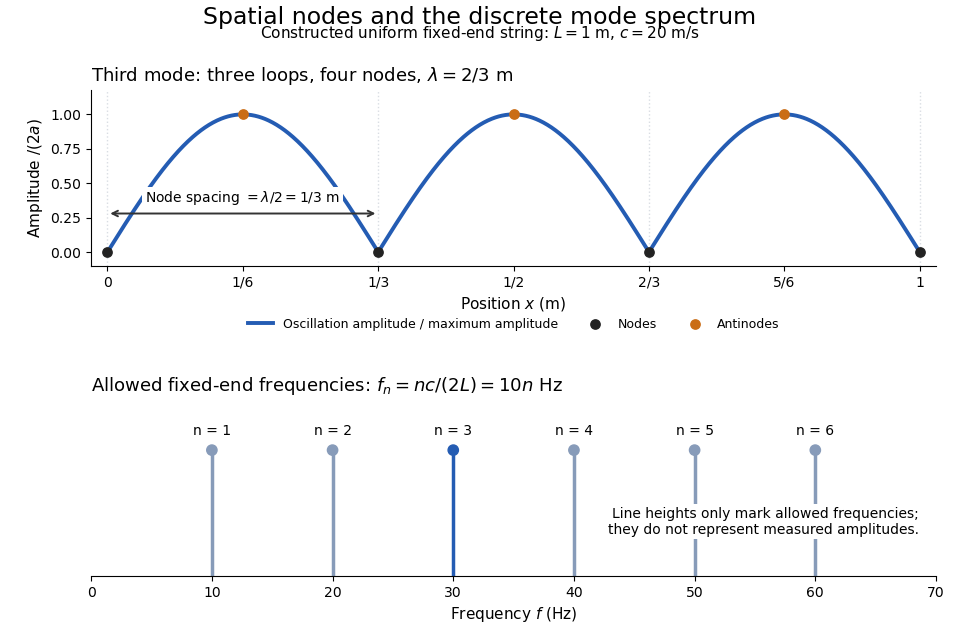
Third-mode nodes and antinodes, with the discrete frequency spectrum of a one-metre ideal string at wave speed twenty metres per second
. Details. 
The equally spaced eigenfrequencies follow from this string's uniform wave speed and fixed-end boundary conditions. They are not a universal spectrum for every vibrating object. Changing an endpoint constraint changes the allowed mode shapes; changing tension changes wave speed. At fixed and , quadrupling doubles every . The more general construction of arbitrary initial motion belongs to normal mode and wave equation on a string.
New to topics? Read the docs here!