An ideal uniform, flexible string under constant tension has transverse displacement satisfyingwhere is linear mass density, meaning mass per unit length of the straight reference string. The approximation assumes small slope , transverse motion, negligible bending stiffness, negligible damping, and no distributed external force. Constant tension and uniform linear mass density make constant. Some texts use for this same linear mass density, giving ; here must have units , rather than units of volume mass density. [ref]
The units provide a useful check: has units . For and , the wave speed is , so a pulse crosses a one-metre string in . Quadrupling tension doubles wave speed; quadrupling linear mass density halves it. These square-root laws explain how material and loading set the time scale of the vibration.
For a length- string with fixed endpoints, the homogeneous Dirichlet boundary conditions are . Its nonzero normal modes haveThus is an angular frequency, in radians per second, whereas is the frequency in hertz. The wavelength is , and each node of a standing wave lies at for some . For the numerical string above with , the first three frequencies are , and , with angular frequencies , and . [ref]
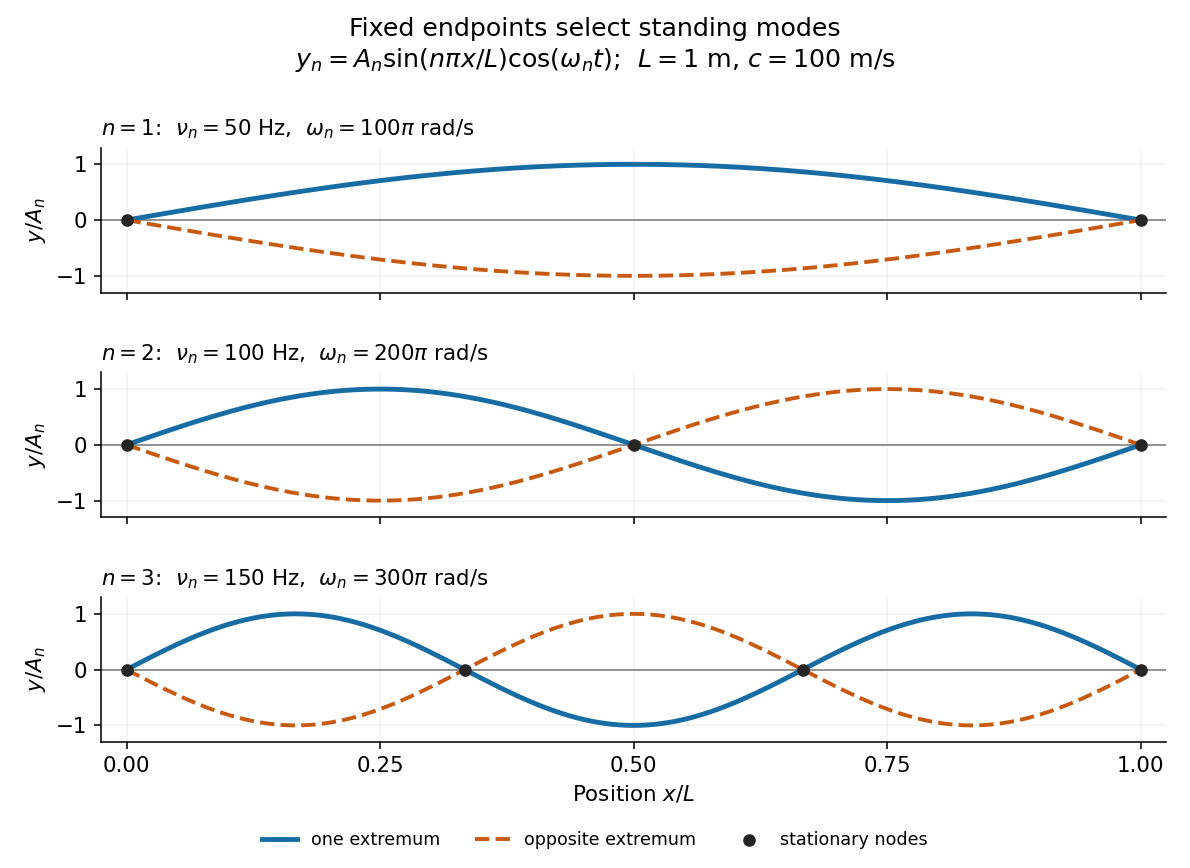

Each normal mode is a standing wave, but it also has a travelling wave description:At a fixed endpoint an incident displacement pulse reflects with reversed sign, allowing incident and reflected displacements to cancel at the endpoint. Periodic reflection for a fixed-end string implements both endpoints through odd, -periodic extensions of the initial data. This is the bridge between moving pulses and the stationary Fourier sine basis. [ref]
A short derivation comes from Newton's second law. The transverse force on a small segment is approximately , and its mass is . Dividing the force balance by and taking the limit gives . Separation of variables then gives ; the fixed-end boundary conditions select , while the temporal equation is a harmonic oscillator equation with .
The second-order central difference approximation to the fixed-end wave equation on interior points has normal modesHere and the endpoint displacements are zero. The eigenvectors form an orthonormal basis in the ordinary Euclidean norm, without an extra grid-spacing weight. They sample the continuous standing wave shapes exactly, while their angular frequencies differ from because of spatial discretization. For fixed , the difference tends to zero as .
For a uniform ideal fixed-end string, a real normal mode of displacement amplitude has total mechanical energy . This follows by integrating the squared sine velocity and cosine slope over the length; each squared trigonometric function integrates to . Thus finitely many excited modes with proportional to have equal total modal energies. Their instantaneous kinetic energies need not agree, because their time factors oscillate at different frequencies.
At a lossless string junction with displacement reflection coefficient from the incident side, reverse incidence has coefficient and the product of transmission coefficients is . Reflection from a fixed far end contributes . Summing all round trips with phase gives . For real with and , numerator and denominator have equal absolute value, so : the finite segment returns all incoming energy while adding a frequency-dependent phase. Short, nonoverlapping pulses can instead be counted as a geometric series of returning pulse energies; overlapping echoes must be added as amplitudes before their energy is evaluated.
For zero initial velocity and initial displacement on with , let be its odd extension to the real line. The displayed D'Alembert's formula solves the wave equation with , since . A pulse travelling toward the endpoint reflects with reversed displacement. For piecewise linear data the equation holds classically between moving corners and in the sense of weak derivatives globally.
For a small-slope travelling wave on a uniform string with linear mass density and tension , the wave equation on a string requires . Its elastic energy of a small-slope string and kinetic energy density are equal, giving total energy density . Its spatial average is , and integrating over a full wavelength gives the title formula. Omitting produces an energy density, not an energy; units and a direct one-period integral detect the mistake independently.
For a mechanical string on with fixed endpoint , take an initially incident symmetric triangular pulse , where . The superposition principle gives the title formula. Both terms satisfy the wave equation away from the corners and satisfy it weakly everywhere; their values cancel at the endpoint. At their displacements cancel on the whole half-line, but the velocity is nonzero on . Hence a flat instantaneous shape need not mean zero wave energy.
For a uniform fixed-end mechanical string of length , linear mass density and wave speed , let its th normal mode be , where . The conserved energy is the sum of kinetic energy and elastic potential energy,The sine and cosine squared integrals are , so substitution proves the title formula. Orthogonality makes energies of distinct normal modes add. For zero initial displacement and initial modal velocity , and , giving .
For a uniform fixed-end mechanical string of length and tension , a single sine normal mode of amplitude has conserved energy . Hence amplitudes proportional to give equal energies, even though their displacement magnitudes differ. In particular makes the first two modal energies equal. Orthogonality removes cross terms in the integrated kinetic energy and potential energy, so the modal energies add.
A uniform string with fixed ends , tension , linear mass density , and attached central point mass obeys the wave equation away from zero, continuous displacement at zero, and . The normal modes split into antisymmetric modes that leave the mass at rest and symmetric modes that move it.
To prove the spectral equations, use on the left and on the right, with . Continuity gives and the force law gives . If , then , , and . Otherwise and cancellation gives . In dimensionless variables , , strict monotonicity gives one symmetric root in each , . The apparent zero root of the sine equation has only the zero profile and is excluded.
For , the lowest root tends to zero. The Taylor series gives and hence . The two nearly straight half-strings supply a restoring force , explaining this harmonic oscillator limit.
For the wave equation on a string, prescribing and selects equal incoming and outgoing profiles. Write D'Alembert's formula as . The two traces imply and , proving the displayed expression. These data do not generally describe a disturbance launched from an everywhere resting string. For nonsmooth , derivatives and boundary traces need their piecewise classical or weak derivative interpretation; an endpoint cusp may prevent a classical derivative at an isolated time.
For two-sided string data with zero slope, take on and zero outside. At , the displacement vanishes throughout , whereas the spatial derivative is . Cancellation along a line in spacetime need not cancel the derivative transverse to that line. At , however, oddness gives for every , so the spatial derivative is zero even though its one-sided temporal limits there differ.
At a free termination of a taut string, zero transverse force imposes a Neumann boundary condition. Incident and reflected displacement amplitudes add with equal sign so their slopes cancel. The endpoint is a displacement antinode, all incident power is reflected, and the flux through the boundary vanishes. This is a transverse-wave boundary condition, distinct from the quantum open-string usage of similar notation.
The small-slope energy density is and power flux is . The wave equation gives . For a right-going wave, ; a harmonic wave has mean flux .
For a string occupying , its small-slope force on the endpoint is . The driver force on the string has the opposite sign, so injected power is . A right-going traveling wave has nonnegative outgoing instantaneous power in this ideal model.
For a uniform string with tension , linear mass density , left end fixed, and a freely transverse-moving point mass at , the wave equation and endpoint law areThe last equation is Newton's second law: the string pulls the mass back toward the interior, giving the minus sign. With wave speed , a nonzero normal mode has spatial part and satisfiesFor , its dimensionless roots occur once in each , , because decreases from infinity to zero while increases. For , : the right end has a homogeneous Neumann boundary condition. There is no nonzero zero-frequency mode, since a linear spatial profile vanishing at the left end and with zero right slope must vanish everywhere.
Multiplying the spatial equation by and using integration by parts givesFor two different modes, the same calculation gives the weighted inner product orthogonality . The endpoint mass therefore contributes to both inertia and mode orthogonality.
For the lossless small-slope wave equation on a string, tension and linear mass density give wave speed . With transverse force exerted across a cut toward increasing , a rightgoing displacement has velocity . Its positive mechanical impedance is therefore . A leftgoing component has under the same fixed orientation. A rightgoing time-harmonic wave with peak displacement wave amplitude carries mean power .
For a semi-infinite ideal string on with tension and linear mass density , let a free transverse endpoint mass be . Use a time-harmonic wave , where . The endpoint boundary condition from Newton's second law is . It gives the title displacement reflection coefficient, with characteristic impedance of a stretched string . Since numerator and denominator have equal moduli, all mean incident power is reflected. The endpoint kinetic energy varies within a cycle, but its mean rate of change is zero. A free mass changes the reflected phase, and does not by itself provide dissipation. The limits and give and respectively at fixed positive angular frequency.
A static lossless taper preserves frequency. If characteristic impedance varies slowly on the local wavelength scale, reflection is small and mean power is conserved. At fixed tension this gives the displayed amplitude law, while wave speed and wavelength scale as . A long section containing an abrupt step is not automatically adiabatic.
A semi-infinite wave equation on a string with linear mass density , wave speed , and tension has positive characteristic mechanical impedance . At an end attached to a massless viscous damper of coefficient , displacement and transverse-force balance give the displacement reflection coefficientHere is the fraction of mean incident power dissipated. A prescribed gives two positive damper coefficients, , with opposite reflected phases. Matching removes reflection.
For a massless join between two ideal strings with a common tension , require continuous transverse displacement and continuous transverse force . With for linear mass densities , the displacement reflection coefficient and transmission amplitude areThe reflected and transmitted mean-power fractions are and , with . Reflection from the heavier side reverses phase; reflection from the lighter side does not. Total reflection occurs in the limits or zero, while a finite positive impedance mismatch transmits some energy. Equal mechanical impedances remove reflection.
Two semi-infinite strings with common tension and a point mass at their join have continuous transverse displacement, . With time factor and a right-moving incident factor , Newton's second law at the join gives . Solving gives the displayed reflection coefficient and . Their power fractions obey . Reversing the time convention complex-conjugates the coefficients. The limits and recover a massless join and a fixed boundary, respectively.
For two ideal strings under a common tension, the positive mechanical impedances satisfy , where are their linear mass densities. The reflected fraction of incident power is . Solving for the positive ratio gives or its reciprocal. Squaring yields the displayed linear mass density ratios. For , the heavier string has times the lighter string's linear mass density; the impedance ratio is only .
For , the wave equation with zero endpoint displacement, zero initial displacement and initial velocity has the distributional weak solutionExpand the Dirac delta in the Fourier sine basis and solve each modal ordinary differential equation. Equivalently take the odd, -periodic extension of the initial velocity and use . The image impulses enforce the fixed endpoints. At jump fronts the Fourier series selects the midpoint of the two one-sided values.
A fixed-end string of length initially straight receives velocity on an interval of width centred at , and zero elsewhere. Its sine-mode velocity coefficient is . For linear density , orthogonality gives mode energy and total energy . Their ratio is the displayed formula. Zeros in either sine factor suppress a normal mode completely.
Zero values at both endpoints of a length- string allow the D'Alembert formula to be written with opposite travelling waves and a -periodic profile. This represents reflection with sign reversal at each fixed endpoint. For positive-time boundary conditions, periodicity concerns the arguments visited by the string solution; unused profile values can be defined by periodic extension.
For with fixed endpoints, initial displacement zero and initial velocity a Dirac delta at , the Fourier sine series coefficient of that velocity is . Each coefficient evolves by . Here . At critical damping, replace by ; for an overdamped mode replace it by . The initial conditions hold in the sense of distributions.
Articles by others on the same topic
There are currently no matching articles.