Fixed-temperature law of simulated annealing
ID: fixed-temperature-law-of-simulated-annealing

On a finite state space with finite objective function values, the fixed- target is a Boltzmann distribution:The partition function normalizes the weights but cancels from the Metropolis–Hastings acceptance probability. A short detailed balance proof explains the target. With symmetric and ,Summing over gives , so this is a stationary distribution. On a finite state space, a connected graph of positive symmetric proposals makes the accepted Markov chain an irreducible Markov chain. Convergence from any starting state additionally requires an aperiodic Markov chain; one positive self-transition suffices under irreducibility. Replacing by ensures this. For asymmetric , require connectivity through bidirectional proposals: one-way proposals are rejected.[ref]
In the five-state barrier example for simulated annealing, gives exact Boltzmann weights . Multiplying by givesFor the uphill edge, detailed balance is visible numerically:Thus the global minimum has the largest individual stationary probability, , but is far from certain at this positive . At the exact stationary distribution is .
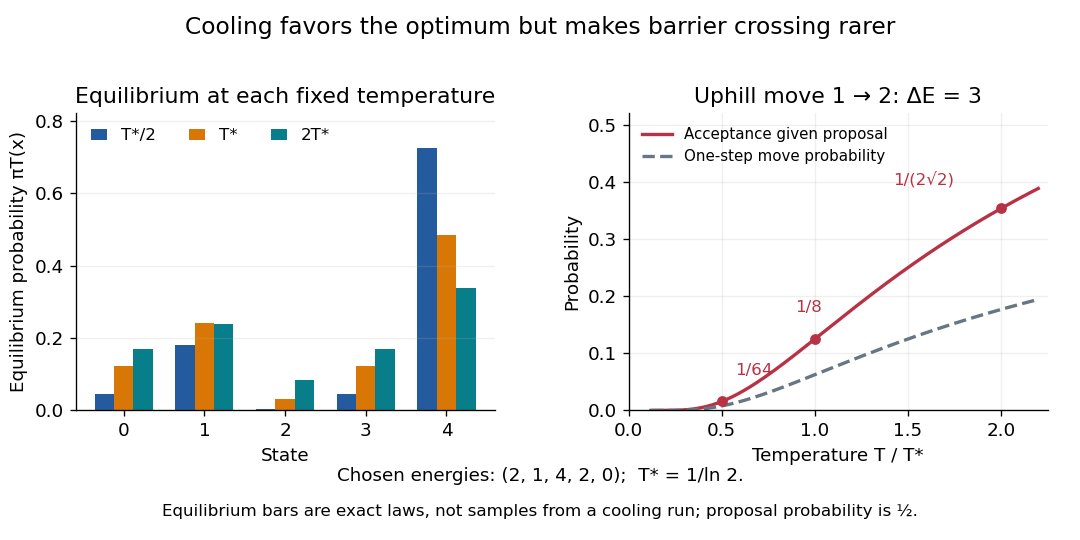
Lower temperature concentrates equilibrium weights while suppressing uphill acceptance
. Exact Boltzmann distributions for the chosen five-state objective function, and the uphill acceptance probability conditional on the proposal . The one-step transition probability is half that acceptance probability. The bars describe equilibrium at each fixed temperature, not the evolving probability distribution during cooling. Details.
For any finite , let be the set of global minima and the smallest objective function value. Cancelling from numerator and denominator shows that each nonminimal state's weight tends to zero as , while every state in has equal weight. Therefore tends to the uniform distribution on . This is a statement about a family of equilibrium probability distributions; it does not prove that a cooling Markov chain follows that family.
New to topics? Read the docs here!