
Take two point masses joined by a massless spring of spring constant and equilibrium length . Assume one-dimensional motion along the spring, no external force, no damping, and an extension satisfying Hooke's law; keep . For a real spring this is a model within its elastic range. Its potential energy is , soHere is angular frequency and is frequency. Choose so the model bodies do not cross. The internal normal mode has displacements and about equilibrium offsets from the centre of mass; its amplitude ratio is . The other normal mode is collective translation with zero frequency and no spring extension. This free pair has different boundary conditions from normal modes of two equal masses between three springs.
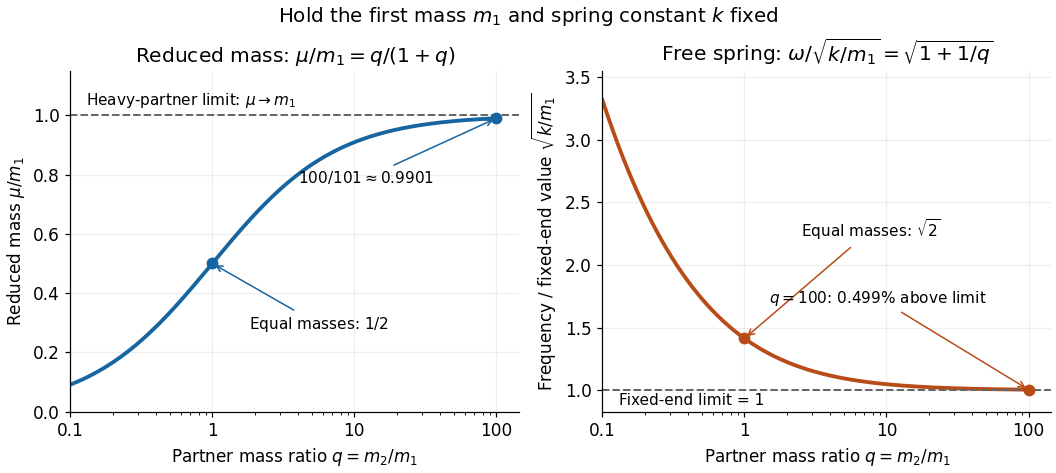
For and two masses, and . Replacing the second mass by gives and . Fixing the second endpoint instead would give : the free heavy partner still moves. The free pair's angular frequency exceeds that fixed-end limit by the factor , about at .

New to topics? Read the docs here!