Galton-Watson extinction fixed point
ID: galton-watson-extinction-fixed-point

For a Galton-Watson process with one ancestor and offspring probability generating function , the branching extinction probability is the smallest fixed point of in . A direct way to find it is to compute extinction by generation :Zero is an absorbing state, so extinction by generation is exactly the event . [ref]
https://ocw.mit.edu/courses/18-445-introduction-to-stochastic-processes-spring-2015/27aaeb9eb9a9cecce93d9ad74413ddf5_MIT18_445S15_lecture19.pdf. Hao Wu, MIT 18.445, Lecture 19, slide 4
For , the equation isBoth and are fixed points, but iteration from zero selects . The first values are , , , and . Iteration started at would stay at forever and would give the wrong extinction answer for this offspring distribution.
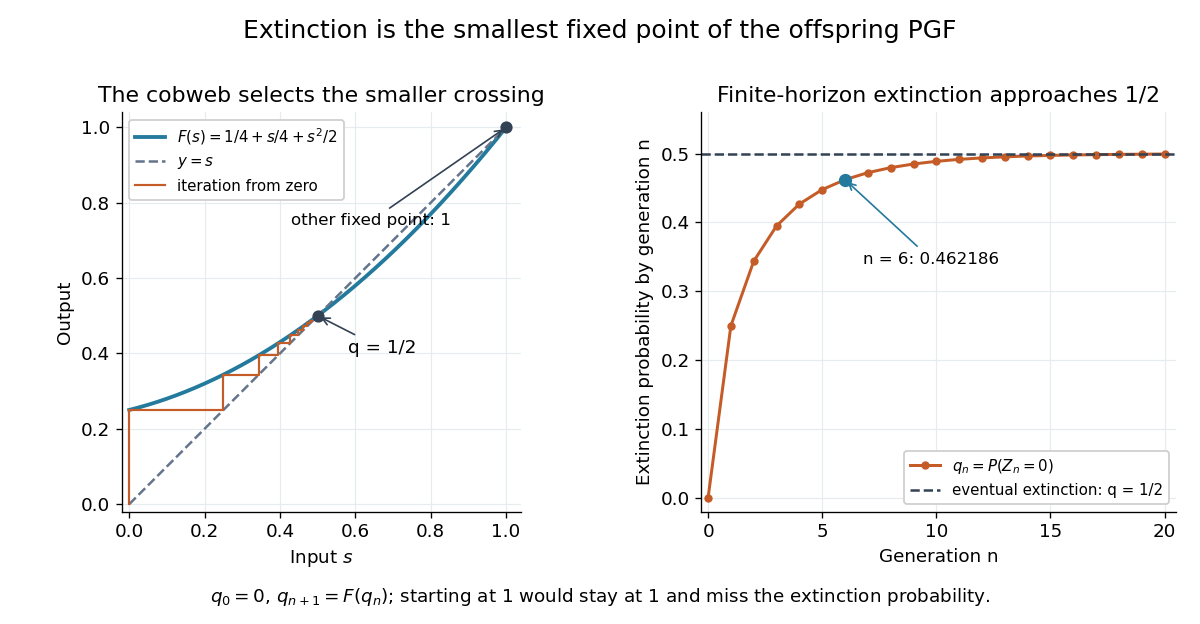
The smallest extinction fixed point selected by iteration from zero
. Details. 
The vertical steps in the figure apply the offspring probability generating function; horizontal steps return to the diagonal to start the next iteration. This gives a useful numerical calculation even when solving explicitly is difficult. For the displayed law, every finite iteration is a lower bound for the eventual branching extinction probability; at generation six, about additional extinction probability remains beyond the current empty families.
Why the smallest fixed point? The ancestor's children's descendant families are independent; given children, all are empty generations later with probability . Averaging gives . The increasing extinction events give the limit , and continuity of the probability generating function yields . For any other fixed point , and monotonicity of imply at every step; hence . [ref]
https://www.uni-muenster.de/Stochastik/lehre/WS1011/SpezielleStochastischeProzesse/Ch_1.pdf. University of Münster branching-process notes, Section 1.4, Theorem 1.7
New to topics? Read the docs here!