For a Galton-Watson process with one ancestor and offspring probability generating function , the branching extinction probability is the smallest fixed point of in . A direct way to find it is to compute extinction by generation :Zero is an absorbing state, so extinction by generation is exactly the event . [ref]
https://ocw.mit.edu/courses/18-445-introduction-to-stochastic-processes-spring-2015/27aaeb9eb9a9cecce93d9ad74413ddf5_MIT18_445S15_lecture19.pdf. Hao Wu, MIT 18.445, Lecture 19, slide 4
For , the equation isBoth and are fixed points, but iteration from zero selects . The first values are , , , and . Iteration started at would stay at forever and would give the wrong extinction answer for this offspring distribution.
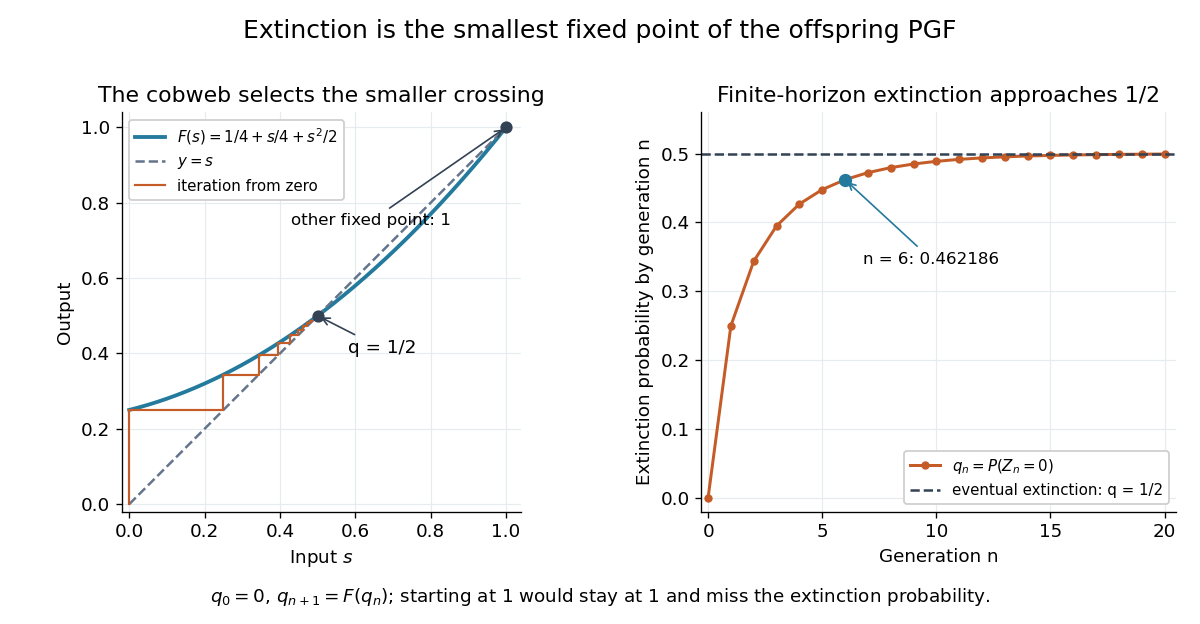
The smallest extinction fixed point selected by iteration from zero
. Details. 
The vertical steps in the figure apply the offspring probability generating function; horizontal steps return to the diagonal to start the next iteration. This gives a useful numerical calculation even when solving explicitly is difficult. For the displayed law, every finite iteration is a lower bound for the eventual branching extinction probability; at generation six, about additional extinction probability remains beyond the current empty families.
Why the smallest fixed point? The ancestor's children's descendant families are independent; given children, all are empty generations later with probability . Averaging gives . The increasing extinction events give the limit , and continuity of the probability generating function yields . For any other fixed point , and monotonicity of imply at every step; hence . [ref]
https://www.uni-muenster.de/Stochastik/lehre/WS1011/SpezielleStochastischeProzesse/Ch_1.pdf. University of Münster branching-process notes, Section 1.4, Theorem 1.7
For a Galton-Watson process, replacing an individual's reproduction by a one-descendant uneventful step with probability changes its offspring probability generating function to the displayed mixture. Its fixed-point equation reduces to , so the smallest fixed point and hence the extinction probability of a branching process are unchanged. The mean is , which also preserves the subcritical/critical/supercritical classification. The excluded case never reproduces or dies and need not share the extinction probability.
For a Galton-Watson process with one ancestor, the branching extinction probability is the probability that some generation is empty:The equality uses the absorbing state at zero. The complementary branching survival probability is the probability that every generation is nonempty. The Galton-Watson extinction fixed point computes from the offspring distribution.
For , , one ancestor has . Starting instead from ancestors with independent descendant families givesAll families must die out. With three ancestors, eventual extinction has probability and survival has probability ; by generation two, extinction has probability . Extra ancestors change the extinction probability without changing the offspring distribution. [ref]
https://www.uni-muenster.de/Stochastik/lehre/WS1011/SpezielleStochastischeProzesse/Ch_1.pdf. University of Münster branching-process notes, Lemma 1.2 and equation (1.10)
For finite offspring mean , the extinction classification is:
- If , extinction has probability . For example , gives and ; its only fixed point in is .
- If and , extinction also has probability . For example gives and , despite expected generation size in a Galton-Watson process remaining one.
- If , extinction has probability . The value can be zero: if , every individual has at least one child, so an initially nonempty family never becomes empty. In particular gives and .
The critical exception is : every individual has exactly one child, , and forever from one ancestor. Thus but ; a blanket claim that every critical Galton-Watson process becomes extinct would be false. These cases concern the Galton-Watson process with its common offspring distribution and independence assumptions. [ref]
https://www.uni-muenster.de/Stochastik/lehre/WS1011/SpezielleStochastischeProzesse/Ch_1.pdf. University of Münster branching-process notes, Section 1.4, trivial cases and Theorem 1.7
This probability answers whether any lineage persists, which the offspring mean alone cannot quantify in the supercritical case. A branching process conditioned on extinction uses the same fixed point to reweight reproduction and describe families known eventually to die out.
For a Galton-Watson process started from one ancestor, this is the probability that every generation is nonempty. It is the complement of the branching extinction probability. The binomial branching survival correction distinguishes finite-binomial reproduction from the Poisson branching process near mean one.
Articles by others on the same topic
There are currently no matching articles.