
A galvanic cell supplies electrical work from a spontaneous redox chemical reaction under the specified conditions. In discharge through a passive load, oxidation occurs at its negative anode and reduction at its positive cathode. Separating the reacting compartments makes the Electrons take an external route, where their transport can deliver useful work. See Flowers et al., Chemistry 2e, §17.2: separated reactions and electrical work.
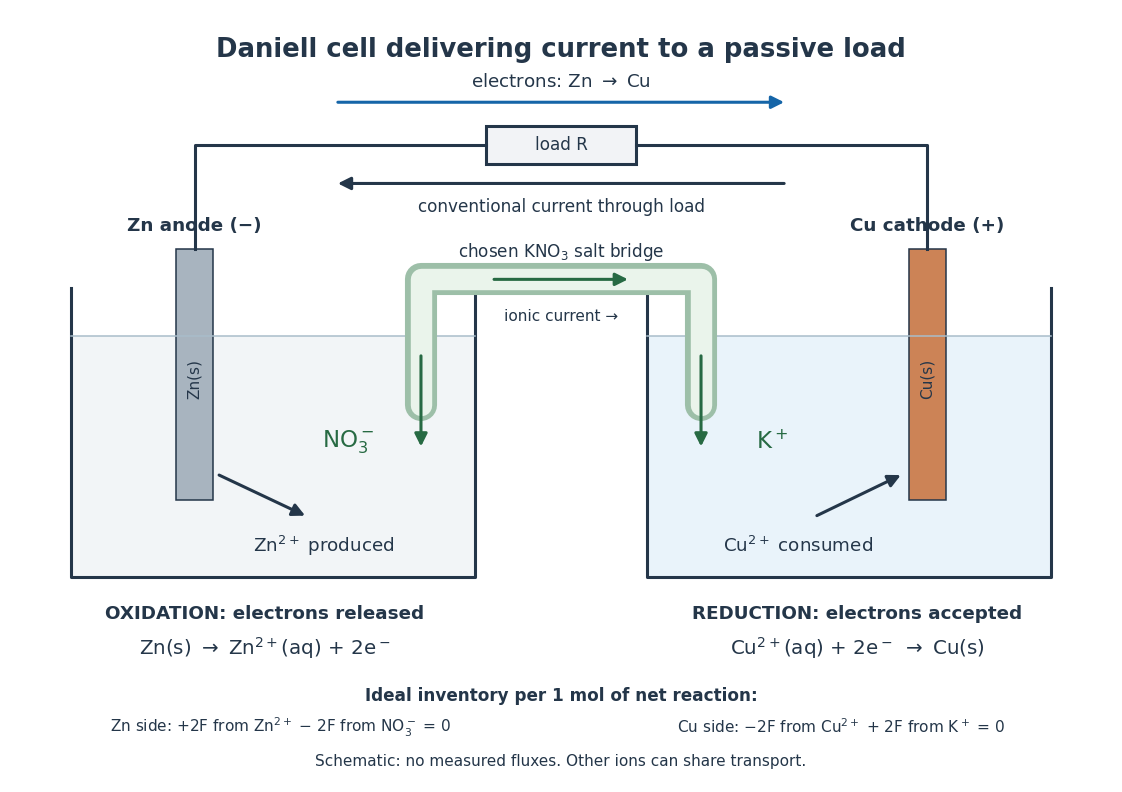

In the metallic external electrical circuit, Electrons move from anode to cathode, while conventional current goes from cathode through the load to anode. Inside the cell, net ionic conventional current closes the loop from the anode compartment toward the cathode compartment. Oppositely moving cations and anions can both contribute to that direction; see electrolyte for the signed current density calculation. A cell can maintain a nonzero terminal electric potential difference near open circuit while delivering almost no power; the Daniell cell voltage and load experiment makes this distinction concrete.
New to topics? Read the docs here!