
For a family of affinely parametrized geodesics with tangent and connecting field , the Jacobi equation in the convention used here isIt describes the relative acceleration produced by spacetime curvature.
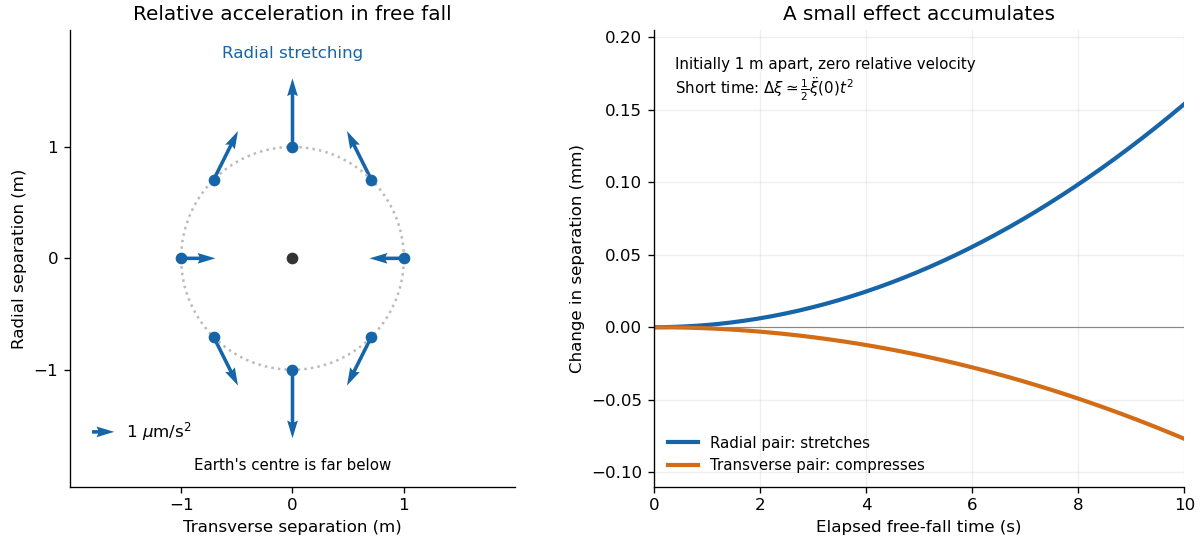
Here describes an infinitesimal separation and the covariant derivatives compare it in a frame transported along the reference geodesic. The Riemann curvature tensor thus becomes something measured with neighboring trajectories. The Newtonian version follows by differentiating gravitational acceleration with respect to position. In the exterior of a spherical mass, let be radial separation and separation in either transverse direction. Newton's law of universal gravitation givesThe upper particle falls less strongly than the lower one, stretching their radial separation; side-by-side particles accelerate toward converging radial directions, compressing their transverse separation. See Oregon State's derivation of tidal acceleration.
For a spherical Earth model with , and , a one-metre radial separation gives ; a one-metre transverse separation gives . Initially comoving particles therefore change separation after one second by approximately : micrometres radially or micrometres transversely. This short-time calculation holds the reference radius fixed to leading order. Its beauty is that common falling motion drops out, leaving a measurable stretching pattern that reveals curvature.


Geodesic deviation refers to the phenomenon in general relativity that describes how nearby geodesics—paths followed by free-falling particles—diverge or converge due to the curvature of spacetime. In a curved spacetime, even if an object starts out on a geodesic (which is the generalization of a straight line in curved space), the path of that object may not remain parallel to the path of a nearby object over time.
New to topics? Read the docs here!