Newton's law of universal gravitation gives the attractive force between two point masses. With source mass at the origin and relative position of mass , write :Here is the gravitational constant. The minus sign points toward ; the magnitude follows an inverse-square law, so doubling the separation quarters the force. The opposite force on satisfies Newton's third law. [ref]
Both masses accelerate. Applying Newton's second law to each in the isolated two-body problem givesThe relative standard gravitational parameter includes both masses; replacing it by requires the test particle approximation .
Historically, Newton's Book III, Proposition VII argues that gravitational attraction applies to all bodies and scales with their masses; its second corollary states the inverse-square law for individual particles. [ref]
https://en.wikisource.org/wiki/The_Mathematical_Principles_of_Natural_Philosophy_(1729)/Proposition_7:_Gravity_tending_to_all_Bodies. Newton, Principia, Book III, Proposition VII, Motte's 1729 translation
Free fall is motion under gravity alone: there is no supporting normal force, engine thrust or appreciable drag force. In the Newtonian mechanics model, a test particle of mass obeys , hence . The mass cancels. Bodies released at the same position with the same velocity follow the same path in this model, even if their gravitational weights differ. [ref]
https://www1.grc.nasa.gov/beginners-guide-to-aeronautics/free-falling-objects/. NASA Glenn: free-falling objects and the cancellation of mass
A dropped stone is one example; a coasting satellite is another. Free fall does not require motion straight down or decreasing distance to the attracting body. An ideal circular orbit has constant radius while its velocity continually turns under centripetal acceleration. The circular orbit as continuous free fall connects the familiar drop with orbital motion.
Near a surface, treating the gravitational acceleration as constant gives a useful first prediction. Over larger heights, the inverse-square law changes the acceleration during the fall. Radial free fall from rest uses conservation of mechanical energy to account for that change exactly, within the specified Newtonian gravitational field. The contrast matters: the simplest formula is an approximation to a physical model, rather than a law with the same numerical everywhere.
History also makes the idealization tangible. Galileo's Two New Sciences (1638), Third Day, Theorem II, derives distance proportional to the square of time for uniformly accelerated motion from rest; its first corollary gives successive distances in the ratios over equal time intervals. This is a kinematic statement, predating the gravitational inverse-square law. [ref]
https://galileoandeinstein.phys.virginia.edu/tns_draft/tns_160to243.html. Galileo, Two New Sciences, Third Day, Theorem II and Corollary I; Crew and de Salvio's 1914 translation, pp. 174–176
On Apollo 15's final lunar surface excursion, David Scott released a hammer and a feather together. The near-vacuum removed the large difference in drag force familiar on Earth. NASA's report describes their arrival together within the accuracy of the release; this demonstration illustrates the free fall prediction without establishing infinite experimental precision. [ref]
Take downward displacement as positive, assume a constant gravitational acceleration , and release a point mass from rest at . Integrating twice givesFor a downward distance , the arrival time and speed areFor the model values and , these are approximately and . Doubling the height multiplies both quantities by ; it does not double them. The same speed follows from the work-energy theorem, .
For intervals of length , the successive downward displacements areThus equal spacing in time produces increasingly separated positions. This is the odd-number pattern in Galileo's result. It assumes constant acceleration and release from rest; a nonzero initial velocity adds a linear term to .
The approximation can be estimated for a spherical source of radius and standard gravitational parameter . Writing , the gravitational magnitude at height isFor , a Taylor expansion gives . Small height relative to the source's radius makes nearly constant gravity plausible; negligible drag force remains a separate requirement.
Let a test particle start at rest at radius outside a fixed spherically symmetric source. The spherical shell theorem gives the exterior Newtonian gravitational potential , where is the source's standard gravitational parameter. Zero initial transverse velocity makes the motion radial. Conservation of mechanical energy per unit mass givesThe minus sign selects inward motion; the positive square root is its speed. For a fall from to the surface , that speed is . In the limit of release from rest infinitely far away, the familiar free-fall speed is , equal in magnitude to the local escape velocity. A finite starting radius gives a smaller speed.
The arrival time follows from the same first integral. Set . ThenFor arrival at this is finite, and the field formula is used only outside the source. For , givesKeeping the smaller initial gravitational magnitude constant would predict , about longer. The actual acceleration increases during the fall.
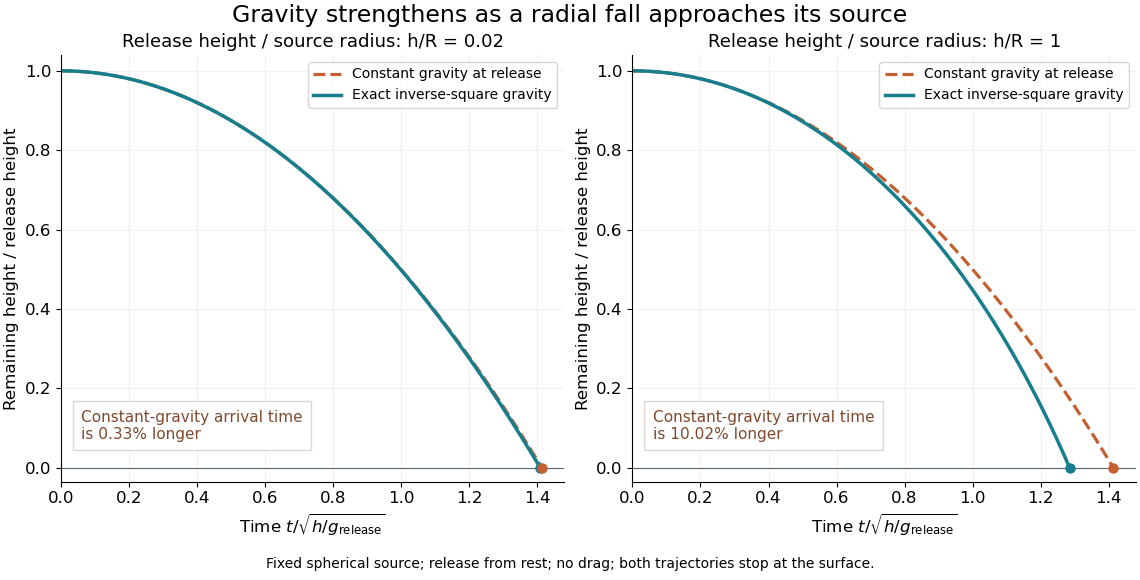
The curves compare a shallow fall, , with a fall from , so . Each comparison holds the release height and initial gravitational magnitude fixed. The constant-gravity model is close for the shallow fall and increasingly inaccurate for the larger one. This is also a practical use of nondimensionalization: the normalized trajectories depend on , while supplies the dimensional time scale.
In an Earth-fixed rotating reference frame, the horizontal displacement of a freely falling body receives contributions from Coriolis acceleration and centrifugal acceleration. A short-fall approximation substitutes the unperturbed downward velocity into the Coriolis term and the Earth's surface position into the centrifugal term. If gravitational acceleration excludes centrifugal acceleration, both contributions must be included explicitly.
A body released from rest relative to Earth at the equator has unperturbed downward velocity . The Coriolis acceleration in local Earth coordinates gives eastward acceleration . Integration gives and impact time , proving the title formula. This is first order in Earth's rotation, neglecting air resistance and the height dependence of the effective local gravitational acceleration. For a short fall at latitude , its leading eastward term is multiplied by .
The Newtonian gravitational field is the gravitational force per unit mass of a test particle. For a point mass at the origin,The test particle's mass cancels: different small masses have the same gravitational acceleration at the same position. In SI, the Newtonian gravitational field has units . The same exterior expression holds for a spherically symmetric source, by the spherical shell theorem.
Choose a reference radius , set , and use nondimensionalization with . Then : at , the magnitudes are . This makes the spatial variation visible without specifying a planet. [ref]
https://openstax.org/books/university-physics-volume-1/pages/13-1-newtons-law-of-universal-gravitation. OpenStax: inverse-square attraction and spherical sources
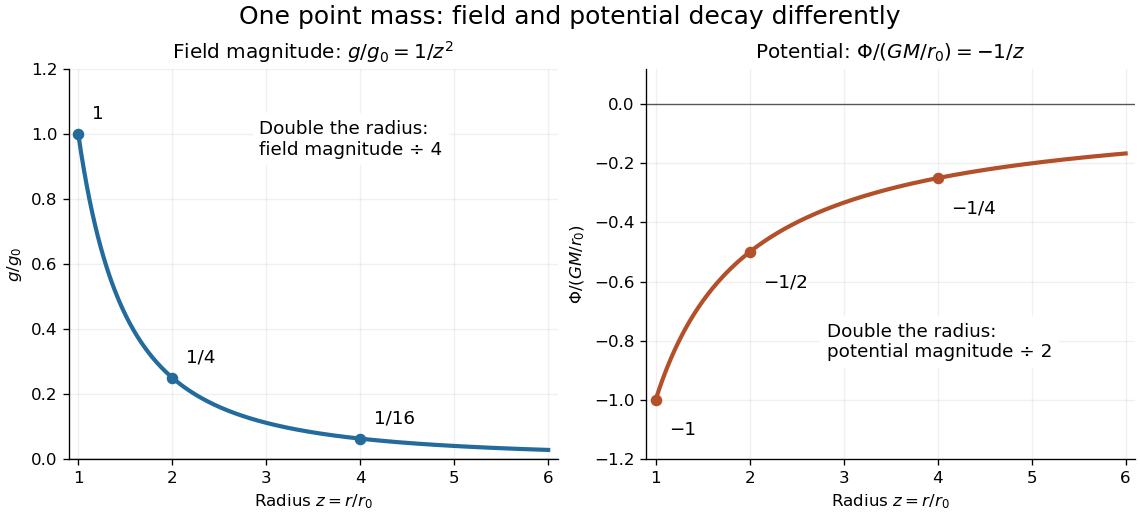
Normalized Newtonian gravitational field and point-mass potential
. Doubling the radius quarters the magnitude of the Newtonian gravitational field, but halves the magnitude of the negative Newtonian gravitational potential. Both curves approach zero as radius increases; the inward gravitational acceleration is minus the gradient of the Newtonian gravitational potential. Details.Spread mass uniformly along on an axis, with linear mass density . In its perpendicular bisector plane, axial field components cancel, and the radial component isThis is an exact line mass model and a thin-rod approximation for a physical cylinder. A centred circular orbit in this symmetry plane has . Thus for , and for . For a finite-width rod, the first limit is useful only while its transverse size remains much smaller than .
A circular infinite cylinder of radius and uniform mass density has linear mass density . A coaxial Gaussian surface of length has inward radial gravitational field and no end-cap flux. Gauss's law for gravity gives outside, hence the displayed result. Inside, enclosed linear mass density is , so . An exterior circular orbit has speed independent of radius. The exterior formula presupposes circular axial symmetry; area alone would not specify the near field of a noncircular rod.
The outward flux of the Newtonian gravitational field through a closed surface is times the enclosed mass. A sphere around a point mass establishes the coefficient; superposition extends the integral law to general mass distributions. The minus sign expresses attractive gravity. A symmetric Gaussian surface can turn the flux relation into a local field calculation, but the integral law alone does not imply that the field is uniform on an arbitrary surface.
Remove a spherical void centered at from a uniform sphere centered at the origin. At points inside the void, superposition combines the sphere's interior field with the removed sphere's field . Their sum is the displayed constant Newtonian gravitational field. A second removed mass outside this void adds a nonuniform contribution.
A uniform Newtonian gravitational field inside one spherical void can be cancelled at a point by the repulsive field representing another removed sphere. The latter field has a Jacobian matrix proportional to : its axial eigenvalue is negative and both transverse eigenvalues positive. The equilibrium is restoring along the axis but unstable transversely. A zero force is thus not enough for stable rest.
For a Newtonian gravitational potential obeying the Poisson equation for Newtonian gravity, define . Commutation of mixed partial derivatives gives . Thus the gravitational force density can be put in conservative form as . The sign is chosen so that is added to the momentum flux; reversing the stress convention reverses the divergence sign.
In cylindrical coordinates, the Newtonian gravitational stress tensor gives radial angular-momentum flux . Nonaxisymmetric structure can correlate the field components and transport angular momentum. The isotropic negative-pressure part has zero off-diagonal component, so it gives no direct radial transport. This separates a shear flux from a contribution to normal force balance.
Self-gravity is the gravitational acceleration produced by a system's own mass density. It is obtained by solving the Poisson equation for Newtonian gravity for that density, rather than treating the Newtonian gravitational potential as an externally fixed field. It competes with pressure and rotational support in gravitational instability of an astrophysical disk.
The product of the gravitational constant and a central mass sets the strength of the exterior Newtonian gravitational field. Its dimensions are length cubed divided by time squared. In the exact relative two-body problem, the parameter is ; using for one source assumes the test particle approximation.
The combination is useful because orbital and falling-body observations constrain directly. A gravitational circular orbit of radius has oscillation period , so measuring and gives . That measurement alone does not separately determine and . Similarly, radial free fall from rest has a natural time scale .
Other interactions require a different model. Inverse-square radiation pressure can reduce the effective attraction for a dust Kepler orbit; calling that effective coefficient a gravitational parameter must not hide the added force.
The acceleration tidal tensor is for gravitational acceleration . It describes differential acceleration . Some authors instead call the positive Hessian matrix the tidal tensor, reversing this sign convention. For a point mass and the positive potential convention , the tensor is .
The tidal tensor is the Jacobian matrix of the Newtonian gravitational field, rather than the gravitational acceleration itself. Its entries have units : multiplying by a displacement produces an acceleration. For a smooth Newtonian gravitational potential, the tidal tensor is a symmetric matrix, since mixed partial derivatives commute. A spatially uniform gravitational acceleration has zero tidal tensor, however large that acceleration is.
Use local axes radial, tangential in the orbital plane, and perpendicular to that plane around a circular Kepler orbit with . The gravitational tidal tensor is . A uniformly corotating frame adds the gradient of centrifugal acceleration, , giving the displayed effective tensor for stationary offsets. Thus the radial differential acceleration is . These are accelerations, or forces per unit test mass; an actual differential force includes that mass. Moving offsets also experience Coriolis acceleration.
For a source point mass at the origin, let , where is an outward unit vector, and let be the source's standard gravitational parameter. Differentiating gives the tidal tensorwhere is the Kronecker delta and is the identity matrix. In an orthonormal basis with first axis radial, the tidal tensor isThe radial eigenvalue separates nearby freely falling test particles; the two transverse eigenvalues bring them together. The farther radial test particle falls inward less rapidly, so its acceleration relative to the nearer one points outward. Transverse gravitational accelerations converge toward the source. Thus an initially resting small cloud stretches radially and squeezes in both transverse directions. These are instantaneous relative accelerations; the subsequent shape also depends on initial velocities and the changing tidal tensor along the cloud's free fall.
Outside the source, the matrix trace is . This matches in a region with zero mass density, by the Poisson equation for Newtonian gravity. Zero matrix trace means no leading change of a small initially resting cloud's volume at order , not that each separation stays fixed. Inside matter, the same sign convention gives instead.
Subtracting the constant and uniform-acceleration terms from the point-mass relative potential gives , with force convention . Its tidal tensor is . This is the leading term for target size small compared with separation.
Disruption of a self-gravitating body when differential gravitational acceleration across it exceeds its binding acceleration. For a body of radius , mass at distance from a much more massive body , the competing scales are and ; their equality gives , up to geometry and internal-structure factors. The tidal tensor gives the directional differential acceleration. A tidal disruption event near a black hole is a specific astronomical application.
Differential gravitational acceleration, multiplied by the affected mass, across a spatially extended body. In the linear approximation the acceleration difference is , where is the tidal tensor. Stellar tidal forces limit the domain of a circumplanetary orbit; sufficiently strong ones can produce tidal disruption.
To isolate a tidal force, subtract the gravitational acceleration shared by the body as a whole. Let a reference test particle follow , and let another have position . In a translating accelerated reference frame with parallel, nonrotating axes,for a source point mass, when . Here is its standard gravitational parameter and the last term uses Big O notation. This Taylor expansion removes the common inward pull and keeps the spatial variation. The near side has an excess pull toward the source; the far side has a deficit of inward pull, which is an outward relative acceleration. Both sides can stretch apart while both still accelerate toward the source.[ref]
Chapter 7: The Theory of Gravitation. §7–4, discussion of stronger near-side and weaker far-side attraction
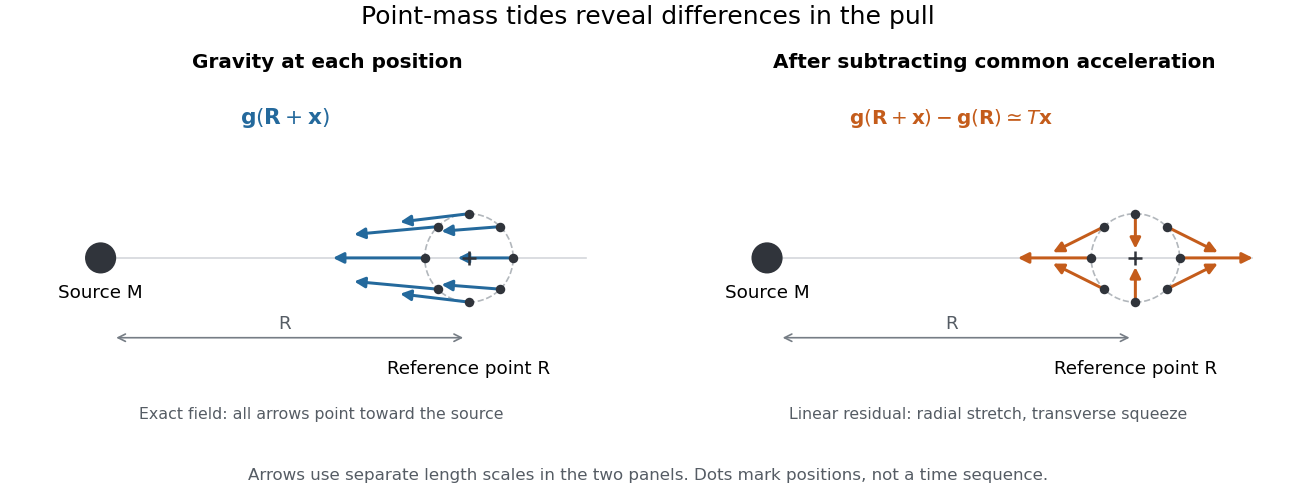
Subtracting common gravitational acceleration reveals radial stretching and transverse squeezing
. Blue arrows show the exact Newtonian gravitational field at several positions near a reference point. Orange arrows show its linear residual, calculated with the tidal tensor. Arrow lengths use separate scales in the two panels; this is a comparison of direction and spatial variation, not two equal-magnitude fields. Details.For a material element of mass , the residual external force in this translating accelerated reference frame is . Actual deformation also depends on elasticity, pressure and self-gravity. A rigid body approximation suppresses deformation but can still have internal forces that resist the tidal force. The point-mass tidal stretching and squeezing pattern describes freely falling, noninteracting test particles, rather than promising the same shape for every solid, star or ocean. A rotating reference frame introduces centrifugal acceleration and Coriolis acceleration, which must be included separately.
A small cohesionless spherical body of radius and density has surface self-gravitational acceleration . The radial stretching of the corotating point-mass tidal field is . Equating them gives the displayed survival-distance estimate. The size cancels because both accelerations are linear in at fixed density. This is a local spherical force-balance estimate, not the exact fluid Roche figure: shape deformation, material strength and nonsynchronous spin can change its numerical coefficient.
A tide is a periodic change in ocean level driven mainly by the differential gravitational forces of the Moon and Sun, together with the Earth's rotation. Their tidal forces act across the extended planet; a uniform acceleration shared by the whole Earth does not by itself generate a tide. Ocean-basin resonance and coastal geometry modify the local response.
A spring tide has an enhanced high-to-low tidal range because the Moon and Sun are approximately aligned as seen from the Earth, so their principal tidal contributions reinforce. Such alignments occur twice in a lunar phase cycle.
A neap tide has a reduced high-to-low tidal range when the directions to the Moon and Sun make approximately a right angle at the Earth. Their principal tidal contributions then partly oppose one another. The solar and lunar contributions are not equal, so this does not mean that tides disappear.
Stipulate a fixed source point mass , two equal test particles of mass , and . This is a chosen model, not a measurement of a particular object. Place the test particles on the outward radial axis at and , with midpoint distance and separation . Neglect their mutual attraction, other sources and all supporting forces.
Each signed radial gravitational acceleration is inward:Their separation has outward relative accelerationThe exact value is . The midpoint tidal tensor predicts , an underestimate of relative to the exact value. For these equal masses, the difference of external forces has the same numerical value in the SI unit of force, the newton. It is not an additional mutual force between the test particles.
The exact formula requires and describes the instantaneous relative acceleration. Because the two sample positions are symmetric about the midpoint, the Taylor expansion error relative to the linear result starts at order ; a one-sided comparison with a reference point generally has relative error of order . If either test particle enters an extended source, use that source's interior Newtonian gravitational field instead of extrapolating the singular point mass model.
For a fixed source point mass, the magnitude of the gravitational acceleration measures the local pull; the radial eigenvalue of the tidal tensor measures how that pull changes across space. Doubling divides by four but by eight. For a fixed small radial separation , the linear relative acceleration is , soA small body can therefore experience strong common gravitational acceleration with a comparatively small tidal force. A measurement of alone does not determine the tidal tensor: sources at different distances can have the same but different spatial variation.
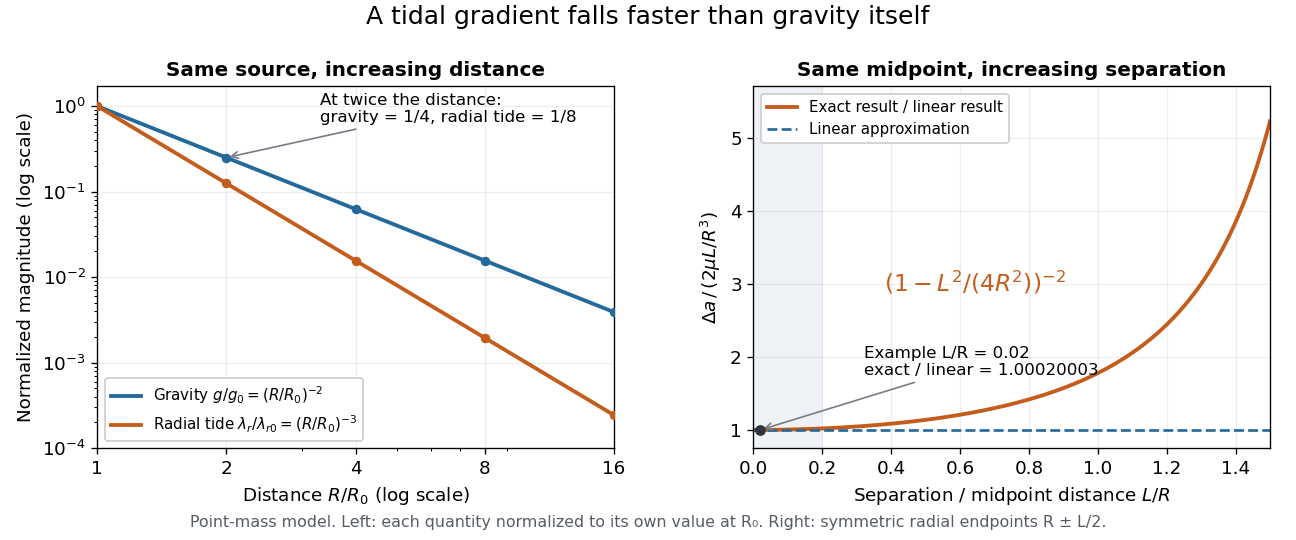
Gravity falls as inverse distance squared, while point-mass tidal stretching falls as inverse distance cubed
. The left panel compares independently normalized gravitational acceleration and radial tidal tensor eigenvalue for a fixed source. The right panel compares exact and linear relative accelerations for two radially separated test particles at a fixed midpoint, showing the finite-separation correction as their separation grows. Details.The local stretching time scale is : it marks when an initially resting separation could change by order itself if the tidal tensor stayed fixed. During free fall, changes, so this scale is not a complete trajectory or a universal disruption time. Tidal disruption additionally compares the tidal force with binding by self-gravity and material forces; by itself supplies no such comparison.
A Love number measures a body's tidal response to an applied potential. The degree-two potential response is sensitive to radial density structure and central concentration, and can complement mass and radius constraints on an exoplanet interior. Inferring it from orbital precession requires separating other contributions and assumptions about rotation and the tidal response.
Gravity gradiometry measures spatial differences of gravitational acceleration. Two simultaneous measurements along a unit vector , separated by , giveThis measures one directional component of the tidal tensor, not its whole matrix. Any identical platform acceleration cancels in the difference. Unequal instrument responses, changing geometry and rotating reference frames can spoil that cancellation. For a large baseline, the quotient is an average of the directional tidal tensor along the baseline, rather than its exact value at one point.
A laboratory gravity gradiometry experiment used two vertically separated clouds of chemical atoms in vacuum, launched into free fall. Shared laser beams applied three pulses (), splitting and recombining matter waves. Balanced photodiodes measured probe-light absorption to infer internal-state populations; scanning the last pulse's wave phase produced an interference fringe.[ref]
The difference of fringe wave phases obeys , with effective wave vector and pulse spacing : shared reference motion cancels, leaving differential gravitational acceleration. Eight lead bricks, each approximately , were placed symmetrically around the lower chamber, about from the fountain apex. The measured signal was , versus a calculated , where denotes terrestrial gravitational acceleration.[ref]
Controls deliberately shook the shared reference reflector and compared actively isolated and unisolated operation. Tilting tests exposed sensitivity to Coriolis acceleration and centrifugal acceleration. Thus shared translation is rejectable, while rotation and finite measurement uncertainty remain limitations. The brick signal detects spatially varying gravity; it does not establish a precision value of the gravitational constant.[ref]
For a point-mass companion at separation , subtract the constant and linear terms of its Newtonian gravitational potential in a frame accelerating with the target's center. The leading residual isIt is degree two in spherical harmonics. In a circular orbit with angular frequency , its time-dependent components force at in a frame with no spin; there is also a static component. This is the leading approximation in , and the tidal amplitude may be absorbed into a harmonic-dependent constant.
Gravitational acceleration is the acceleration of a test particle in free fall in a Newtonian gravitational field. It is a vector pointing along that field; commonly denotes its positive magnitude. Near Earth's surface, the magnitude is approximately constant over shallow vertical scales. For a fixed spherical source it instead varies as , where is the standard gravitational parameter.
This is distinct from gravitational weight, the force , and from apparent weight, the support force a scale measures. An orbiting body can have substantial gravitational acceleration while its apparent weight is zero.
A collision-free positive-mass configuration satisfies the displayed equation when every gravitational acceleration points proportionally toward a common centre. With , homogeneity gives , . Pairwise force cancellation implies . Such a configuration generates a nonrotating homothetic gravitational motion by multiplying all position vectors by one positive scale factor.
For a Newtonian central configuration, set with . The gravitational force scales as , reducing all equations to the displayed scalar ordinary differential equation. Its first integral is . The total energy is , so the scalar energy constant exactly tracks the many-body energy for the fixed shape.
The gravitational constant sets the strength of Newton's law of universal gravitation. Two point masses and a center-to-center distance apart attract with force magnitudeFor fixed masses and separation, doubling would double the force. For bodies with spherical symmetry, the same exterior formula follows from the spherical shell theorem; for arbitrary extended bodies, add the attractions of their mass density elements instead. The gravitational constant connects a laboratory attraction to the Newtonian gravitational field controlling a Kepler orbit.
The gravitational constant and local gravitational acceleration are different quantities. Applying Newton's second law to a test particle gives for one spherical source. The source's mass and the observer's position change ; remains the same parameter of the law. A local falling-body experiment therefore measures a field, not alone. On rotating Earth, an instrument fixed to the surface also responds to centrifugal acceleration, while surrounding mass density and altitude change the gravitational contribution.
Dimensional analysis explains the units. Denote the base physical dimensions of length, mass and time by . Since force has dimension ,By contrast, and the standard gravitational parameter has dimension . A small numerical value of a dimensional constant depends on the units chosen: it is the resulting force for specified physical masses and separation that conveys the laboratory scale.
NIST's current complete listing givesfor the 2022 CODATA adjustment, the latest adjustment listed when checked on 14 October 2026. Parentheses indicate a standard uncertainty , approximately parts per million relative to . The adjustment year is 2022; NIST's May 2024 data update is a different date.[ref]
Fundamental Physical Constants — Complete Listing by National Institute of Standards and Technology and others. 2022 CODATA adjustment, Newtonian constant of gravitation row: value, uncertainty and units
[ref]Fundamental Physical Constants — Complete Listing by National Institute of Standards and Technology and others. Current adjustment heading, next-adjustment notice and data-content update
For an original scale calculation, stipulate two point masses separated by and insert this recommended : . The corresponding acceleration of either mass is at that instant. Reducing the separation to multiplies both by . These are ideal model predictions, not observations; their tiny scale explains why stray forces matter.
Being a constant of a physical law does not make the numerical value exact. The SI fixes the numerical values of seven defining constants, including the speed of light and Planck constant; is determined experimentally. Exact unit definitions still require physical realizations with measurement uncertainty: calibrating a length or a mass does not become error-free.[ref]
An orbit around an isolated source constrains its standard gravitational parameter rather than independently measuring the source's mass and the gravitational constant. In the test particle approximation, a circular orbit of radius and orbital period satisfiesThe left equation equates the required centripetal acceleration to the gravitational acceleration. More generally, a Kepler orbit depends on the same . In the exact relative two-body problem, replace by .
For any positive dimensionless number , replacing by and by leaves and every predicted test particle trajectory unchanged. This is the gravitational mass degeneracy: more observations of the same orbit can refine without separating its factors. A laboratory source whose mass is calibrated independently supplies the missing information.
Consequently an astronomical mass expressed in kilograms as inherits measurement uncertainty from , even if is known much more precisely. To first order,When the relative standard uncertainty of is negligible, that of is approximately . Conversely, the ratio of two source masses inferred using the same is , so this common factor cancels. That distinction explains how excellent orbit determination can coexist with less precise absolute astronomical masses.
A laboratory determination of the gravitational constant must connect a sensor's reading to a gravitational signal from independently characterized masses. For an ideal two-point mass force measurement, invert the model:These are signed small changes obtained by taking the logarithmic derivative, not an instruction to add standard uncertainties with signs. For independent small input uncertainties, linear propagation of uncertainty instead givesCorrelated inputs require their covariances too. In particular, common geometric calibration errors must not be treated as independent simply because several distances were recorded.
For a concrete model check, hold the actual force and masses fixed but overestimate a true by . The exact inferred ratio isThe resulting bias is parts per million, already comparable with the relative standard uncertainty of the recommended gravitational constant. A sensor can resolve very small changes while its inferred answer remains limited by source geometry. The example concerns one idealized separation; it is not an uncertainty estimate for any actual experiment.
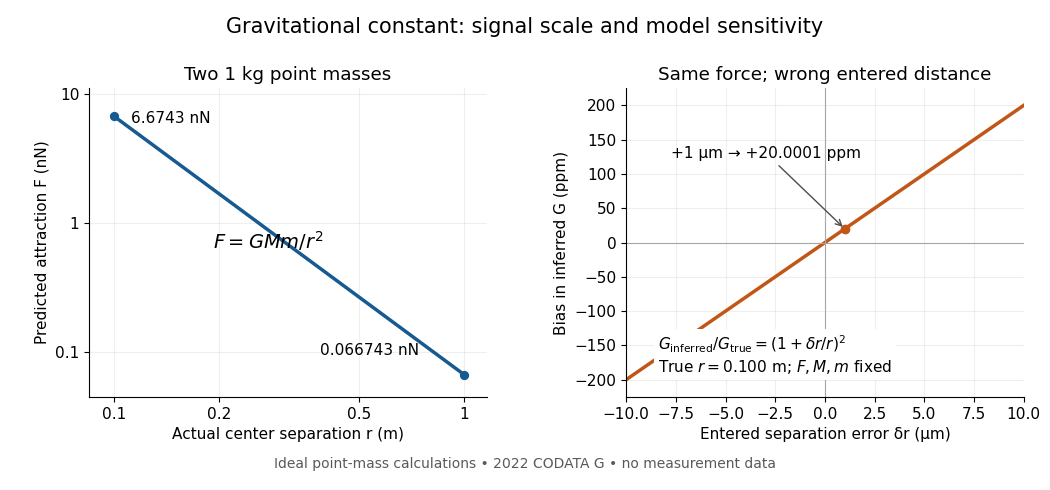
Weak laboratory attraction and the geometric sensitivity of an inferred gravitational constant
. Left: ideal force between two stipulated point masses using the 2022 recommended gravitational constant. Right: exact model bias when only the separation entered in the inference changes. These curves are calculations, not measurement data. Details.Making the source mass larger or bringing it closer strengthens the signal, but also makes detailed mass density and geometry important. Nearby apparatus supplies its own Newtonian gravitational field; electromagnetic shielding does not remove that attraction. Sensor offsets, changing temperature, vibration and source motion can imitate or alter a signal. The Cavendish experiment illustrates calibration of a torsion constant; a different sensor requires its own calibrated response and a full source model.
Repeating readings can reduce independent measurement noise, but a fixed scale error survives averaging. A useful experiment deliberately changes the source configuration, checks whether the signal follows the predicted change, and characterizes what moves with the source. A systematic error that changes with that configuration also survives background subtraction. Comparing methods with different sensors and different dominant errors is therefore valuable.
In 2014, Gabriele Rosi and colleagues used atom interferometry: two rubidium-87 clouds prepared by laser cooling in vacuum, apart, received shared three-pulse Raman transitions spaced by . Fluorescence readout and paired-fringe ellipse fitting yielded differential wave phase. Twenty-four tungsten alloy cylinders, about total, moved between C and F. Cloud subtraction rejected shared vibration; configuration subtraction isolated the source change.[ref]
Precision Measurement of the Newtonian Gravitational Constant Using Cold Atoms by Gabriele Rosi and others. Main text pp. 3–5; Methods pp. 13–14; Fig. 1 caption p. 21
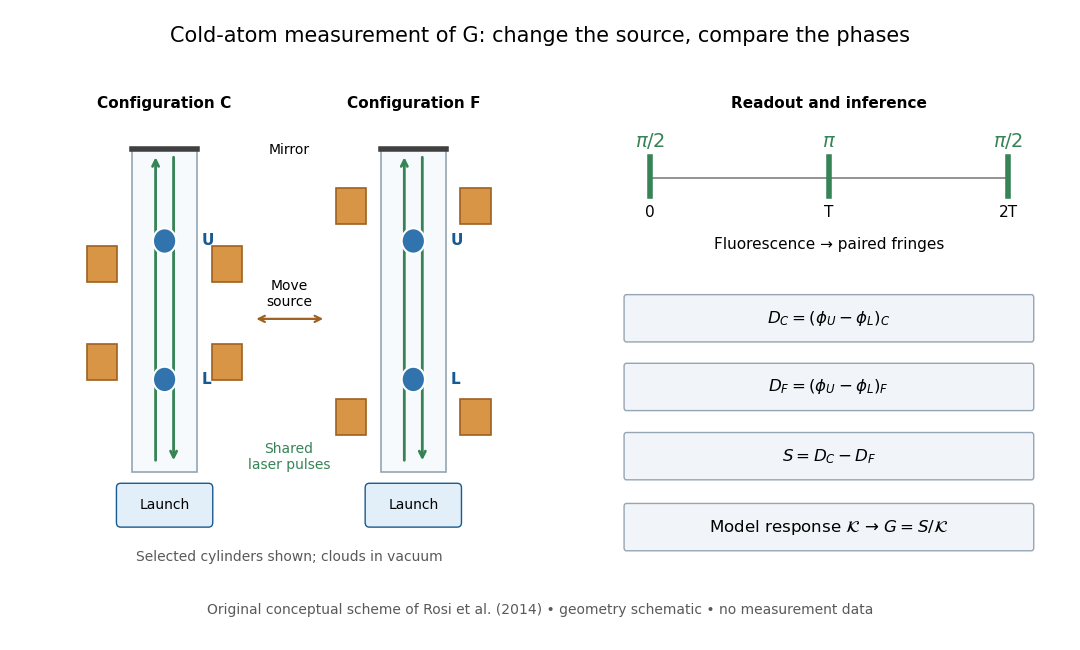
Precision Measurement of the Newtonian Gravitational Constant Using Cold Atoms by Gabriele Rosi and others. Main text pp. 3–5 and Fig. 1 caption p. 21
Details.Calibration used timed flight and light-sheet crossings; mirror tilt compensated Earth rotation. Wave vector reversal rejected unwanted shifts. Modeling included source Newtonian gravitational potential, atom trajectories, cloud distributions and moving supports. Source positioning, mass density variation and cloud geometry limited the reported combined relative standard uncertainty to parts per million.[ref]
Precision Measurement of the Newtonian Gravitational Constant Using Cold Atoms by Gabriele Rosi and others. Main text pp. 5–6; Methods pp. 14–18; Table 1, p. 27
To understand the subtraction without reproducing that full analysis, consider an ideal atom interferometer in uniform vertical acceleration during each pulse sequence. Let be its signed effective vertical wave vector component and the pulse spacing. Its acceleration-dependent wave phase is ; labels U and L denote upper and lower clouds. The double difference is thenA background field identical in C and F cancels even if it differs between the two clouds. In a fixed-geometry, linear-response model, write , where is calculated from the source mass density, calibrated pulse sequence and atom trajectories. Thus . Measuring wave phase accurately is one part of the task; calculating accurately is another. The real nonuniform field and finite clouds require the trajectory-dependent analysis described above rather than this uniform-field approximation.
For mass density , the Newtonian gravitational potential satisfies the Poisson equation . The gravitational acceleration is . An isolated system also requires the exterior vacuum solution and decay at infinity; solving the interior equation alone does not fix a globally physical field.
Suppose the shell has mass density . Its mass is , by integrating . Summing the geometric series gives total mass . At the enclosed shells have indices , so the enclosed mass is the total mass times . The magnitude of the Newtonian gravitational field at every such boundary is therefore the same, . This does not assert that the field is constant throughout each shell.
The Newtonian gravitational potential is potential energy per unit mass of a test particle. Its gradient determines the Newtonian gravitational field:In SI, has units , while has units ; its gradient has units of acceleration, not force. Adding a constant to leaves the Newtonian gravitational field unchanged. For an isolated point mass, the convenient reference is . [ref]
https://ocw.mit.edu/courses/16-07-dynamics-fall-2009/0bb19205a6316ba88f88284bf7257ec6_MIT16_07F09_Lec16.pdf. Peraire and Widnall, MIT Dynamics, Lecture 16: potential per unit mass
Increasing the radius from to raises the Newtonian gravitational potential energy:An external agent supplies this positive work if the initial and final kinetic energies agree; gravity does work . For , the required work is . [ref]
For radius , constant mass density and , normalize the Newtonian gravitational potential to zero at infinity. ThenBy the spherical shell theorem, each spherical shell contributes the potential of a point mass outside it and a constant inside it. Summing inner and outer shells gives inside. Equivalently, angular integration of the free-space Green function of the Laplacian gives . The resulting radial integral has the same value.
The potential and its first radial derivative are continuous at . The interior gravitational acceleration is , and . At the centre while its gradient vanishes.
The dimensionless coefficient describes the leading axisymmetric departure of a planet's external Newtonian gravitational potential from a monopole: , where is colatitude from the spin axis. An oblate mass distribution has positive . The disturbing function is minus the nonspherical potential term. On a circular inclined Kepler orbit, , so orbit averaging gives . The exact circular nodal rate is ; its small-tilt limit is .
For , a nearly circular equatorial orbit has and azimuthal frequency . The radial epicyclic frequency is , and the vertical epicyclic frequency is . Radial stability requires . The nodal precession rate is negative and the apsidal precession rate positive. These sign statements concern small eccentricity and inclination. For an arbitrary inclined orbit, the averaged argument of periapsis instead evolves as and can regress.
An axisymmetric logarithmic Newtonian gravitational potential has spheroidal equipotential surfaces and a flat galaxy rotation curve: . The singular model is defined away from the origin; a fixed reference length makes the logarithm dimensionless. Its central mass density cusp is locally integrable, but its total mass diverges at large radius.
The Poisson equation for Newtonian gravity givesFor , nonnegative mass density away from the origin is equivalent to . Strict positivity requires . This condition does not by itself guarantee a nonnegative galactic distribution function.
A radial Newtonian gravitational potential produces inward acceleration . The point-mass case has and . Treating the power-law gravitational potential as prescribed does not require it to be sourced by the flowing gas.
For a binary star viewed far from its centre of mass, let be the separation and the reduced mass, the total mass, and . The Taylor expansion of the point-mass Newtonian gravitational potential has zero dipole because . Its second moment is , soThis holds for an instantaneous separation in any orbit, not only a circular orbit. The mass quadrupole moment convention gives .
A flattened power-law Newtonian gravitational potential has equipotential spheroids . For and , its midplane circular orbit angular frequency satisfies .
Applying the Poisson equation for Newtonian gravity to a flattened power-law gravitational potential yieldsFor , nonnegative mass density everywhere outside the origin requires and is ensured by . The central density singularity is locally integrable and carries no point mass, although the total mass diverges at large radius in this scale-free model.
The Newtonian potential of a point mass at the origin isIt is the free-space Green function of the Laplacian with the normalization of the Poisson equation for Newtonian gravity. Differentiating gives inward gravitational acceleration . With , the normalized Newtonian gravitational potential is ; at it equals .
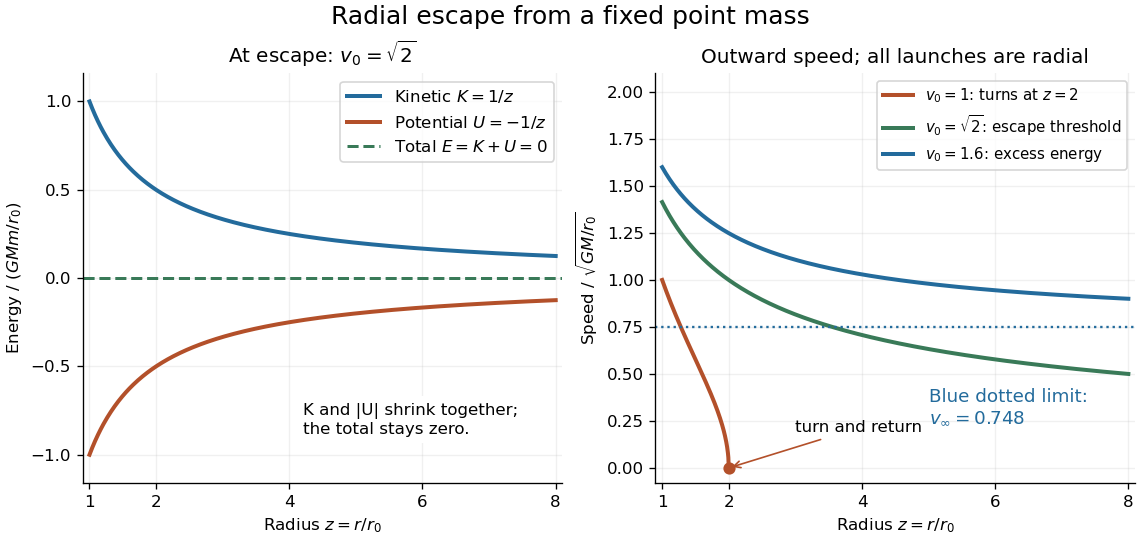
For a radially outward launch from , conservation of mechanical energy in the fixed-source test particle approximation gives the minimum escape velocity:At this threshold the speed tends to zero only at infinite separation. The model neglects air resistance, external tidal forces, and general relativity. [ref]
A circular orbit at instead requires tangential speed . Choosing units with gives , , and . A radial launch at speed reaches and returns; the same speed directed tangentially gives a circular orbit. [ref]
Consider a uniform-density cylinder with an axisymmetric radial Fourier mode . Its displaced boundary gives a first-order surface mass density , although the interior density perturbation vanishes. The gravitational Poisson equation reduces to Laplace equation away from the interface. Regularity internally and decay externally give and . Continuity at and the derivative jump , together with , give the title amplitude. The prime differentiates the modified Bessel function argument. This axial mode is different from an azimuthal mode on a gravitational potential of a displaced cylindrical interface.
A spherically symmetric potential depends only on distance from one point. Its force is central, so angular momentum is conserved.
This is the Newtonian point-mass specialization of gravitational energy, with the reference value chosen at infinite separation.
Assembling a spherical mass distribution in shells gives gravitational potential energy . Integration by parts gives the displayed identity when vanishes at both endpoints. It includes each interacting pair once; no extra factor of one half belongs in the original shell-assembly integral.
For positive masses, let be the actual minimum pairwise separation and use positive binding energy . If are the smallest masses, then . Thus is comparable to with constants depending only on the masses.
With and , the positive binding energy satisfies . The minimum-separation binding-energy bounds imply . At least one pair stays close; this does not bound every particle's distance or exclude a negative-energy gravitational collision.
The Cavendish experiment makes the attraction predicted by Newton's law of universal gravitation measurable between laboratory masses. Two small test masses hang at the ends of a horizontal rod in a Cavendish torsion balance; nearby larger source masses exert a tiny torque. A thin suspension fiber supplies an opposing torque as it twists. Measuring its twist and calibrating its torsion constant lets an experimenter infer the gravitational force and, in a modern analysis, the gravitational constant. [ref]
https://www.phys.uconn.edu/~hamilton/phys258/N/cav.pdf. University of Connecticut, Physics 258/259, The Cavendish Experiment: apparatus and equations of motion, pp. 1–3
The beautiful feature is that the two horizontal forces can cancel as vectors while their torques add. The instrument converts weak attraction into a rotation, with sensitivity set by the fiber's torsion constant. Earth's much larger downward gravitational weight is supported by the suspension rather than supplying the intended torque about its vertical axis. A laboratory measurement can therefore probe the same Newtonian gravitational field that governs the two-body problem.
Henry Cavendish's original paper was Experiments to determine the Density of the Earth, published in Philosophical Transactions, volume 88 (1798), pp. 469–526, and read on 21 June 1798. On p. 469 he credits John Michell with the apparatus idea and explains that Michell died before using it; the instrument reached Cavendish through Francis John Hyde Wollaston. Cavendish's stated aim was Earth's mean mass density. Calling the experiment a determination of the gravitational constant is a modern interpretation, not Cavendish's own formulation of his result. [ref]
https://www.famaf.unc.edu.ar/~wolf/FisicaI/Phil.%20Trans.%20R.%20Soc.%20Lond.-1798-Cavendish-rstl.1798.0022.pdf. Cavendish (1798), original paper, opening p. 469; DOI 10.1098/rstl.1798.0022
The connection between Earth's mean mass density and the gravitational constant follows in a spherical, nonrotating model of Earth. With Earth mass , radius , and surface gravitational acceleration , the spherical shell theorem and Newton's law of universal gravitation giveThus a local comparison of gravitational attractions, together with knowledge of Earth's size and surface gravitational acceleration, reaches a property of the entire planet. These are modern equations explaining the connection, not equations quoted from Cavendish's paper.
For a worked example, use an explicitly simplified two-near-pair model. Each test point mass is , each source point mass is , and each lever arm is , so the rod's full length is . Neglect the rod's mass. At zero twist put the test masses at and , and the sources at and . Here is the near-pair center separation. Ignore each source's attraction on the test mass at the opposite end. Evaluate the two near-pair forces at zero twist and treat their torque as constant for a small twist, requiring . This is a teaching model, not a precision model of Cavendish's actual apparatus.
By Newton's law of universal gravitation, each retained force has magnitude . The left force points down and the right force points up. Using torque about the suspension axis, both contributions are counterclockwise when viewed from above:The net retained horizontal force is zero, yet the net torque is positive. Moving the sources to and reverses both forces and hence the torque. In a real apparatus, the opposite source also attracts each test mass; that correction is explicitly included in the university derivation. [ref]
https://www.phys.uconn.edu/~hamilton/phys258/N/cav.pdf. University of Connecticut, The Cavendish Experiment, p. 2, equation (1): opposite-source correction
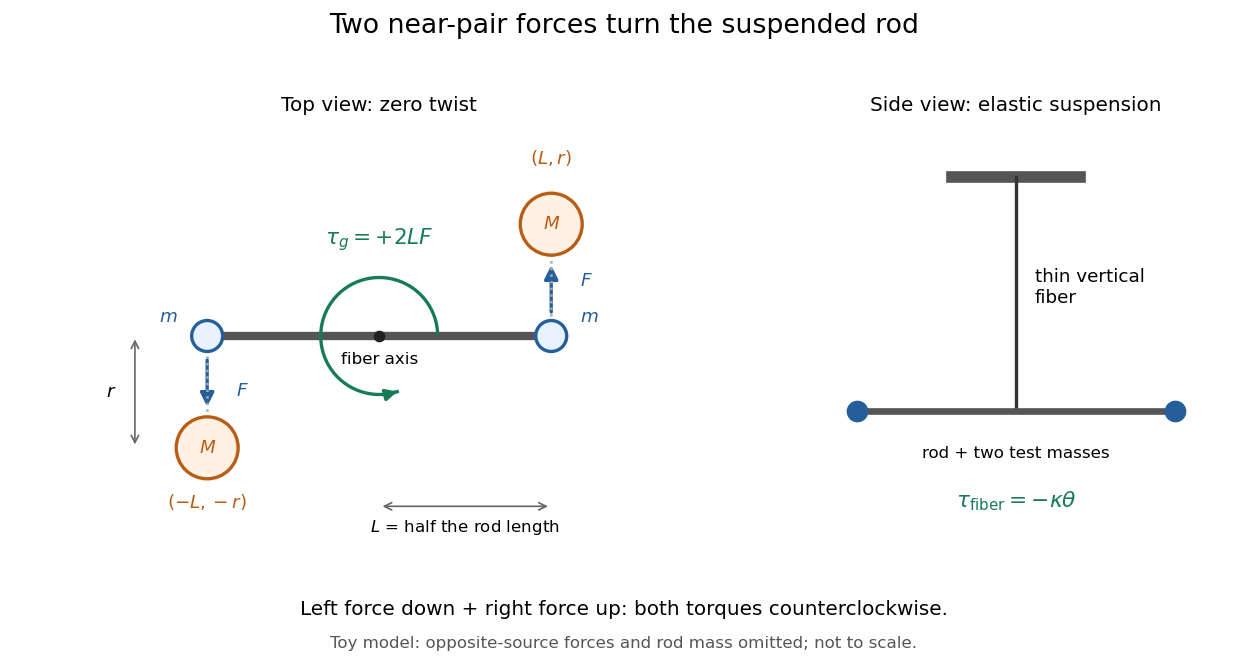
For illustrative parameters, take , , , , and torsion constant . Use , the central value in NIST's 2022 CODATA table; that table gives standard uncertainty . This is an input for the example, not a measurement made with these assumed parameters. [ref]This sub-nanonewton force produces a measurable twist in the Cavendish torsion balance. The displayed digits make the toy calculation reproducible; they do not describe experimental precision.
A Cavendish torsion balance is a torsion balance arranged to measure gravitational torque from nearby source masses. Its suspended horizontal rod rotates about a vertical fiber. In the linear elastic regime, a twist angle , measured from the fiber's untwisted orientation, gives a restoring torque , where is the torsion constant. The minus sign is essential: the fiber resists the twist. Under an approximately constant gravitational torque, the rotational equation using moment of inertia and angular acceleration isAt equilibrium, the two torques balance. The angle is a displacement from the fiber's reference orientation, not the largest excursion during an oscillation. [ref]
https://www.phys.uconn.edu/~hamilton/phys258/N/cav.pdf. University of Connecticut, The Cavendish Experiment, pp. 2–3: restoring torque and equilibrium deflection
For the toy parameters in the Cavendish experiment, the predicted equilibrium twist isHere , consistent with using a small geometric displacement in the toy model, but not an estimate of its total measurement error. Reversing the source positions ideally takes the equilibrium angle from to : the magnitude of the change is . A stable zero offset then cancels in the difference. A real reading may track a reflected light spot; the law of reflection doubles a mirror's rotation in the outgoing beam, so the spot's angular change must not be confused with the rod's angle. [ref]
https://sciencedemonstrations.fas.harvard.edu/presentations/cavendish-experiment. Harvard Natural Sciences Lecture Demonstrations, Cavendish Experiment: mirror readout and source reversal
How can the fiber's torsion constant be found without already knowing the gravitational force? Measure the oscillation period and calculate the moment of inertia. For the same toy rod, neglecting its mass and treating both test masses as point masses, . With the source torque absent or treated as constant, let be a small departure from equilibrium. Neglect damping and any change of gravitational torque with angle. The rotational equation becomes simple harmonic motion:Here is the angular amplitude, specifies the initial phase, and is the angular frequency. A softer fiber gives a larger equilibrium twist but also a longer oscillation period: greater sensitivity costs observation time. An undamped oscillation does not settle at equilibrium; damping is needed for settling. [ref]
https://www.phys.uconn.edu/~hamilton/phys258/N/cav.pdf. University of Connecticut, The Cavendish Experiment, p. 3, equation (7): period calibration neglecting damping
The toy moment of inertia and undamped oscillation period areTiming this oscillation period would recover the assumed torsion constant. The units check explains the result: torque divided by torsion constant is an angle in radians, and has units of time squared when radians are treated as dimensionless in SI.
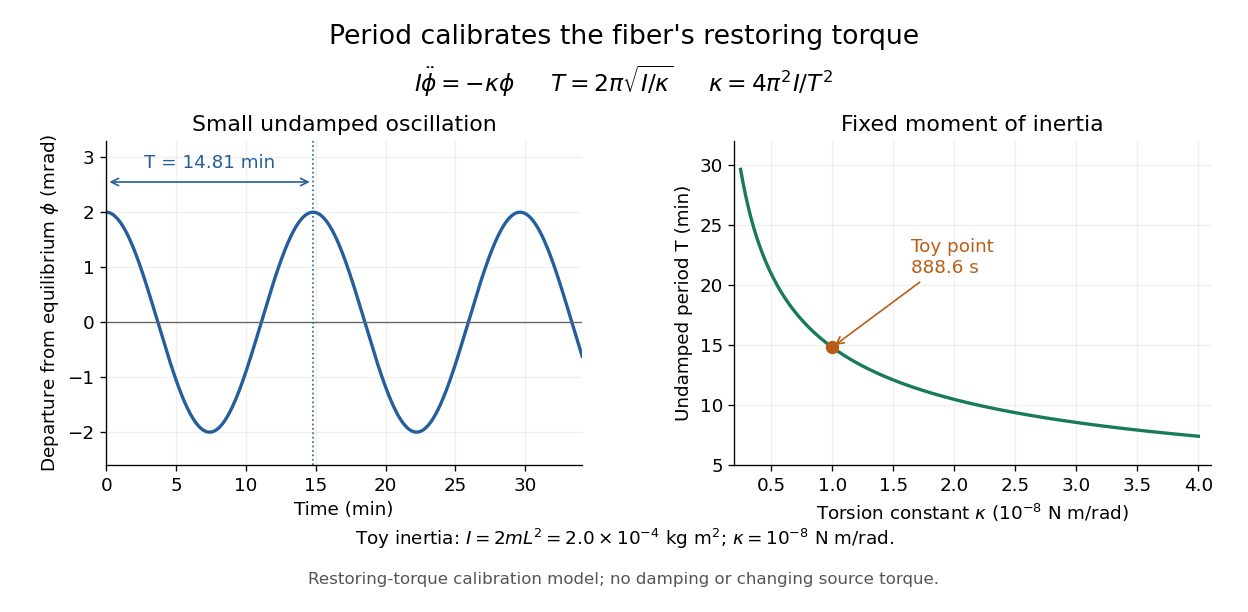
Undamped small torsional oscillations calibrate the restoring torque: a softer fiber has a longer period
. Details. Combining the equilibrium twist with the period calibration, the two-near-pair model would infer the gravitational constant asThe test mass cancels in the second expression because it enters both the gravitational torque and the toy moment of inertia. If the measured quantity is the magnitude of the change between opposite source positions, use . Substituting the toy twist and oscillation period returns the input ; it is a consistency check, not independent experimental evidence.
The sensitivity of a Cavendish torsion balance also explains its practical difficulty. Air motion can exert unwanted torque; unequal temperatures can drive that motion. Cavendish discusses this effect on p. 471 and describes observing from outside a closed room to avoid disturbing the instrument. [ref]
https://www.infinitoteatrodelcosmo.it/wp-content/uploads/2021/07/cavendish-1997-xxi-experiments-to-determine-the-density-of-the-earth.pdf. Cavendish (1798), original paper, p. 471: temperature-driven air currents and remote observation
Mechanical vibrations can excite the same slow oscillations used to calibrate the torsion constant, while changes in the fiber or source separations alter the inferred force. Precision therefore depends on resolving the equilibrium angle, calibrating the full suspended moment of inertia and torsion constant, and modeling the actual source geometry. The two-near-pair model omits opposite-source attraction, rod contributions, finite-size effects, damping, and the variation of gravitational torque as the rod turns. [ref]https://sciencedemonstrations.fas.harvard.edu/presentations/cavendish-experiment. Harvard Cavendish demonstration: sensitivity, settling, and separation-dependent measurement



