
A Huffman code is the prefix code returned by Huffman coding; the algorithm chooses a code tree, while the code specifies the actual symbol-to-codeword assignment. For the probability distribution in symbol order , the illustrated binary tree givesThe codeword lengths are . This is a prefix code because no complete codeword is an initial segment of another complete codeword. Thus a decoder can start at the root of a tree, follow one edge per bit, emit a symbol on reaching its leaf, then restart at the root of a tree. In particular,
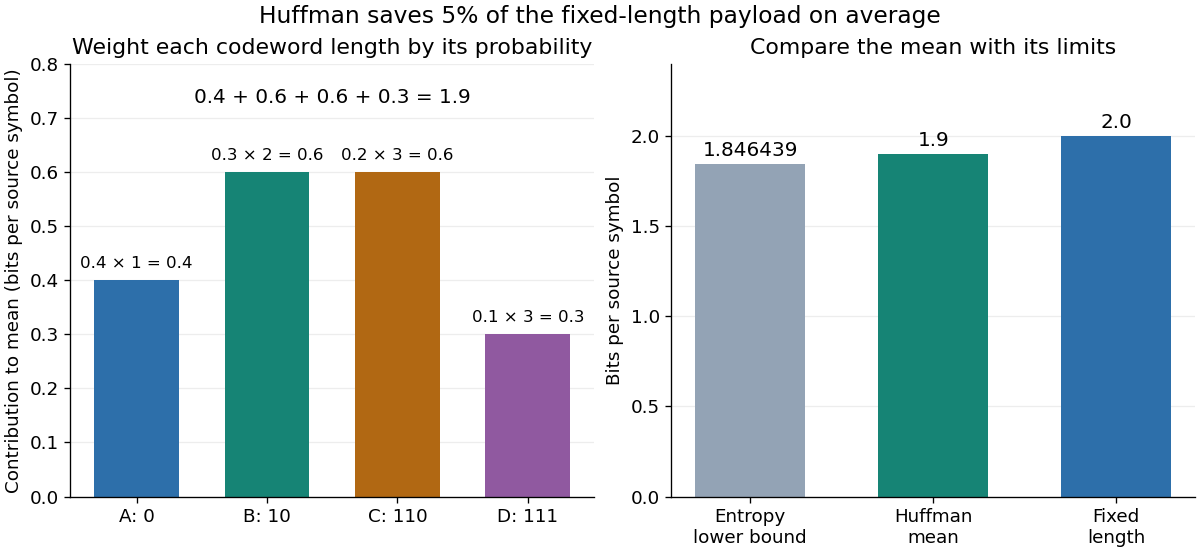
011010111 splits as 0 | 110 | 10 | 111 and decodes to . No separators are transmitted: the leaf tells the decoder where a codeword ends.The expected codeword length isbits per source symbol. Four symbols would require bits each if all codewords had the same length, so this Huffman code saves bit per symbol on average, or of that fixed-length payload. A particular message can grow: uses nine bits here instead of eight. These lengths count the encoded symbols only; transmitting a code description or message framing can add further cost.
The Kraft inequality is saturated by this Huffman code:Its Shannon entropy isbits per symbol, slightly below the expected codeword length . The entropy lower bound for prefix codes applies to every binary prefix code for this probability distribution. It need not be attainable with integer codeword lengths for individual symbols; Huffman coding reaches the best mean within that class. [ref]
https://web.iitd.ac.in/~sumeet/mackay.pdf. David J. C. MacKay, Information Theory, Inference, and Learning Algorithms, chapter 5, section 5.4: symbol-code bounds

A Huffman code need not be unique. In the first example, the tied and weights can exchange their edge labels, changing codewords but preserving their codeword lengths. Ties can also change the lengths themselves. For a second probability distribution , first merge to weight . The next merge can join with either or the subtree, since both have weight . Joining with permits , with all lengths . Joining with the subtree permits , with lengths . Both are optimal prefix codes with expected codeword length : for the latter, . Tie choices can change the code tree without changing the minimum mean.
// Target: algebra.bigb
New to topics? Read the docs here!