
Hyperbolic functions combine the exponential function to describe a hyperbola much as trigonometric functions describe a circle. Their two basic members are the hyperbolic cosine and hyperbolic sine, defined for every real number byTheir derivatives exchange the two functions:These formulas follow by applying differentiation to the exponential function definitions. [ref]
https://openstax.org/books/calculus-volume-2/pages/2-9-calculus-of-the-hyperbolic-functions. Gilbert Strang and Edwin Herman, OpenStax Calculus Volume 2, §2.9: hyperbolic definitions and derivatives
Adding and subtracting gives and . Multiplying these equalities proves the hyperbolic Pythagorean identity:Consequently the parametric equation traverses the entire right branch of the unit hyperbola , where . For example, gives , while gives approximately . Compare on the unit circle, where the squared coordinates add to one. The minus sign changes the geometry from a closed circle to an unbounded hyperbola.
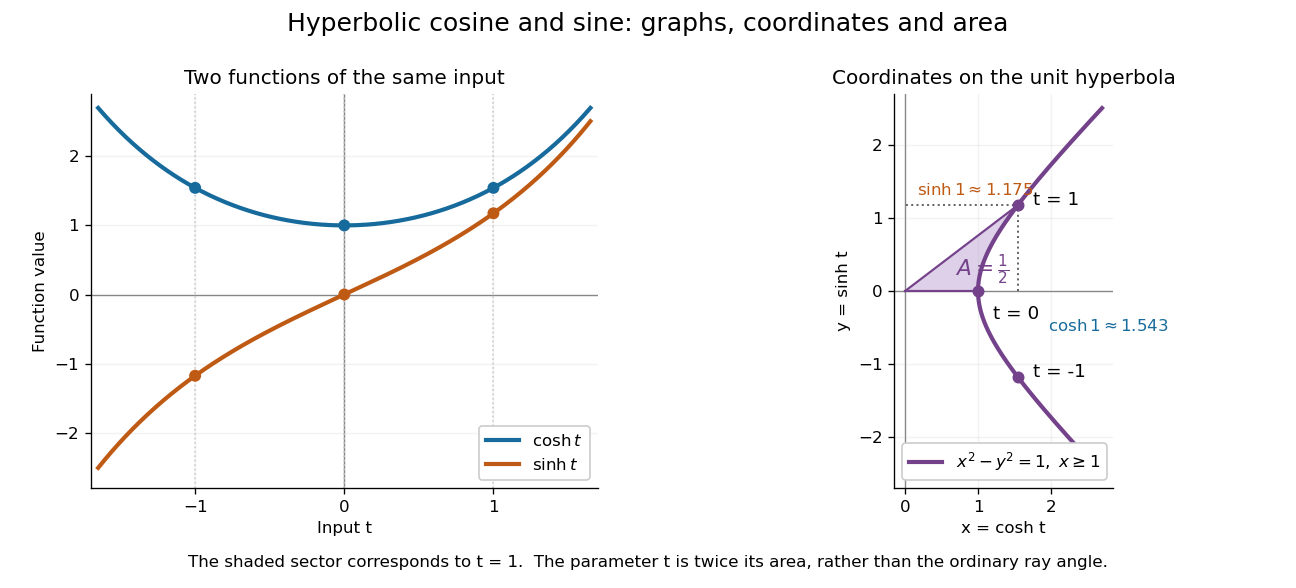

The other members are ratios and reciprocals: hyperbolic tangent is , hyperbolic cotangent is , and hyperbolic secant is ; denominators must be nonzero. The hyperbolic sine and hyperbolic cosine both solve the second-order linear differential equation . In fact has and , making this basis convenient for an initial value problem. Their geometry also makes hyperbolic substitution useful for integrals containing , and the hyperbolic cosine gives the physical catenary of a hanging chain.
New to topics? Read the docs here!