Independent spin Barnett response
ID: independent-spin-barnett-response

Consider an explicitly stipulated dilute independent spin-one-half two-level system with zero applied magnetic field. Each constituent has and , with constant signed gyromagnetic ratio . Ignore interactions and the specimen's own magnetic field. At positive temperature , thermal equilibrium with the rotating lattice gives energy levels . Define the dimensionless variable , where is the reduced Planck constant and is the Boltzmann constant. The partition function and Boltzmann distribution giveTaking the expected value giveswhere is number density. This is the rotational version of the independent-moment magnetic response. The angular momentum aligns with positive rotation even when the magnetic moment points oppositely. The probability ratio provides a direct population check of the sign.
For , expand the hyperbolic tangent to obtainThe slope against is positive for either sign of , while the slope against has the sign of . At fixed , reversing reverses both means, and gives zero. At fixed nonzero , the formal limit saturates at ; the linear approximation must not be extrapolated there. At , the response vanishes. These limits describe the toy canonical ensemble, whose equilibration is assumed.
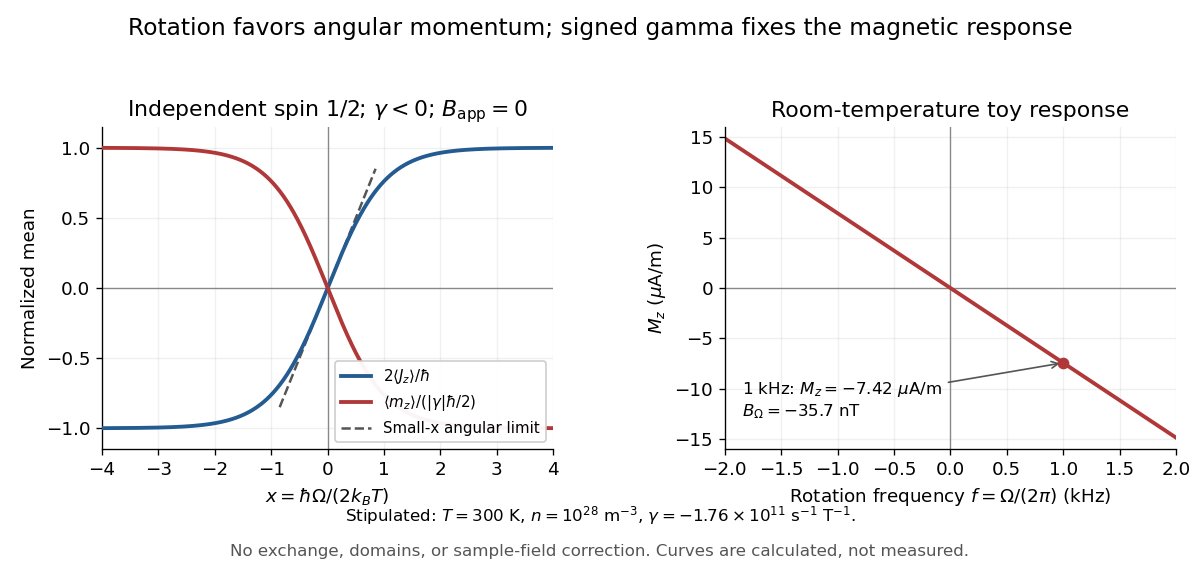

For a numerical example, stipulate , , , and rotation frequency . With , , and , the model givesThese are teaching inputs and calculated outputs, not measured material values. The corresponding internal angular momentum density is . Keeping a rotor at prescribed while its internal angular momentum changes requires the drive to supply the appropriate angular impulse. In an isolated body the mechanical part instead changes oppositely, as in magnetomechanical angular momentum balance. There is no creation of net angular momentum by choosing a rotating frame.
New to topics? Read the docs here!