The impulse of a force over a time interval is its vector integral:Its International System of Units unit is . The impulse-momentum theorem equates the net impulse to the change in momentum. For one fixed-mass point mass, integrate its net force; for a closed collection obeying Newton's third law, integrate the sum of external forces. In one dimension, the signed area under the force versus time graph gives the impulse; negative force contributes negative area. [ref]
Three stipulated rightward net force pulses illustrate the same : constant for , a triangle rising from zero to at and falling to zero at , and constant for . Their areas areApplied separately to the same fixed mass , each gives . Their peak forces differ: , , and . Thus impulse fixes the final momentum change, while the force history determines how abruptly it occurs.
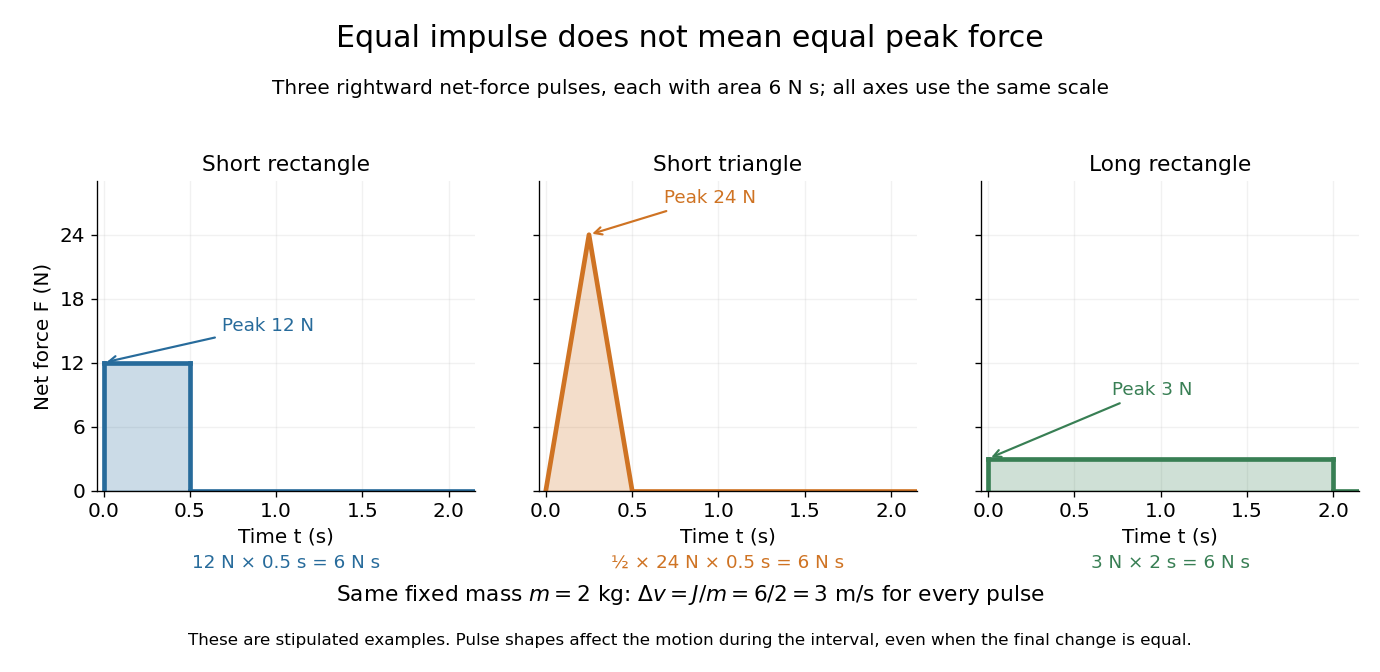

The mean net force over the chosen interval is . Extending the interval for a fixed impulse reduces this mean force. A lower peak force additionally depends on the pulse shape: the two short pulses above have the same mean but different peaks. This explains why controlling the duration and shape of a stopping impulse matters in cushioning a collision.
An impulse directed along the position vector relative to a specified origin. Its angular impulse vanishes because . It can nevertheless change kinetic energy; if an initially circular Kepler orbit receives radial velocity , the added specific orbital energy is .
A radial impulse that multiplies the initial circular kinetic energy by adds radial velocity and leaves specific angular momentum . The new specific orbital energy is , yielding orbital eccentricity and semilatus rectum . For , the apsidal radii are ; for there is no finite apocentre. A nonzero radial kick occurs away from an apsis, so the old circular radius is not automatically the new periapsis.
Integrating the closed-collection balance in momentum conservation and applying the fundamental theorem of calculus givesFor one fixed-mass point mass, this becomes . Zero external impulse implies equal initial and final total momenta; momentum conservation throughout the interval requires zero net external force throughout it.
Articles by others on the same topic
There are currently no matching articles.