
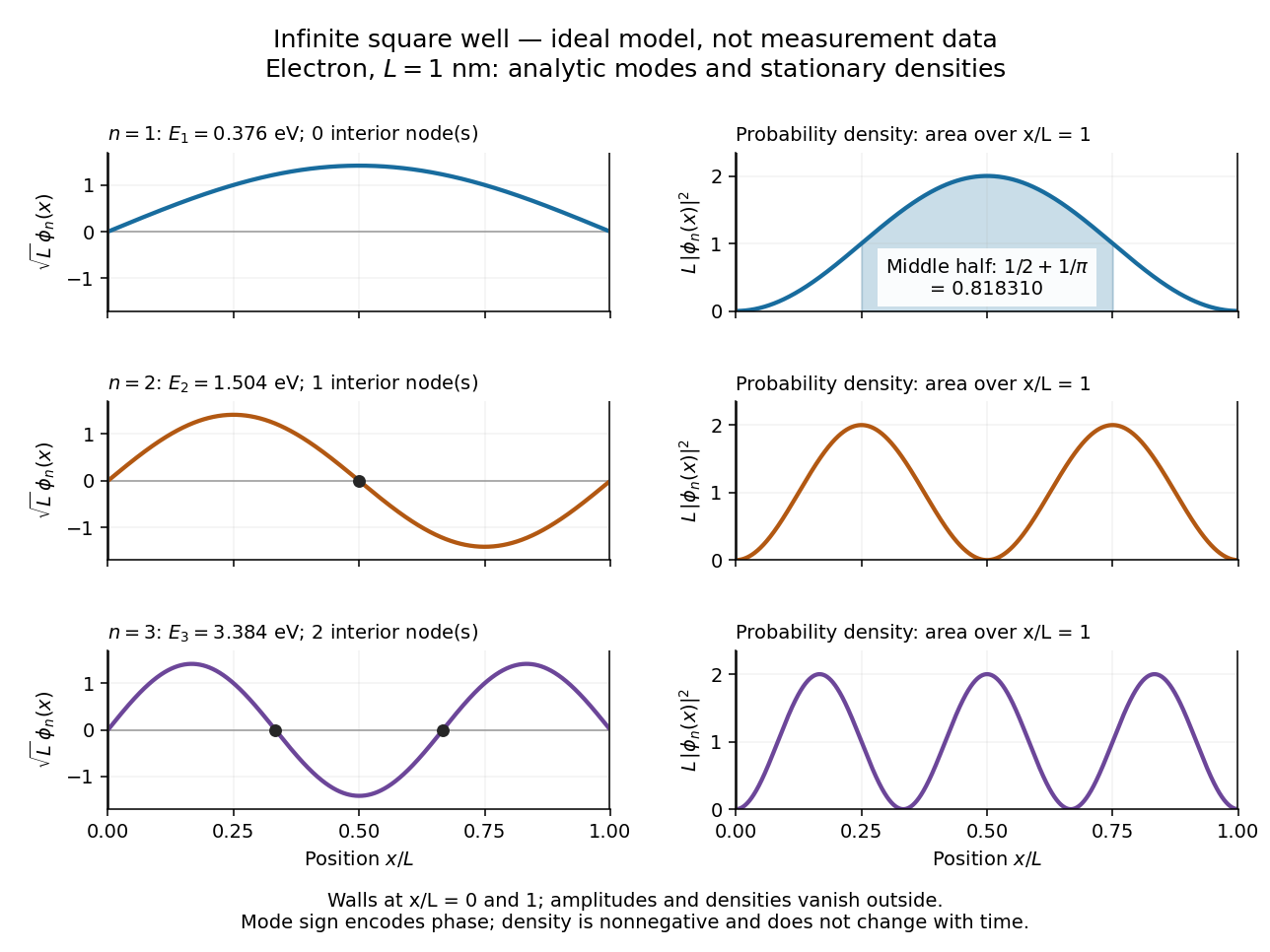
The infinite square well is an ideal confinement model with potential energy for and infinite walls outside. The walls impose Dirichlet boundary conditions and a vanishing exterior wavefunction. Inside, the time-independent Schrödinger equation isThe first wall removes the cosine term; the second requires , hence . The solution is identically zero and cannot satisfy wavefunction normalization. Each energy eigenstate has interior nodes of a standing wave, at for . More curvature costs more kinetic energy, explaining the growth. The positive ground-state energy is a confinement effect: a constant zero-energy wavefunction cannot satisfy both walls and remain normalized.
For an Electron with mass in a box of length , use and . These constants are from the 2022 CODATA adjustment. [ref]. Substitution givesDoubling quarters every energy eigenvalue; doubling halves them. This scaling makes the particle in a box useful for estimating confinement energies before attempting a more realistic calculation. A finite square well permits exterior tails for bound states and has only finitely many bound energy eigenstates. For an Electron, the scalar box calculation assumes fixed spin and no spin-dependent interactions.
For the ground state, the probability of finding the particle in the middle half of the box is fully computable:Thus half the available length contains about of the probability. The figure contrasts the signed wavefunctions with their nonnegative probability densities: a negative lobe is an amplitude with opposite quantum phase, not negative probability.
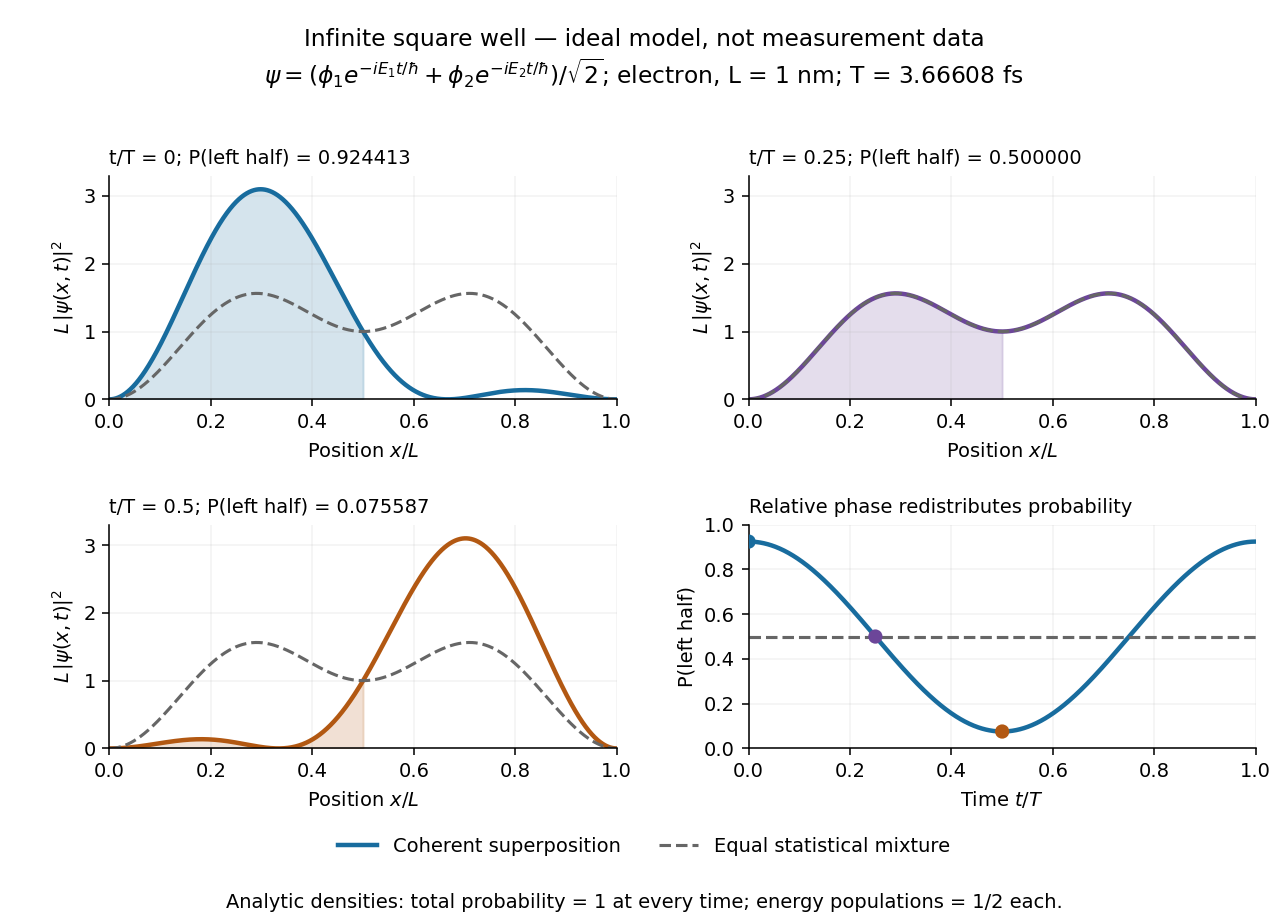
An equal quantum superposition of the first two energy eigenstates gives a simple example of moving density:Its density period is for the Electron box above. At the cross term enhances the left side; at it vanishes; at it enhances the right side. More quantitatively,which takes the values , , and at those times. Orthogonality keeps the total probability one throughout. An energy measurement still returns or with equal probabilities: changing position density arises from relative quantum phase, not changing populations. A mixed state describing a statistical mixture with those populations has the constant probability density ; it lacks this matter-wave interference term.


New to topics? Read the docs here!