
The relative displacement of a Kepler orbit sweeps equal areas about the attracting focus of a conic in equal times. A short interval near periapsis covers a wide angle at small separation; the same interval near apoapsis covers a narrow angle at large separation. The swept areas are equal even though the travelled distances are different. In particular, the sectors have curved ellipse boundaries: triangles formed by joining their endpoints only approximate the swept areas for short intervals.
Let be the relative specific angular momentum. The areal velocity isA central force exerts zero torque about its centre, so conservation of angular momentum makes this rate constant. This explanation also applies to other central forces; the ellipse shape specifically comes from Newtonian gravity.
In the , , example, specific angular momentum is , giving areal velocity . At periapsis and apoapsis, the velocity is perpendicular to the relative displacement, so . The endpoint speeds are consequentlyThe fourfold speed difference is consistent with the fourfold separation difference. Away from these endpoints, gives only the transverse component of velocity; the full speed follows from the vis-viva equation.
To actually place equal-time markers, use Kepler's equation. Write mean anomaly as , with at periapsis and mean motion . The different symbol avoids confusing this angle with the mass . Solve for eccentric anomaly in radians, then compute the relative position:This timing procedure is explained in NASA educational archive, How Orbital Motion is Calculated.
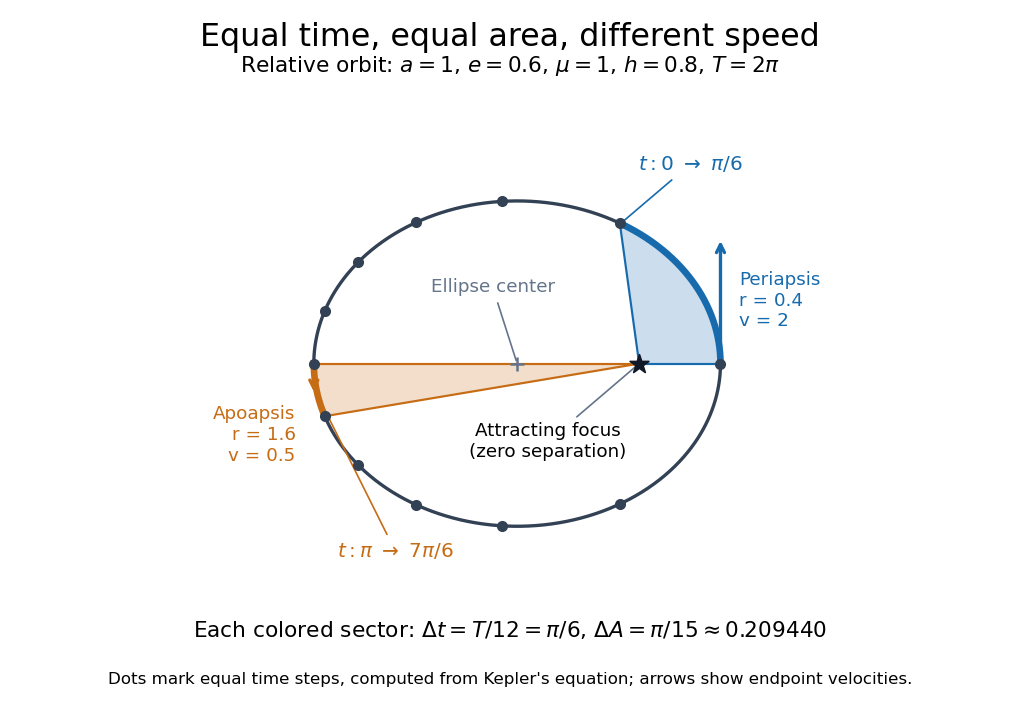

For the first interval , the final eccentric anomaly is . For the equal interval starting at apoapsis, it ends at . Both swept areas are , one twelfth of the entire ellipse's area . The diagram computes its markers from Kepler's equation, making visible how uniform time steps become uneven spatial steps.
New to topics? Read the docs here!