
For a nonnegative measurable function on a measure space, defineThe supremum may be infinite. A simple function assigns finitely many heights to measurable sets, so its integral is height times measure, summed over those pieces. This definition groups points by their values rather than requiring a partition into short intervals. See MIT lecture 11, Definition 108.
A real-valued function is Lebesgue integrable when . Its integral is , where is its positive part and . This finiteness requirement avoids subtracting two infinities. For functions taking values in the complex numbers, integrate the real part and imaginary part separately.
Consider the Dirichlet function on . It is a simple function, andIts Riemann integral does not exist. For every partition of an interval , each nondegenerate contains both rational numbers and irrational numbers, by their respective density of the rational numbers and density of the irrational numbers. Thus its infimum there is and its supremum is . The lower Darboux sum is , whereas the upper Darboux sum is . Refinement never closes this gap. A finite scatterplot cannot represent this behavior: the assertion concerns every subinterval and every partition of an interval.
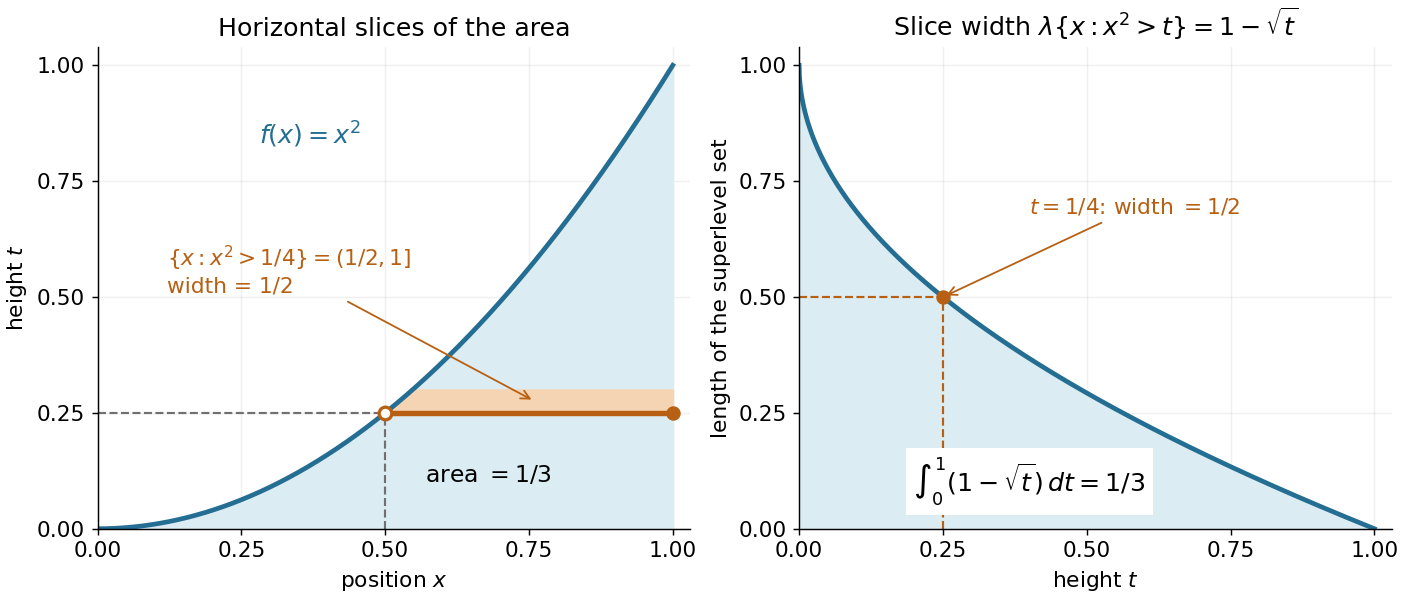
Another view builds the Lebesgue integral from horizontal layers. For any nonnegative measurable function, the layer cake representation statesBoth sides may be infinite. The right side integrates the measure of a superlevel set against Lebesgue measure in the height variable . See Gautam Iyer's measure theory notes, Theorem 9.5.
For on with Lebesgue measure, the superlevel set at is , of Lebesgue measure ; for it is empty. ConsequentlyAt height , the layer extends from to , a width of . The picture shows why the same area can be accumulated vertically or horizontally. In a probability space, the identical formula expresses the expected value of a nonnegative random variable through its exceedance probabilities.
A proof outline avoids extra assumptions on the measure space. For a nonnegative simple function with disjoint measurable sets , the superlevel set has measure . Integrating this finite sum gives . Next use approximation by nonnegative simple functions . For every , the superlevel sets increase to . Continuity from below of a measure and the monotone convergence theorem on the height variable give the formula for .


"More complex and general" integral. Matches the Riemann integral for "simple functions", but also works for some "funkier" functions that Riemann does not work for.
Ciro Santilli sometimes wonders how much someone can gain from learning this besides the beauty of mathematics, since we can hand-wave a Lebesgue integral on almost anything that is of practical use. The beauty is good reason enough though.
New to topics? Read the docs here!