Lyapunov moment inequality
ID: lyapunov-moment-inequality

The Lyapunov moment inequality says that higher positive absolute moments give no smaller absolute moment sizes on a probability space. For a real random variable and ,allowing an infinite value. For the left expression is an Lp norm; below one it is a quasi-norm, so the usual triangle inequality terminology needs that distinction. The comparison uses a probability measure of total mass one; arbitrary unnormalized measure spaces need a factor depending on their total mass.
For a nonnegative count, the first moment size is its expected value, while the second is the square root of its second moment. Both ten-trial counts in second moment method have first moment size one. The independent count has second moment size , whereas the shared-outcome count has second moment size . The second moment distinguishes models with the same average because its square increases the influence of rare large counts.
More generally, for with a Bernoulli random variable of parameter ,It rises from one at toward ten as . Replacing by a parameter gives , which decreases toward zero for a fixed positive exponent when , making the rare-event and large-exponent limits different questions. For a scaled Rademacher random variable taking values and two with equal probabilities, every absolute moment size is exactly two: increasing the exponent does not distinguish signs when the absolute value is constant.
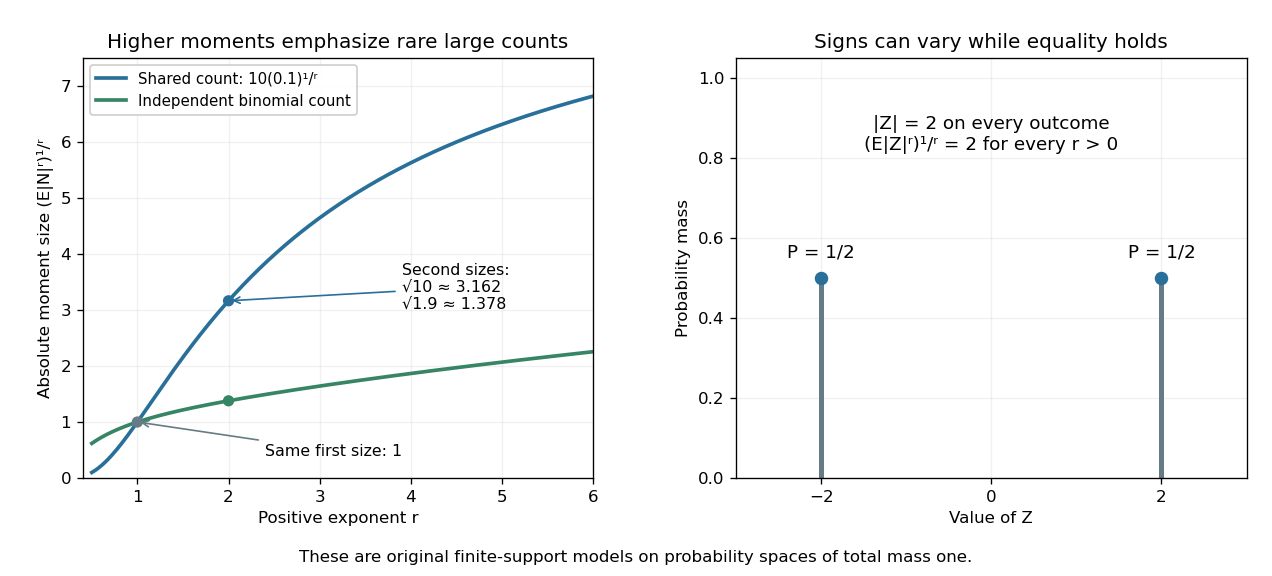
Lyapunov moment inequality reveals how higher moments emphasize large outcomes and when equality holds
. Left: the two original ten-trial models from second moment method have the same mean one, but different absolute moment sizes at exponents above one. The shared model has with . Right: equal masses at and two keep almost surely, giving equality for every pair of positive exponents. These are fully specified mathematical probability models. Details.
For finite , apply the reversed Jensen's inequality to the strictly concave function and the nonnegative random variable :Taking the positive th root proves the claim. Equality in this finite case holds exactly when is constant almost surely. If the higher moment is infinite, the upper bound is infinite and remains valid. Exponent zero is excluded from the statement; logarithmic or geometric limiting summaries require separately stated conventions, especially when can vanish.
New to topics? Read the docs here!