Morphogen response threshold
ID: morphogen-response-threshold

A morphogen response threshold is a concentration level used to distinguish developmental responses to a morphogen. In an idealized threshold model, otherwise equivalent biological cells exposed to take one response and those exposed to take another. Two morphogen response thresholds can assign three bands: fate A for , fate B for , and fate C for , all in the toy arbitrary concentration units. The A/B/C labels specify a response rule, not named cell types or a claim that every morphogen produces sharp boundaries. See the positional-information model in Gilbert's reference under morphogen.
For the decreasing morphogen gradient and , solve using the natural logarithm:With and diffusion length , the morphogen response thresholds and giveThus fate A occupies , fate B occupies , and fate C occupies in this idealization. The equality convention belongs to the response rule. If , the crossing is at the source; if , that morphogen response threshold is never reached anywhere in the tissue.
Now double the prescribed source concentration from to , keeping , , diffusion length and a fixed morphogen response threshold unchanged. The whole morphogen gradient doubles, but the boundary moves by an additive distance:For , the crossing moves from to , a shift of . Every fixed morphogen response threshold below the original source concentration shifts by this same distance in the toy model. The example compares two Dirichlet boundary conditions, and ; doubling an experimentally supplied source flux is a different boundary specification.
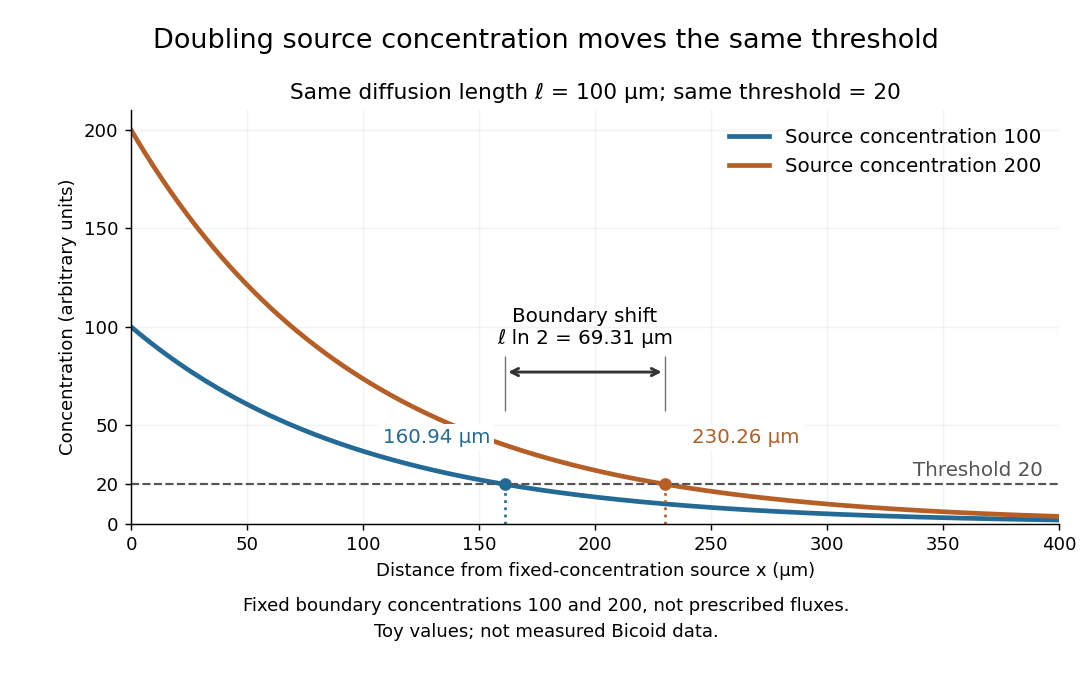

These calculations are useful because they separate changes in source concentration, diffusion length and response rule. Their limits are equally concrete: growing tissues change the geometry, a transient response can precede steady state, molecular fluctuations can blur a boundary, and signaling feedback or altered transport can change the morphogen gradient or its interpretation. A local instantaneous morphogen response threshold need not capture exposure duration, signaling adaptation or the receiving biological cell's state. Experiments on cultured human biological cells found different responses to the level and rate of change of developmental signals, illustrating why signal dynamics can matter. [ref]
https://pmc.ncbi.nlm.nih.gov/articles/PMC6398983/. Heemskerk et al., Rapid changes in morphogen concentration control self-organized patterning in human embryonic stem cells, eLife 8 (2019), e40526: primary experiments
Quantitative measurements of bicoid protein and its downstream gene expression also make precision a question for experiment, rather than something guaranteed by drawing threshold lines. [ref]https://pmc.ncbi.nlm.nih.gov/articles/PMC2253670/. Gregor et al., Probing the limits to positional information, Cell 130 (2007), 153–164: primary measurements
Morphogen gradients provide one mechanism for spatial patterning in biological development, alongside other signals and interactions. New to topics? Read the docs here!