Signaling feedback returns the effect of a downstream event to an earlier stage of signal transduction, closing a loop analogous to feedback control. Trace the causal arrows: if an earlier relay activates a later relay and the later relay changes the earlier relay's activity, the return path closes the loop. Negative feedback opposes the initiating change; positive feedback reinforces it. Signaling feedback is a possible property of signal transduction, not a requirement of every pathway.
For a schematic example, let relay activate relay . If inhibits , increased eventually produces an opposing influence: negative feedback. If activates , increased produces a reinforcing influence: positive feedback. These signs describe effects on activity, rather than the direction in which molecules travel. A closed loop containing two inhibitions can have positive feedback, because inhibiting an inhibitor reinforces the original change. The sign belongs to the whole loop.
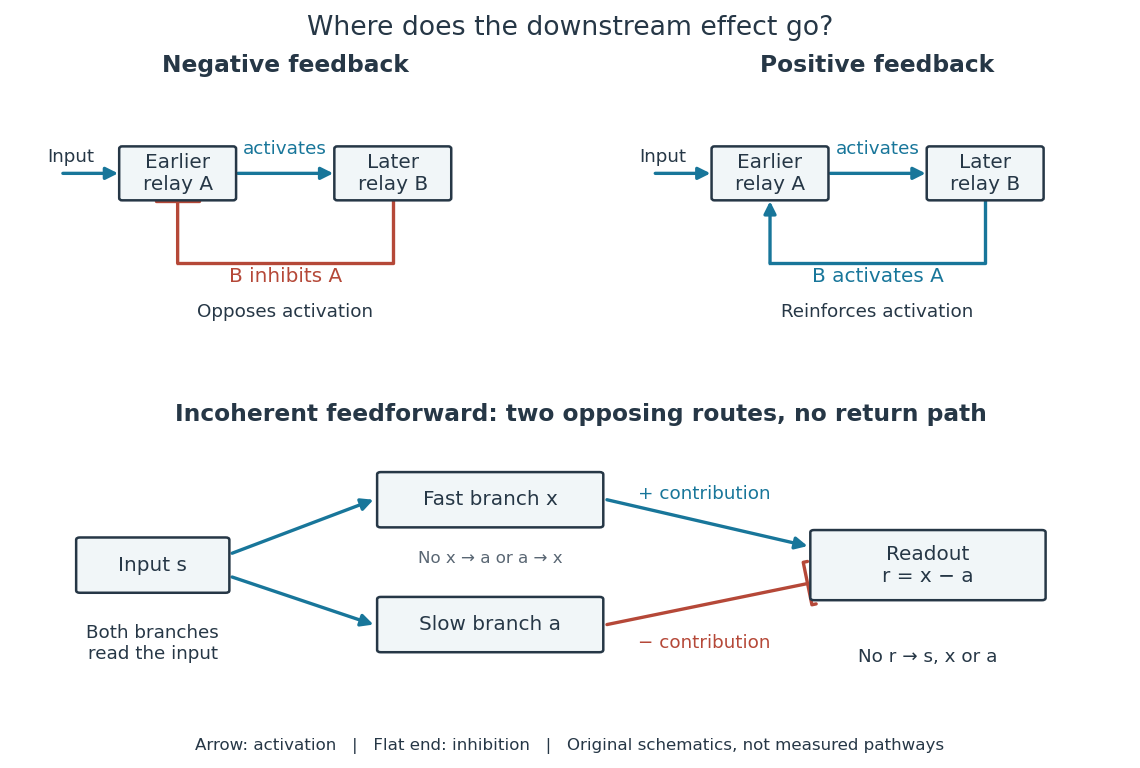

Negative feedback can restrain excessive activation and help preserve a usable range of responses. Positive feedback can support a decisive transition: Alberts and colleagues describe an enzyme whose product increases its own activity. Such reinforcement can contribute to switchlike behavior, but a positive feedback arrow alone does not prove bistability. A different structure, an incoherent feedforward loop, sends opposing influences forward from the same input; inhibition there is not a downstream return. [ref] [ref]
https://cqb.pku.edu.cn/tanglab/pdf/78.pdf. Ma et al., Defining Network Topologies that Can Achieve Biochemical Adaptation, Cell 138 (2009), pp. 760–773: definitions on p. 764
A worked mathematical model shows why negative feedback does not automatically produce complete signaling adaptation. Let be a fixed normalized input, a normalized response, a dimensionless feedback gain, and a time constant. Suppose response removal contributes and a return proportional to the response contributes . The ordinary differential equation isSetting the derivative to zero gives the equilibrium point . A displacement obeys , so its decaying exponential function establishes asymptotic stability. For a unit input switched on at , initial condition , and second,The negative feedback reduces the eventual response from to , but this response rises monotonically and never returns to its zero baseline. Attenuation and complete signaling adaptation are different properties. This deliberately simple mathematical model specifies no molecular pathway; integral action provides a contrasting way to remove a lasting offset in a stable feedback control system. [ref]
https://www.fbswiki.org/wiki/index.php/Feedback_Principles. Åström and Murray, Feedback Systems, Chapter 2: proportional and integral feedback
Articles by others on the same topic
There are currently no matching articles.