Mössbauer velocity scan
ID: mossbauer-velocity-scan

Let be the source velocity towards the absorber, positive for approach along the photon direction. A first-order Lorentz transformation of the photon energy gives ; hence, for ,Moving the source shifts its emission line through the stationary absorption line. A minimum in transmitted photon counts marks their strongest overlap. The absorber is the narrow energy discriminator; the downstream particle detector only needs to count the transmitted gamma rays.
For a thin absorber with unsplit Lorentzian line shapes, the overlap is a convolution of the source and absorber profiles. The combined full width at half maximum is . A simple expected transmission model isHere is the off-resonance intensity, encodes a relative shift of the two transition energies, and includes the resonant absorber strength and . The convolution result can be checked by multiplying the Fourier transforms of two Cauchy distributions: their exponential decay constants add. The width of the absorption dip in velocity is , rather than the width of one individual spectral line converted to velocity.
For the teaching system with and , the dip's full width at half maximum is . Stipulate at zero temperature and expected off-resonance counts per equal-duration bin: the central bin then has expected counts, and the half-depth bins have . These are model expectations, without sampled counting noise. Holding all other parameters fixed while heating both lattices to multiplies by . This isolates how a falling recoil-free fraction weakens the dip.
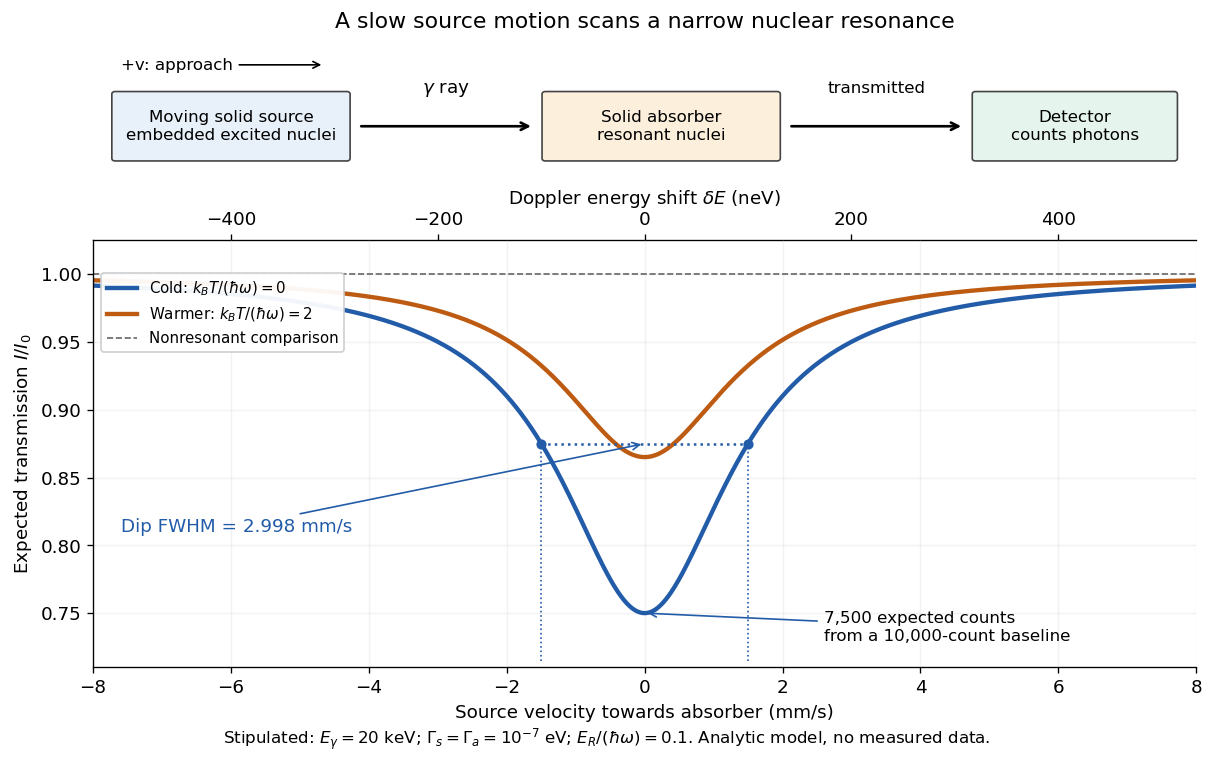
Mechanical velocity scans an absorption line much narrower than detector resolution
. Original ideal transmission model, with schematic source, absorber and counting detector. Both curves use the same stipulated energy widths; heating changes only . Dashed markers show the cold curve's half-depth positions. This is a new analytic teaching scan, not a historical measurement or a fit. The upper scale converts velocity to Doppler effect energy shift. Details.
The thin-absorber model is deliberately limited. A thick absorber can saturate and broaden the dip; unresolved hyperfine structure can create multiple components. Differences in chemical surroundings can shift the centers, and uncontrolled motion can smear them. These effects must be modeled before interpreting an observed width as a natural linewidth. Their sensitivity also makes the Mössbauer effect useful: a small displacement of a narrow dip can reveal a small change in the local nuclear environment.
New to topics? Read the docs here!