A nucleus bound in a solid can emit or absorb a photon without exciting lattice vibrations, transferring momentum to the solid as a whole. The resulting recoil energy is negligible compared with the isolated-nucleus recoil, making very narrow resonant emission and absorption lines observable. The Pound-Rebka experiment uses this effect to resolve the small frequency shift from gravitational redshift.
The striking feature is the combination of a large photon energy and a tiny natural linewidth: an atomic nucleus can act as an extraordinarily selective energy filter. The Mössbauer effect supplies a narrow shared emission line and absorption line even when nuclear recoil would separate the corresponding free-nucleus lines. A slow mechanical motion can then tune their overlap through the Doppler effect. The Pound-Rebka experiment is an application to general relativity; the discovery experiment below concerns the recoil-free process itself.
A recoil-free nuclear transition emits or absorbs a gamma ray while leaving the internal vibrational state of the surrounding solid unchanged. It belongs to the elastic part of the process: no phonon is created or destroyed. The photon still carries momentum , where is the speed of light. The emitting solid takes momentum ; the absorbing solid takes . Conservation of momentum holds for each event.
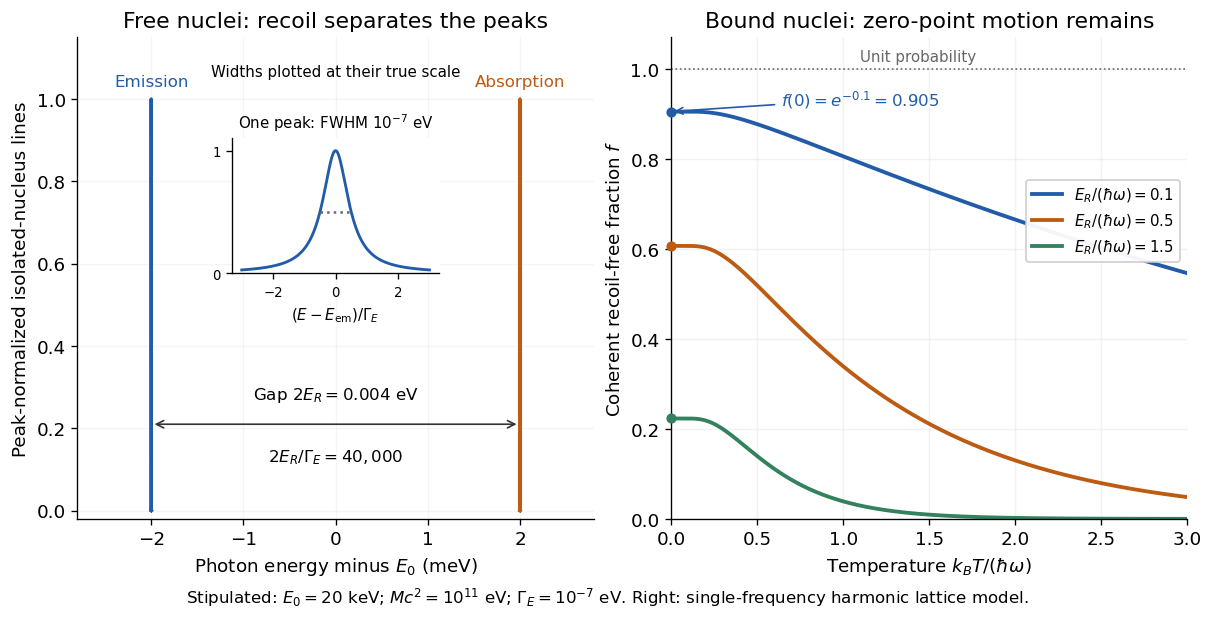
Why does an isolated atomic nucleus pose a problem? Start with an excited state at rest and let be its transition energy, with nuclear mass and . Conservation of momentum gives a recoil momentum of magnitude ; its nonrelativistic kinetic energy is thereforeBy conservation of energy, emission spends part of on nuclear recoil, whereas absorption must supply both and the final kinetic energy. To leading order,Thus the relevant comparison is against the overlapping spectral line widths, rather than alone. If greatly exceeds the widths, the isolated-nucleus lines have negligible overlap. Finite Lorentzian line shape tails mean that this is suppression, rather than an absolute prohibition on absorption.
For a bound atomic nucleus, the recoil-free channel transfers momentum to the center of mass of the emitting or absorbing solid, with negligible kinetic energy . Other channels exchange phonons and carry substantial energy into or out of the internal vibrations. A large makes the elastic channel's energy cost small; the vibrational quantum state determines its probability. Merely replacing by a large mass in the free-particle formula does not calculate that probability.
Here is a deliberately stipulated teaching system, independent of historical isotope data: , , and a single-line natural linewidth measured as an energy full width at half maximum. These give and . A solid of such nuclear masses has elastic recoil energy , far below . In this article is an energy width; the corresponding lifetime is , with the Planck constant divided by .
The Lamb-Mössbauer factor is the fraction in the coherent elastic line. In the harmonic-lattice approximation it is a Debye–Waller factor. Write the displacement of the emitting or absorbing atomic nucleus relative to its equilibrium site as , put , and define the angular wavenumber . Choose the equilibrium site so that . Its directional displacement variance is . A harmonic solid in thermal equilibrium has a Gaussian distribution for this displacement, whose characteristic function gives the elastic amplitudeTaking the squared magnitude gives the intensity fractionThe factor belongs to the amplitude exponent; it disappears when the amplitude is squared. For an isotropic solid, , so an equivalent expression is . Directional and three-dimensional mean squared displacements must not be substituted for one another without this factor.
An Einstein solid approximation replaces the vibrational spectrum by one positive angular frequency . For the directional quantum harmonic oscillator, with the same effective mass as in ,Here is the Boltzmann constant and is temperature. This follows by taking the expected value of in each oscillator energy eigenstate, , and averaging with the Boltzmann distribution. Substitution givesThe zero-temperature limit retains zero-point energy and a nonzero displacement variance. Cooling therefore increases the recoil-free fraction towards a limit below one for finite . At high temperature, the exponent tends to . This is a single-frequency approximation to a harmonic lattice's coherent elastic weight, not a complete description of all zero-net-energy processes of an isolated oscillator. Real vibrational spectra, directional binding and anharmonic motion can change its predictions.
Extend the stipulated teaching system by choosing , so . Then , while at . If source and absorber are independent, the fraction of events eligible for recoil-free emission followed by recoil-free absorption contains the product ; this gives for two zero-temperature copies. It is not the total probability of absorption, which also depends on the number of resonant atomic nuclei, geometry and spectral line overlap.
Let be the source velocity towards the absorber, positive for approach along the photon direction. A first-order Lorentz transformation of the photon energy gives ; hence, for ,Moving the source shifts its emission line through the stationary absorption line. A minimum in transmitted photon counts marks their strongest overlap. The absorber is the narrow energy discriminator; the downstream particle detector only needs to count the transmitted gamma rays.
For a thin absorber with unsplit Lorentzian line shapes, the overlap is a convolution of the source and absorber profiles. The combined full width at half maximum is . A simple expected transmission model isHere is the off-resonance intensity, encodes a relative shift of the two transition energies, and includes the resonant absorber strength and . The convolution result can be checked by multiplying the Fourier transforms of two Cauchy distributions: their exponential decay constants add. The width of the absorption dip in velocity is , rather than the width of one individual spectral line converted to velocity.
For the teaching system with and , the dip's full width at half maximum is . Stipulate at zero temperature and expected off-resonance counts per equal-duration bin: the central bin then has expected counts, and the half-depth bins have . These are model expectations, without sampled counting noise. Holding all other parameters fixed while heating both lattices to multiplies by . This isolates how a falling recoil-free fraction weakens the dip.
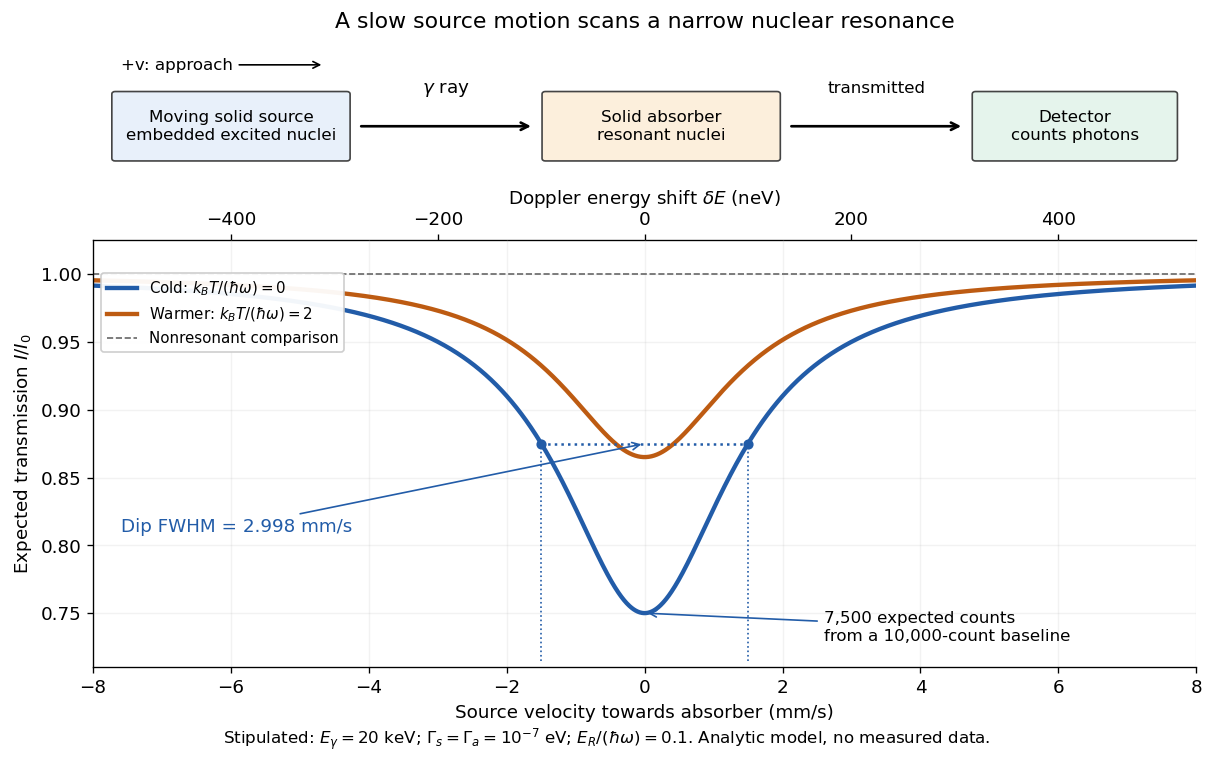
Mechanical velocity scans an absorption line much narrower than detector resolution
. Original ideal transmission model, with schematic source, absorber and counting detector. Both curves use the same stipulated energy widths; heating changes only . Dashed markers show the cold curve's half-depth positions. This is a new analytic teaching scan, not a historical measurement or a fit. The upper scale converts velocity to Doppler effect energy shift. Details.The thin-absorber model is deliberately limited. A thick absorber can saturate and broaden the dip; unresolved hyperfine structure can create multiple components. Differences in chemical surroundings can shift the centers, and uncontrolled motion can smear them. These effects must be modeled before interpreting an observed width as a natural linewidth. Their sensitivity also makes the Mössbauer effect useful: a small displacement of a narrow dip can reveal a small change in the local nuclear environment.
Rudolf Ludwig Mössbauer found the effect during his Heidelberg work in 1957.[ref]
Rudolf Ludwig Mössbauer, CV by Lindau Nobel Laureate Meetings. CV, opening paragraphs: Heidelberg discovery in 1957
His 1961 lecture Recoilless nuclear resonance absorption of gamma radiation describes crystalline preparations using the transition of the iridium isotope . Separate cryostats, lead collimation and a particle scintillation detector measured transmission. Liquid-air cooling of both preparations enhanced absorption; cooling only the source against a room-temperature absorber slightly reduced it. A rotating source cryostat supplied nearly constant projected velocities over selected arcs. Centimetres per second suppressed absorption relative to zero velocity; a nonresonant absorber supplied the comparison. This tested a narrow common emission/absorption energy beyond the detector's resolution. Temperature data alone had not established its width. The lecture cites the initial and direct-verification publications from 1958.[ref]

