Neutrino directional-coincidence model
ID: neutrino-directional-coincidence-model

How much does a small directional uncertainty help? Consider an original idealized model: a source direction fixed in advance, uniform background directions over the full sphere, and circular acceptance radius . The accepted solid angle and single-event background probability areThe derivation integrates the area element on a unit sphere. For small in radians, : halving the radius quarters the accidental acceptance, to leading order. At acceptance vanishes; at it covers the full sphere. The solid angle has units of steradians; is dimensionless.
For , take a deliberately crude point spread function: stipulate that every signal direction lies uniformly inside that cap. The signal and background probability density functions per steradian are inside the cap and zero outside, and everywhere. Both integrate to one. For an event inside the cap their likelihood ratio isThis ratio compares two specified directional models; it is not the probability that the event came from the source. Such a conditional probability would additionally require prior source odds and the other selection information. For fixed source fraction among selected events, a normalized mixture distribution has density . For independent events the likelihood is the product of those densities; its ratio to background alone isOutside-cap events contribute factors rather than being silently discarded. At , ; for a full-sky cap, and every gives . A directional model that cannot distinguish source from background carries no directional evidence.
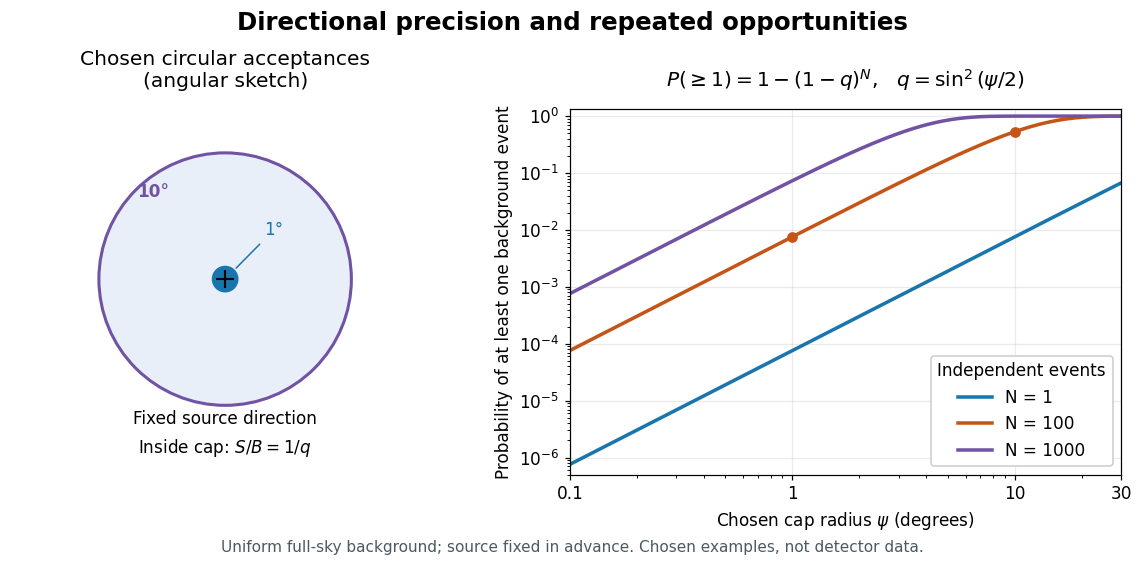
Chosen angular acceptance, directional likelihood and repeated background opportunities
. Original exact spherical-cap calculation and uniform-cap signal model. Radii and event counts are chosen illustrations, not IceCube angular resolutions or discovery data. The fixed source direction and independent uniform background assumptions are essential. Details.
As an original numerical example, radii and give and , respectively: nearly a hundredfold difference. For a fixed number of independent background events, the binomial distribution givesWith chosen , those radii give approximately and . A small single-event acceptance can become a common coincidence after many opportunities. This probability concerns a fixed cap, rather than a scan for the most favorable cap anywhere. For independent searches with common local tail probability , the corresponding global tail probability is ; overlapping sky searches generally violate that independence. Actual source tests must include directional response, nonuniform exposure, energy information and the look-elsewhere effect in their null calibration.
New to topics? Read the docs here!