
Ordinary kriging assumes for an unknown constant . A predictor has zero bias for every precisely when , where is the all-ones vector. Ordinary kriging minimizes the error variance subject to this constraint, giving the best linear unbiased predictor. Its explicit system isThe sign of the last term follows from the displayed convention . To derive the system, differentiate . To prove the minimum, let solve it and let be another feasible choice. Then , soA positive-definite matrix makes equality possible only for . This argument uses second moments, not a normal distribution assumption. Ordinary kriging is the special case of universal kriging with and .
For an original one-dimensional teaching example, observe at , and predict at . Choose unit marginal variance, exact observations without measurement noise, an unknown constant mean, and the exponential covariance functionThe exponential covariance function corresponds to a stationary Ornstein-Uhlenbeck process, so it gives a valid covariance model. Its semivariogram is . The resulting matrix and vector areSolving the displayed system givesThese values can be checked directly: the weights sum to one and . Substitution into gives . Nearest-neighbor interpolation must choose between the two equally close samples at one and three, returning either three or two; their error variances under this model are both . Thus the benefit is quantified under the chosen model, without knowing the unobserved target value.
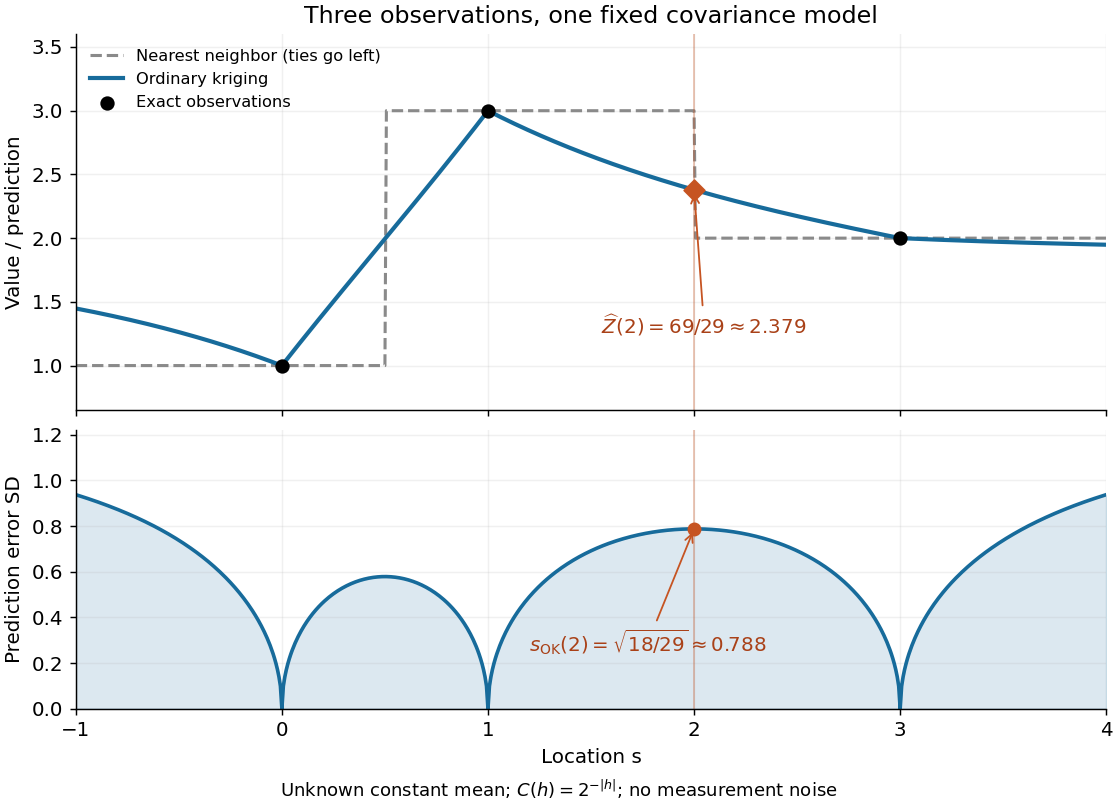
Ordinary kriging combines three samples and reports uncertainty under a fixed exponential covariance model
. Details. The upper panel applies the same ordinary kriging calculation at each target location. The lower panel shows the square root of its error variance, in the units of the observations. It is zero at the exact observation locations and rises between and beyond them. No confidence interval is inferred from a variance alone; a probability distribution assumption is needed to attach a coverage level.
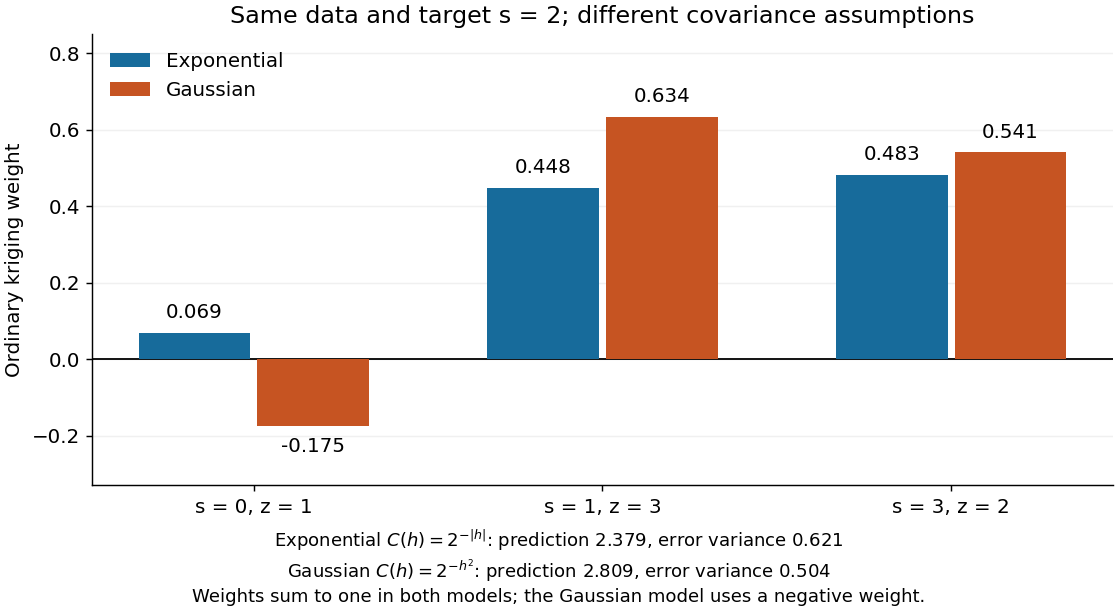
The weights are not required to be positive. Keep the same observations and target, but replace the covariogram by the smoother Gaussian kernel . ThenThe negative coefficient compensates for dependence between samples; the constraint eliminating bias still holds. Kriging is not generally a convex combination, and its prediction need not stay between the observed values. A smaller model-based error variance does not establish that one covariance function is better supported by these three observations.


New to topics? Read the docs here!