Parallel first-order reaction mechanism
ID: parallel-first-order-reaction-mechanism

A parallel first-order reaction mechanism consumes the same reactant through competing routes. Extend the product-split idea in catalytic selectivity by following both reaction products over time. Stipulate irreversible first-order reactions and in a uniformly mixed closed system of fixed volume and temperature. Initially only A is present, with concentration . With ,Here abbreviates a sum of rate constants, not an equilibrium constant. The rate equations are , , and . Integrating the last two after solving the first proves the expressions and their conserved total .
Choose two alternative models: model U has ; model V has . Both have , so every measurement of A alone is identical, even with no measurement error. Yet their P-to-Q concentration ratios at any are and , respectively. This is a precise failure of identifiability from that one observable. A calibrated measurement distinguishing P from Q resolves it within the stipulated two-route model.
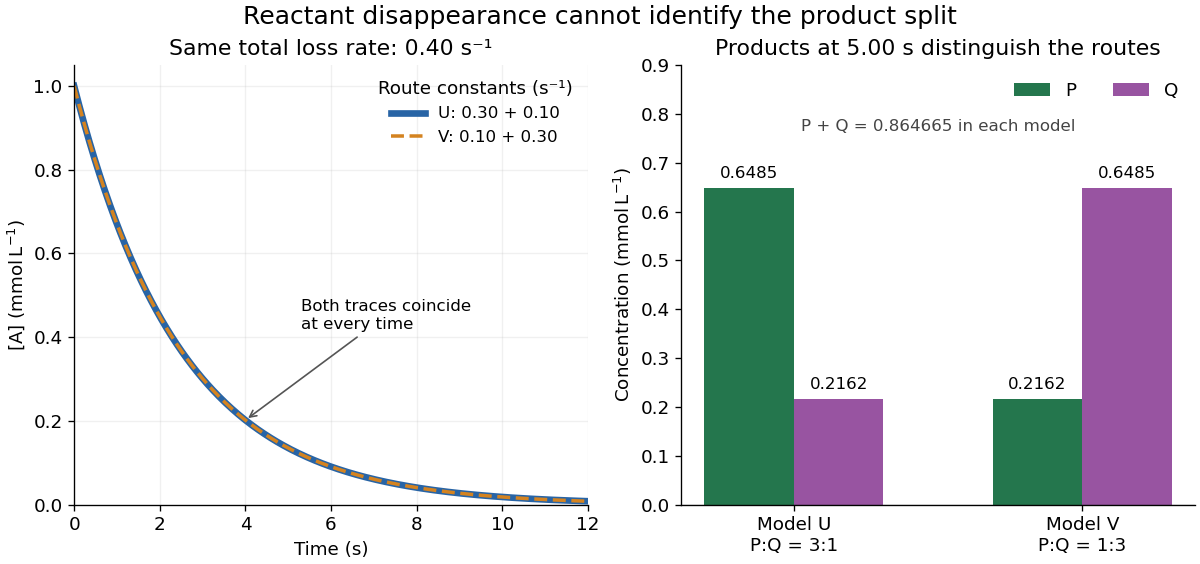

At , both models give . Model U gives ; model V exchanges these. Measuring only the summed reaction product concentration would also fail to distinguish them. Product-specific observations therefore answer a question that total conversion cannot. As with any reaction mechanism, fitting these observables still does not rule out a more elaborate untested route.
New to topics? Read the docs here!