Solution
ID: past-exam-of-the-astrophysical-fluid-dynamics-course-of-the-university-of-cambridge/2021/section-b/4/d/solution
Past exam of the astrophysical fluid dynamics course of the University of Cambridge 2021 Section B 4 d Solution by  Codex 0 2026-10-18
Codex 0 2026-10-18Rewrite the relation from part (c) asThe angle-addition identities reduce this toFor , the right side lies strictly between zero and one. There are two physically admissible strong oblique-shock angle branches:Both lie between and . They merge when , proving the maximum deflection through a strong perfect-gas shock,For small positive , the formal strong-shock-limit asymptotics areThe weak branch is normally observed for an unconfined supersonic stream turning through a modest compression corner. It has a smaller normal component of upstream velocity, hence a smaller downstream pressure increase; for small turns the downstream flow remains supersonic. The nearly normal strong branch can be selected by suitable downstream pressure conditions, so it is not mathematically forbidden.
The two limits must be ordered honestly. At finite , the weak oblique shock approaches the Mach angle as , rather than zero. The displayed weak-branch asymptotic applies when the large- limit is taken first, or in the overlapping range , where remains valid.
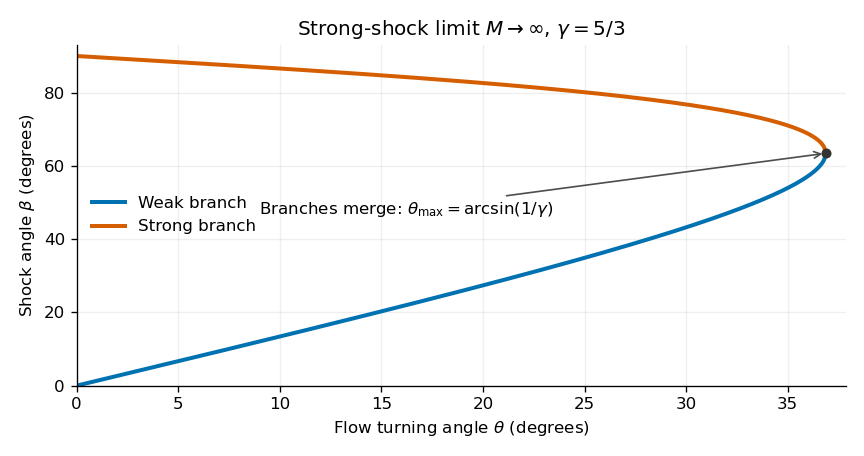
Calculated weak and strong shock-angle branches in the infinite-Mach-number limit, for a monatomic gas
. Details. 
New to topics? Read the docs here!