An oblique shock is inclined relative to the upstream velocity. In an inviscid perfect gas, the normal velocity satisfies the normal-shock jump conditions while the tangential velocity is continuous.
Measure shock angle from the incident flow to the shock front, and deflection towards it. The strong normal-compression ratio and continuity of tangential velocity give . Angle-addition identities reduce this to . The two title branches exist for and merge at . As , their formal limits are and . The weak-branch expansion requires ; at finite Mach number its true zero-deflection limit is the Mach angle.
A shock polar is the locus of possible downstream velocity vectors, or an equivalent pressure/deflection relation, as the orientation of an oblique shock varies for fixed upstream conditions. Entropy admissibility selects physical compressive shocks. The strong-shock perfect-gas velocity polar is a circle, while finite-Mach polars have a different shape.
The normal velocity is reduced by in the strong-shock limit while tangential velocity is unchanged. If the upstream speed is and the shock normal makes angle with its direction, then and . Eliminating the angle gives the displayed circle, centered at with radius . It is the limiting shock polar in downstream velocity space.
For the circle with center distance and radius , the most deflected ray from the origin is tangent. The right triangle formed by the origin, center and tangency point gives . This is a velocity-vector deflection angle, not the angle of the shock normal.
If with and the upstream Mach number is , the shock angle is the Mach angle to leading order and the flow deflection isThe normal speed decreases, so the downstream flow turns toward the shock front.
The Mach angle of a supersonic flow with Mach number is . Infinitesimal pressure disturbances lie on the corresponding Mach cone, and a weak oblique shock approaches this angle as its strength tends to zero.
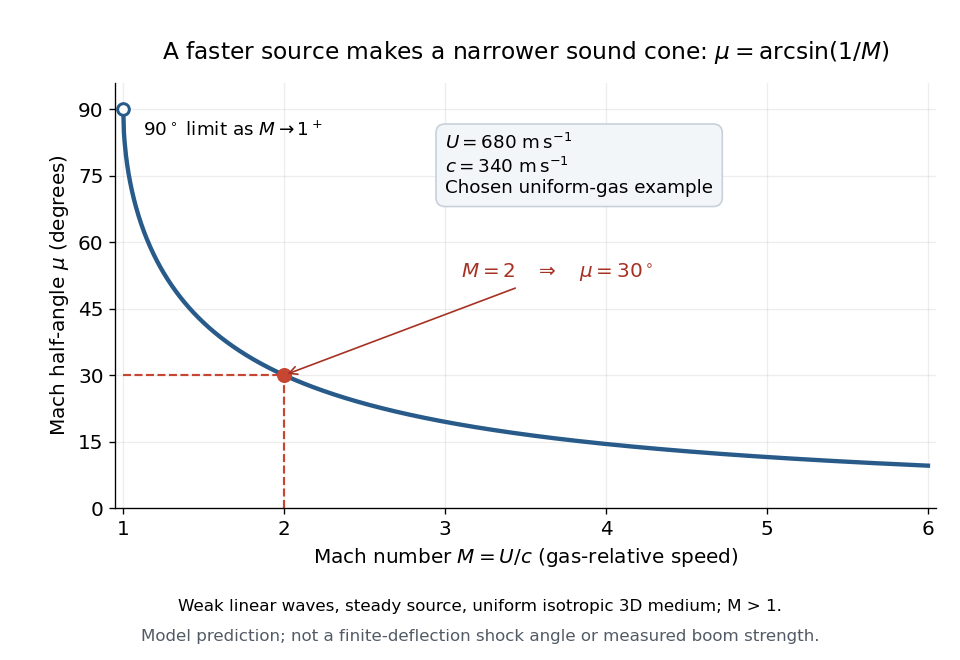
The Mach angle is the half-angle between a Mach cone generator and its backward motion axis for a steady point source in a uniform three-dimensional medium with isotropy and constant sound speed. It obeysThe relation concerns weak acoustic waves in linear acoustics. It is not the angle of a finite oblique shock produced by finite turning of the fluid flow; that angle also depends on the deflection and the gas properties.[ref]
Mach Angle (NASA Glenn Research Center). Mach Angle, geometric construction and displayed sin(mu)=1/M and mu=asin(1/M) equations
For a short proof, choose an old emission in the moving-point acoustic wavefronts construction and set . Its circle has center and radius . A tangent line from the present source at the origin meets the circle at a right angle to its radius. The resulting right triangle has hypotenuse and opposite side , giving the displayed sine ratio. The emission age cancels: every wavefront has the same tangent directions, so a continuum of expanding spheres produces one simple Mach cone.
In an original example, stipulate uniform gas with sound speed and a source moving through it at . Then and . An emission one second earlier is now a sphere centered behind the source with radius . The selected sound speed defines this example; it is not a constant for air at every temperature. The Mach angle decreases as increases: its derivative is in radians, and its limits are as and as .
The Mach cone forms the geometric envelope of acoustic wave wavefronts from a source moving at a supersonic Mach number . In the source reference frame the ray-velocity sphere is centered at and has radius . Its tangent rays make angle to the backward flight direction; all other emitted acoustic rays lie inside that Mach cone.
The Mach cone is the geometric envelope of the spheres in moving-point acoustic wavefronts. To obtain its axial boundary without a diagram, put and impose the geometric envelope conditions and onThe partial derivative condition gives . Substituting into gives , henceFor , the Mach cone section has slope magnitude , consistent with a Mach angle of . If emission begins at a finite time, the reached region is limited by the oldest wavefront; the infinite cone describes the steady geometric boundary obtained with an indefinitely long source history. In a uniformly moving gas, advection shifts each emission's sphere by the gas velocity times its age; working with the source's relative velocity through the gas restores the same construction.
Articles by others on the same topic


An oblique shock is a type of shock wave that occurs in supersonic flows when the flow encounters a ramp, wedge, or other surfaces that create a change in direction. Unlike normal shocks, which are perpendicular to the flow direction, oblique shocks are inclined at an angle relative to the flow direction.