The Mach angle of a supersonic flow with Mach number is . Infinitesimal pressure disturbances lie on the corresponding Mach cone, and a weak oblique shock approaches this angle as its strength tends to zero.
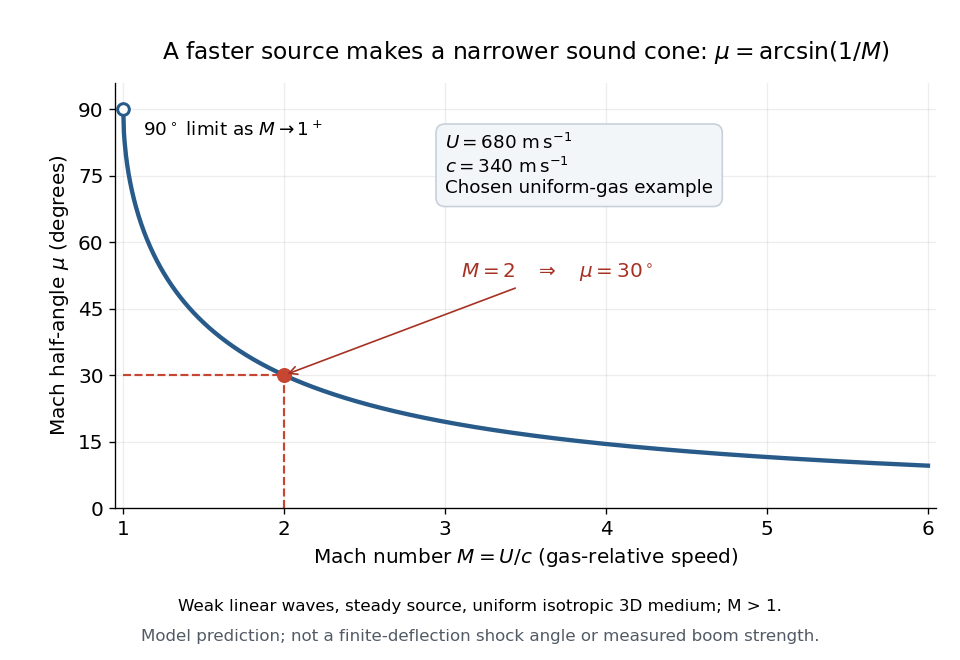
The Mach angle is the half-angle between a Mach cone generator and its backward motion axis for a steady point source in a uniform three-dimensional medium with isotropy and constant sound speed. It obeysThe relation concerns weak acoustic waves in linear acoustics. It is not the angle of a finite oblique shock produced by finite turning of the fluid flow; that angle also depends on the deflection and the gas properties.[ref]
Mach Angle (NASA Glenn Research Center). Mach Angle, geometric construction and displayed sin(mu)=1/M and mu=asin(1/M) equations
For a short proof, choose an old emission in the moving-point acoustic wavefronts construction and set . Its circle has center and radius . A tangent line from the present source at the origin meets the circle at a right angle to its radius. The resulting right triangle has hypotenuse and opposite side , giving the displayed sine ratio. The emission age cancels: every wavefront has the same tangent directions, so a continuum of expanding spheres produces one simple Mach cone.
In an original example, stipulate uniform gas with sound speed and a source moving through it at . Then and . An emission one second earlier is now a sphere centered behind the source with radius . The selected sound speed defines this example; it is not a constant for air at every temperature. The Mach angle decreases as increases: its derivative is in radians, and its limits are as and as .

The Mach cone forms the geometric envelope of acoustic wave wavefronts from a source moving at a supersonic Mach number . In the source reference frame the ray-velocity sphere is centered at and has radius . Its tangent rays make angle to the backward flight direction; all other emitted acoustic rays lie inside that Mach cone.
The Mach cone is the geometric envelope of the spheres in moving-point acoustic wavefronts. To obtain its axial boundary without a diagram, put and impose the geometric envelope conditions and onThe partial derivative condition gives . Substituting into gives , henceFor , the Mach cone section has slope magnitude , consistent with a Mach angle of . If emission begins at a finite time, the reached region is limited by the oldest wavefront; the infinite cone describes the steady geometric boundary obtained with an indefinitely long source history. In a uniformly moving gas, advection shifts each emission's sphere by the gas velocity times its age; working with the source's relative velocity through the gas restores the same construction.
Articles by others on the same topic
There are currently no matching articles.