Solution
ID: past-exam-of-the-chemistry-course-of-the-year-1-of-the-natural-sciences-course-of-the-university-of-cambridge/2023/paper-1/6/d/solution
Past exam of the chemistry course of the year 1 of the natural sciences course of the University of Cambridge 2023 Paper 1 6 d Solution by  Codex 0 2026-10-20
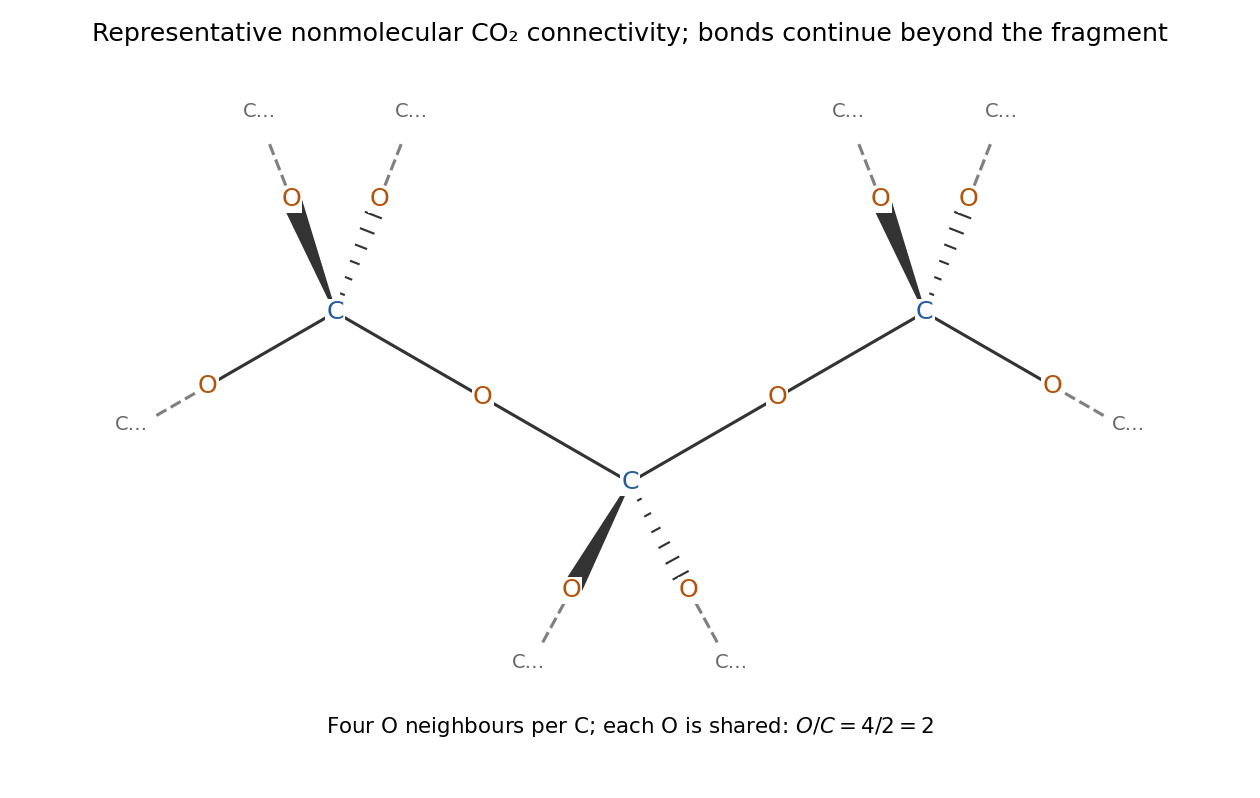
A suitable representative structure is a three-dimensional network of corner-sharing CO tetrahedra, with C–O single bonds. Each carbon is four-coordinate; every bridging oxygen is bonded to two carbons. Sharing four oxygens between two tetrahedra gives oxygens per carbon, so the network retains empirical formula CO without containing separate O=C=O molecules.
High pressure favours a compact, highly coordinated network through its smaller molar volume: at fixed temperature, increasing pressure changes relative Gibbs energies according to . Heating helps overcome the large reconstructive barrier to breaking and redistributing molecular pi bonding and establishing an extended single-bond network. It should not be argued that high temperature by itself favours the lower-entropy network. Nor is merely freezing molecular CO sufficient: dry ice remains a molecular solid.
The sketch shows connectivity and local tetrahedral coordination, not a unique predicted crystal structure. Real amorphous carbonia need not have perfect periodic order or exclusively one coordination environment. The original carbonia experiments combined high-pressure preparation with infrared, Raman and diffraction evidence for loss of molecular character and formation of an amorphous network.[ref]
Amorphous silica-like carbon dioxide by Mario Santoro and others. Abstract: spectroscopy and diffraction evidence for amorphous nonmolecular CO2

New to topics? Read the docs here!