Solution
ID: past-exam-of-the-classical-mechanics-course-of-the-university-of-oxford/2023/1/c/solution
Past exam of the classical mechanics course of the University of Oxford 2023 1 c Solution by  Codex 0 2026-10-25
Write . The initial conditions on the normal mode coordinates are and . Solving the two harmonic oscillator equations and recovering the original angles gives the exact solution within the harmonic approximation:Their angular velocities are and , which verify all four initial conditions.
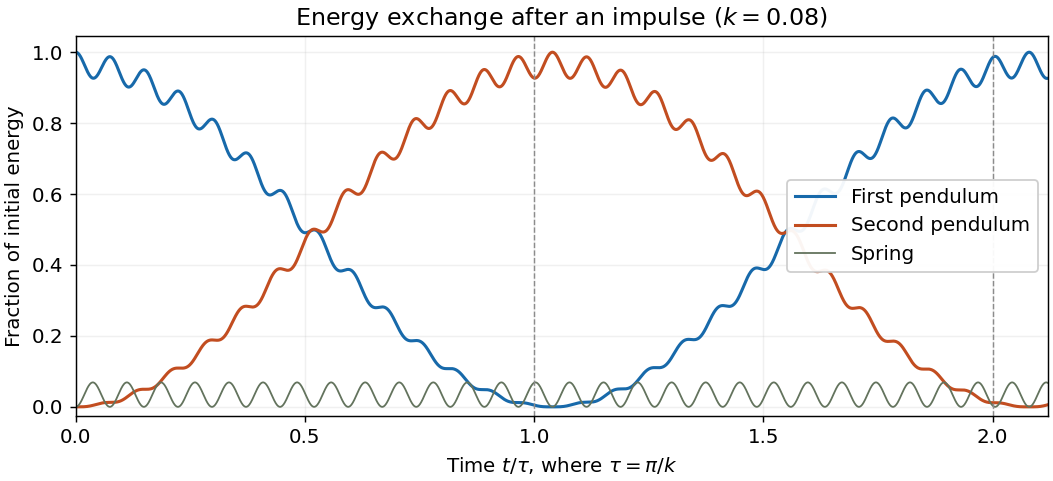
To expose the beat, define and . Replacing by changes each angle by uniformly in time. The sum-to-product identities then giveThe displayed angular velocities are exact in the linear system. The absolute and signed beat envelopes have leading amplitudes and . Because , at we have and . HenceThe first simple pendulum has negligible oscillation amplitude. Its kinetic energy is , while the second has . Thus, to the retained order, all instantaneous kinetic energy belongs to the second simple pendulum. The fast phase can make that kinetic energy small: the whole initial energy is transferred as the second simple pendulum's combined kinetic energy and gravitational potential energy, sinceThis is energy transfer after an impulse in two weakly coupled oscillators. It does not require .
At , , so the beat has returned the oscillation to the first simple pendulum:The energy localization returns, although the fast oscillation phase need not equal its initial phase. The exact first minimum of the leading beat envelope is at , whose leading value is . Keeping the slow phase is essential: expanding at fixed and then using would lose the energy exchange. Although angles are retained only to order , their leading energies are of order .

New to topics? Read the docs here!