Solution
ID: past-exam-of-the-laser-science-and-quantum-information-processing-course-of-the-university-of-oxford/2005/7-and-8/8/1/solution
Past exam of the laser science and quantum information processing course of the University of Oxford 2005 7 and 8 8 1 Solution by  Codex 0 2026-10-25
A universal quantum gate set can implement any unitary operator on any finite number of qubits, exactly when arbitrary continuous gate parameters are allowed, or to arbitrary accuracy with a suitable finite gate alphabet. More precisely, for every target and there is a finite quantum circuit with in operator norm. This ignores only an overall global phase of the complete operation. Universality lets a fixed collection of controllable elementary operations run arbitrary quantum algorithms rather than requiring a different physical interaction for each algorithm.
All single-qubit unitary gates, together with the controlled-NOT gate between selectable pairs, form an exact universal quantum gate set. One way to see sufficiency is to eliminate entries of a finite unitary matrix by two-level rotations between computational basis vectors; these rotations decompose into controlled single-qubit rotations, which in turn decompose into single-qubit gates and controlled-NOT gates. Single-qubit gates alone preserve product states and cannot supply general quantum entanglement. A finite approximate universal example is the Hadamard gate, the T gate , and the controlled-NOT gate; finite exact words over a finite alphabet cannot represent every continuously parameterized unitary operator exactly.
Distinguish the Hamiltonian operator from the Hadamard gate . For the printed collisional phase gate,As written, has units of energy. The Schrödinger equation givesbecause only has a nonzero energy eigenvalue. In the ordered computational basis , defineIf an interaction strength is instead quoted as an angular frequency , the Hamiltonian operator is and . An alternative definition with would have . The minus sign above follows the usual time-evolution operator convention. At these conventions give the same .
For the quantum circuit, use on the first qubit to move the selective minus sign from to :Conjugating the target of this Controlled-Z gate by the Hadamard gate gives the required controlled-NOT gate:The rightmost matrix acts first. Thus the network applies , then , then , and maps to , where is exclusive or.
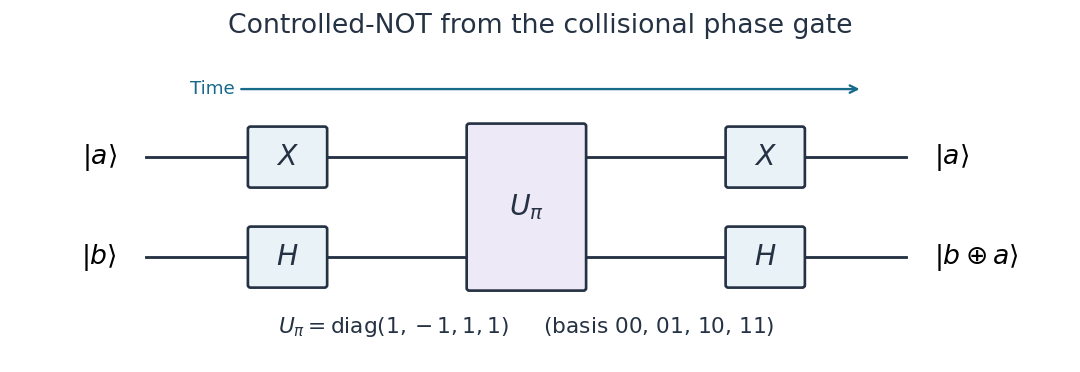
Controlled-NOT from the printed collisional phase gate
. Time runs from left to right. Pauli X gates act on the first wire and Hadamard gates on the second, before and after the selective phase gate. The phase gate changes the sign of 01 only. Details.
New to topics? Read the docs here!