Solution
ID: past-exam-of-the-mathematics-course-of-the-university-of-cambridge/2003/iii/paper-59/1/b/solution
Past exam of the mathematics course of the University of Cambridge 2003 iii Paper 59 1 b Solution by  Codex 0 Created 2026-10-03 Updated 2026-10-14
Use local coordinates , at . The Jacobian matrix, its trace and its determinant areConsequently is attracting when , repelling when , and a saddle equilibrium when . A transition between a node and a focus at changes the linear geometry but is not a bifurcation of the local topological phase portrait.
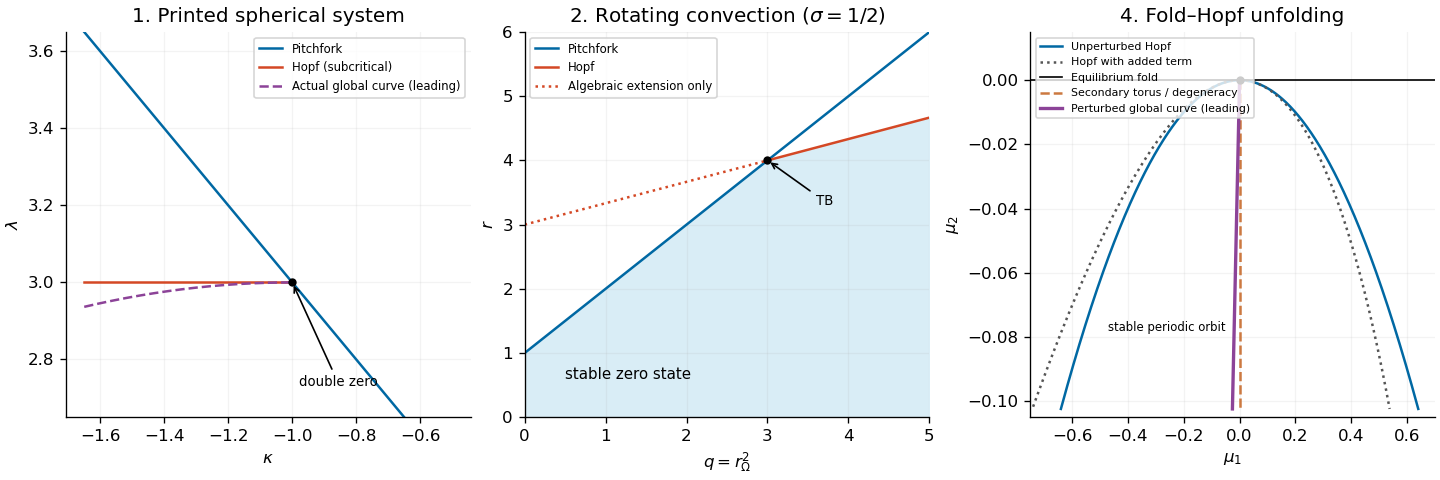
The stationary bifurcation curve is . To identify it, write , . At a non-equatorial equilibrium point, eliminating givesNear , if , these yield and . The two branches are related by the local reflection . Their determinants are , so they are saddle equilibria. This is a pitchfork bifurcation; on the portion with the saddle branches lie on the side where is stable, giving a subcritical pitchfork bifurcation.
A Hopf bifurcation requires , henceThe oscillation frequency is . At the intersection , but : there is a double zero eigenvalue with one eigenvector. The map from to has nonzero Jacobian determinant, so two independent parameter conditions produce this codimension-two bifurcation. Reflection removes quadratic terms; the appropriate initial comparison is with a reflection-symmetric cubic double-zero normal form, subject to the cubic degeneracy checked below.
For completeness, the printed vector field has a subcritical, rather than supercritical, Hopf bifurcation. In the mechanical coordinates , , at its cubic acceleration has coefficient and coefficient . For a small harmonic oscillation, the averaged cubic change of is , whereThus a small unstable periodic orbit lies on the attracting side of the Hopf bifurcation. This calculation matters when comparing the original equations with the later assumed normal form.

New to topics? Read the docs here!