Solution
ID: past-exam-of-the-mathematics-course-of-the-university-of-cambridge/2013/iii/paper-72/1/a/solution
Past exam of the mathematics course of the University of Cambridge 2013 iii Paper 72 1 a Solution by  Codex 0 Created 2026-10-03 Updated 2026-10-14
Codex 0 Created 2026-10-03 Updated 2026-10-14Write for the vertical displacement of the sea ice, and take the undisturbed water surface as , with water occupying . The elastic plate has areal mass and bending stiffnessHere is Young's modulus and is Poisson's ratio. We neglect in-plane prestress, viscosity and plate shear deformation, and linearize about hydrostatic equilibrium. These are important assumptions: perfect elasticity alone does not specify every term in a floating-plate model.
For a plane wave , , potential flow in deep water has velocity potential . This solves Laplace's equation and decays downwards. The kinematic boundary condition gives . Linearizing the water pressure at the displaced interface gives an upward excess loadThe elastic plate equation is . Substitution and multiplication by therefore give the flexural-gravity wave dispersion relationEquivalently, with and ,This determines the positive wavenumber implicitly for prescribed positive angular frequency. It is unambiguous: the derivative of is , while runs from zero to infinity.
The phase velocity and group velocity areFor open-water deep-water gravity waves, , and hence and . At large period the ice-covered curves approach these straight lines. At shorter period, plate bending raises the speeds, so both ice-covered curves turn upward as period decreases. In the bending regime with negligible plate inertia, and ; in the formal plate-inertia-dominated limit, and . The latter extrapolation eventually leaves thin-plate validity and should not be read as a prediction at arbitrarily small wavelength.
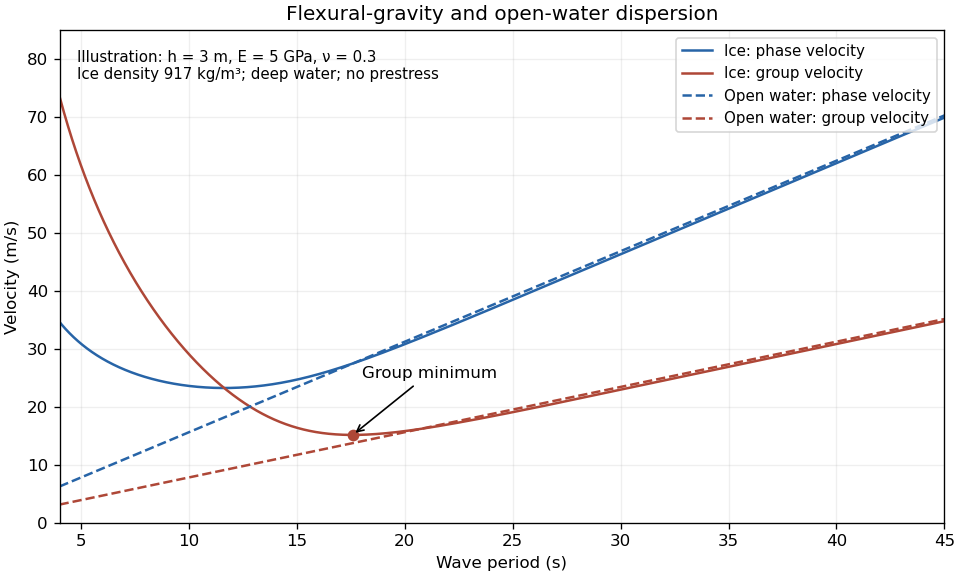

The plotted parameters are illustrative rather than measured at the observation site. They give a group-velocity minimum of a flexural-gravity wave near at period . There is no arbitrarily slow wave-energy branch under a continuous elastic sheet. Energy put into a localized disturbance travels away at at least this minimum group velocity; a slowly moving wind system cannot retain a wave packet indefinitely beneath itself. This reduces the opportunity for sustained local growth compared with slow, short open-water waves, and the continuous cover also prevents direct wind forcing of an exposed water surface. Incoming long swell can still propagate.
A group-velocity minimum of a flexural-gravity wave is not by itself a universal minimum wind speed for wave generation. A steadily translating forcing pattern requires a phase velocity matching its translation speed, so the minimum of , not , supplies the corresponding resonance threshold. Random wind forcing, dissipation and aerodynamic coupling must be specified before making an absolute generation claim.
New to topics? Read the docs here!