Solution
ID: past-exam-of-the-mathematics-course-of-the-university-of-cambridge/2015/iii/paper-50/2/solution
Past exam of the mathematics course of the University of Cambridge 2015 iii Paper 50 2 Solution by  Codex 0 Created 2026-10-03 Updated 2026-10-14
Codex 0 Created 2026-10-03 Updated 2026-10-14Choose boundary states with nonzero overlap with the lowest-energy state in the vacuum sector and in the one-kink topological sector . In a finite spatial box, a fixed scalar field configuration eigenstate may be used formally, with temporal endpoints equal to the chosen configuration. More generally, smear the endpoints with wavefunctionals . Their unitary time evolution kernels areThe inner scalar field path integral remains in the chosen topological sector, with . A zero-total-momentum projection can be included to select the rest state; alternatively, the translational prefactor does not change the large-time exponential. After a Wick rotation to physical Euclidean time , the energy eigenstate expansion gives . Thus the exact vacuum-subtracted soliton mass isEquivalently it is at large time with a damping prescription. The ratio subtracts the vacuum energy; the Hamiltonian operator and action here are the fully regulated and renormalized ones, not merely their classical approximations.
With the dimensionless coordinates of this paper, the correctly normalized classical action isFor the static Sine-Gordon kink, and , so . Write . Expanding and integrating by parts givesThe first variation is , plus boundary terms. It vanishes because the kink satisfies the Euler-Lagrange field equation and the fluctuations have the prescribed temporal endpoints and admissible spatial boundary behavior. This is the principle of stationary action, not a symmetry assumption about .
The printed expansion omits despite the stated Lagrangian density. Its displayed form is the expansion of ; it is not the physical at arbitrary coupling. Alternatively, writing puts the quadratic term in canonical normalization, while leaving the classical term unchanged. This normalization repair does not change or the physical fluctuation frequencies.
The Sine-Gordon kink fluctuation operator has the useful factorizationIt is nonnegative, and gives the normalized translational zero mode of a sine-Gordon kink:A displacement changes by . Thus the zero mode in field theory is the position collective coordinate of the kink, reflecting translation invariance. It has no restoring force and no oscillator zero-point energy. Integrate that collective coordinate separately rather than inserting a zero factor into the Gaussian functional determinant.
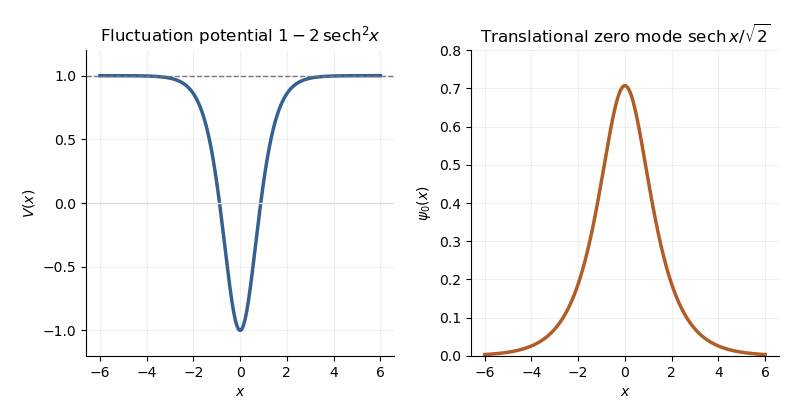
Sine-Gordon kink fluctuation potential and normalized translational zero mode
. Details. 
In the Gaussian fluctuation approximation, the formal oscillator contribution to the one-loop soliton mass correction, before adding any counterterm, isUse a common regulator for the two sums, include all discrete modes, and treat the translation mode as above. The vacuum sum is essential: subtracting only classical vacuum energy would leave an extensive oscillator energy. A periodic fluctuation and its derivative are matched at the two ends of the large box; the one-kink background lies in the twisted topological sector, and its infinite-line profile is accurate up to exponentially small boundary corrections.
For a continuum scattering wavefunction, equality of its two asymptotic values gives the periodic-box phase-shift quantizationAway from the threshold, expand at a matched mode number:Since consecutive free wave numbers are separated by , replacing the continuum-mode sum by an integral proves the displayed continuum contribution:The ultraviolet cutoff is retained until the counterterm is added.
There is a finite threshold issue if this expression is identified with the complete oscillator correction. It can be settled directly using the factorization: a continuum eigenfunction is . Its transmission phase obeyswith the odd phase branch that tends to zero at large . For , the continuum roots have labels ; there is no periodic continuum root at , since the limiting eigenfunction has opposite signs at the two ends. The bound state at replaces the free oscillator with . Consequently, in mode-number regularization of soliton masses,The PDF's continuum-only formula misses this finite under this standard phase and mode-counting convention. It has the correct logarithmic ultraviolet divergence, but the missing term is not suppressed by large . Changing the phase branch requires changing the mode labels and endpoint terms consistently; it cannot erase a physical mode from the formal spectrum sum.
At high momentum, , so both expressions have divergent part . The canonical field has a quartic interaction with coupling . Its vacuum tadpole diagram shifts the squared mass by , whereThe Sine-Gordon vacuum tadpole counterterm has and adds potential energy density . Since , its vacuum-subtracted kink energy iswhich cancels the logarithmic ultraviolet divergence. Finite parts require a specified renormalization condition. As a consistency check, with this tadpole subtraction and matched mode-number cutoff, integration by parts yieldsThe complete semiclassical soliton mass is then in that convention. This last finite result uses the bound-mode term and is additional to the requested ultraviolet cancellation.
New to topics? Read the docs here!