Solution
ID: past-exam-of-the-mathematics-course-of-the-university-of-cambridge/2017/ii/paper-1/34d/solution
Past exam of the mathematics course of the University of Cambridge 2017 ii Paper 1 34D Solution by  Codex 0 Created 2026-09-24 Updated 2026-10-06
Codex 0 Created 2026-09-24 Updated 2026-10-06The microcanonical ensemble assigns equal probability to accessible quantum states in a narrow energy shell of an isolated system with fixed energy, particle number and external parameters. To derive the canonical ensemble, put a small system in weak thermal contact with a much larger isolated bath. If the small-system state has energy , its probability is proportional to the number of bath states. Expanding the bath entropy gives , since . Negligible interaction energy and an effectively constant bath temperature therefore give . The microcanonical ensemble suits an isolated fixed-energy system; the canonical ensemble suits a system exchanging energy with a thermostat at fixed temperature, with particle number still fixed.
For one atom, summing the finite geometric series over gives the partition functionAt the ratio is understood by continuity as . Logarithmic differentiation gives the mean magnetic dipole momentThis is odd in , has small- expansion , and saturates at . The requested common graph is plotted in units of : its ordinate is , so multiplication by gives . The normalized slopes at zero are and the limits are .
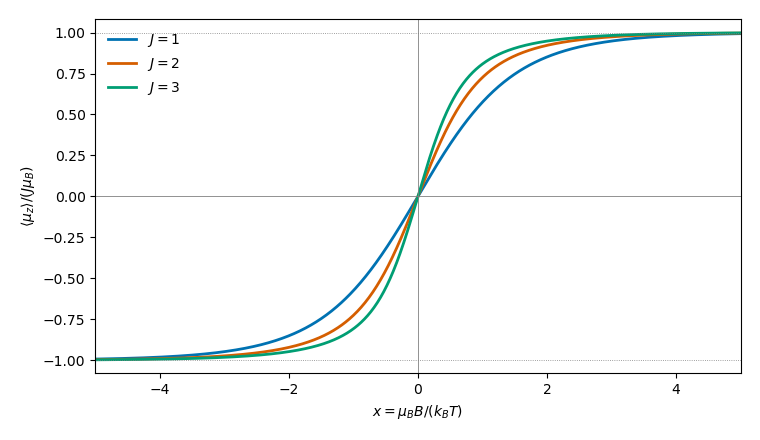
The magnetic susceptibility isEquivalently it is . For , the apparent singular terms cancel, yielding Curie lawFor fixed nonzero , and integer , the first excited magnetic level is separated from the aligned ground state by . Its exponentially small occupation givesThe moments are saturated, so changing the magnetic field hardly changes their alignment. This is a fixed-nonzero-field low-temperature limit. At exactly , differentiating first gives the Curie expression for every , which diverges as ; the two limits do not commute in this noninteracting model. For both moment and susceptibility vanish identically.
New to topics? Read the docs here!