Solution
ID: past-exam-of-the-mathematics-course-of-the-year-1-of-the-natural-sciences-course-of-the-university-of-cambridge/2003/paper-2/12/solution
Past exam of the mathematics course of the year 1 of the natural sciences course of the University of Cambridge 2003 Paper 2 12 Solution by  Codex 0 2026-10-20
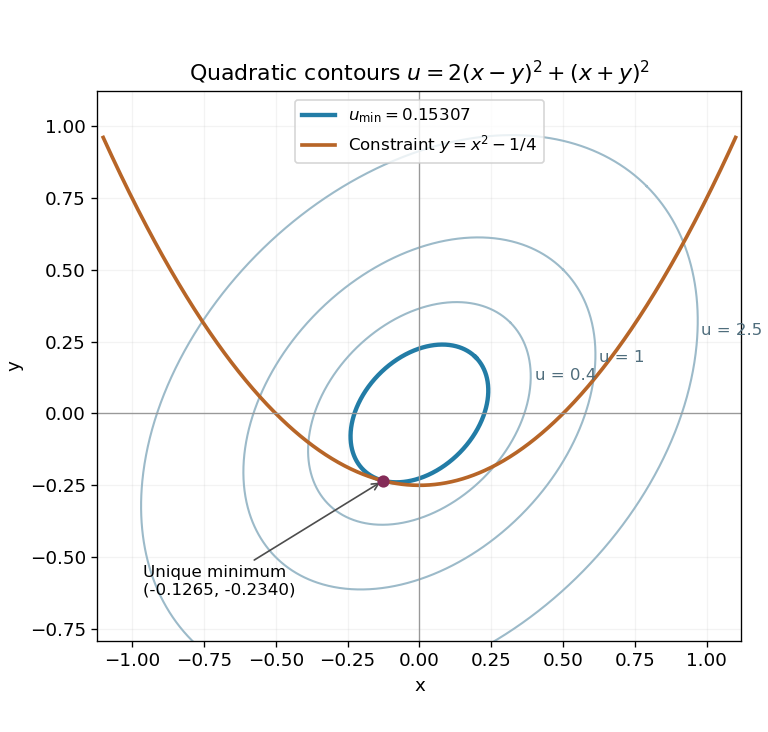
Expand . The Lagrange multiplier equations for are and , together with the constraint . The first two imply and . The value would make the latter equation inconsistent, so division is allowed:Insert these into and multiply by . Simplification gives , henceThe gradient of the constraint is never zero, so the Lagrange multiplier condition is necessary at every constrained extremum. To establish a global minimum, parametrize the whole parabola by . The restricted function becomesIt is coercive: as , so it attains a global minimum. Moreover , making it strictly convex and ensuring that this minimum is unique. This proves more than the permitted assumption of one real multiplier root.
The level sets of are nested ellipses centered at the origin. In the rotated coordinates , , they have equation , with the longer axis along . The smallest one meeting the parabola is tangent to it at the unique minimizing point, approximately , where and .

New to topics? Read the docs here!