A real bilinear form on a normed vector space is coercive when there is one constant such thatThe lower bound uniformly controls every direction in the chosen norm. Unlike the upper bound defining a bounded bilinear form, it forces positive diagonal values at every nonzero vector. No symmetry is assumed. For complex Hilbert spaces, the usual analogue uses a sesquilinear form and ; it is not the same assertion for a complex bilinear form.
A concrete bounded and coercive example on , with the Euclidean norm, isIts quadratic form isThe best lower constant is , attained at . Nevertheless, and , so coercivity does not imply a symmetric bilinear form. The symmetric part of a matrix determines , while the skew-symmetric matrix part changes mixed pairings without changing . This is the symmetric and alternating parts of a bilinear form decomposition.[ref]
For the upper constant, direct multiplication gives . Its eigenvalues are , so the optimal upper constant, the spectral norm, is . The two constants answer different questions: how large a mixed pairing can be, and how small a self-pairing can be relative to squared norm.
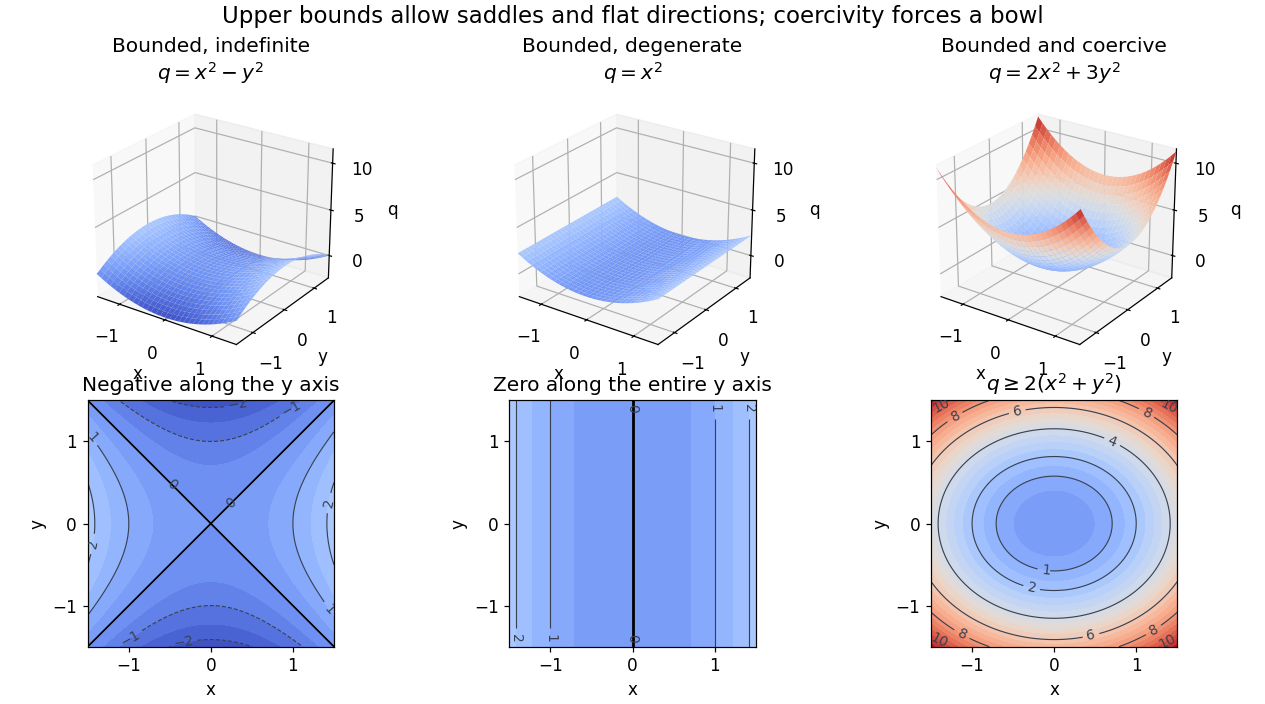
Bounded saddle and flat-direction quadratic forms contrasted with a uniformly coercive bowl
. Details. 
The plotted quadratic forms show the mechanism: descends in one direction, leaves one direction uncontrolled, and controls both. These are self-pairings; their level sets cannot reveal the skew-symmetric matrix part. Calling a quadratic energy here refers to this diagnostic quantity, not to a claim that a nonsymmetric equation comes from minimizing an energy functional.
On a real finite-dimensional vector space with any norm, strict positivity for every nonzero does imply coercivity. Indeed the quadratic form is continuous, and its positive minimum on the compact unit sphere supplies . If is also a symmetric bilinear form, this is positive definiteness. For general , it is the symmetric and alternating parts of a bilinear form decomposition that isolates the positive part. Switching between equivalent norms preserves coercivity, but usually changes its constant.
The infinite-dimensional vector space distinction is explicit on the real l2 sequence space:The Cauchy-Schwarz inequality gives boundedness with , and for every nonzero vector. But with , so no positive works. On the span of , the best lower constant is : each finite restriction is coercive, but the control disappears as grows. Strict positivity is therefore weaker than a uniform lower bound.
The practical payoff is a stability estimate for a weak formulation. Assume is a real Hilbert space, is both a bounded bilinear form and a coercive bilinear form, and the load is a bounded linear functional. The Lax-Milgram theorem gives a unique satisfying for all , including nonsymmetric .[ref]
Introduction to Finite Element Methods by Christian Clason. §2.2, Theorem 2.7, pp. 20–21, equation (2.9): hypotheses, unique solvability and load bound
The dual norm measures load size. Testing with gives the short energy estimateFor the bound holds directly; otherwise divide by . Subtracting the equations for two loads and using the same argument gives . Thus a positive lower constant limits the response to load errors. The upper bound and completeness of the Hilbert space enter the existence theorem; the estimate itself uses the lower bound and the load's dual norm.For the displayed matrix , take . Then for every means , not , with this ordering of the bilinear form. Since ,For , the exact response is and . For , it is , with norm . The actual maximal amplification is the operator norm : the coercivity estimate is valid but need not be sharp for a nonsymmetric bilinear form.
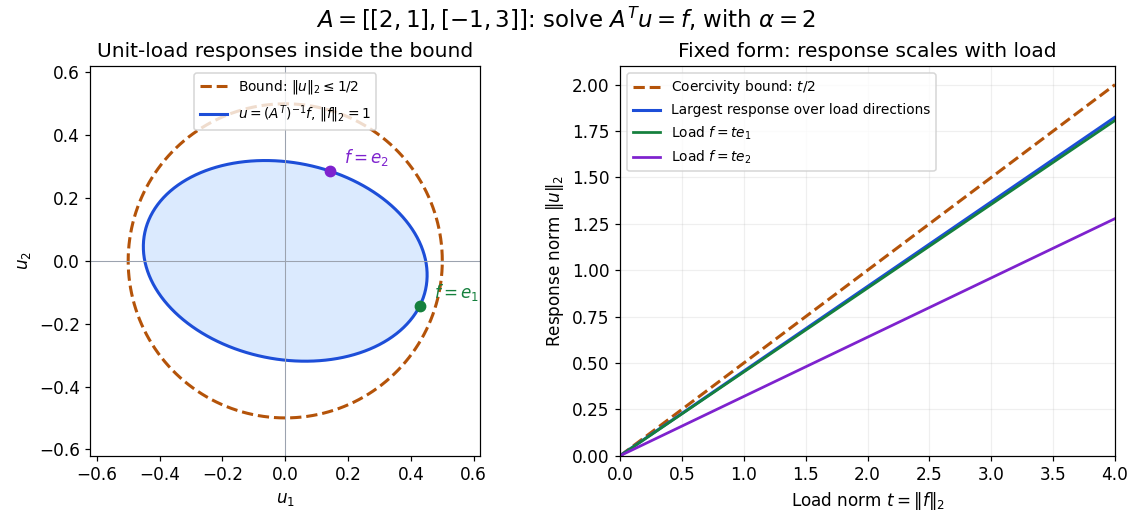
Solutions for unit loads lie inside the coercivity bound, and response grows at most linearly with load norm
. Details. 
Articles by others on the same topic
There are currently no matching articles.