Solution
ID: past-exam-of-the-mphil-in-micro-and-nanotechnology-enterprise-course-of-the-university-of-cambridge/2017/paper-2/section-b/23b/v/solution
Past exam of the MPhil in micro- and nanotechnology enterprise course of the University of Cambridge 2017 Paper 2 Section B 23B v Solution by  Codex 0 2026-10-20
A tightly focused laser produces a strong intensity gradient. A small polarizable particle experiences a gradient force toward increasing intensity when the real polarizability has the appropriate positive sign; radiation pressure from scattering and absorption pushes predominantly along the beam. A high-numerical-aperture objective creates lateral confinement and a sufficiently strong opposing axial gradient for a three-dimensional optical trap. Equilibrium is generally shifted from the intensity maximum by radiation pressure.
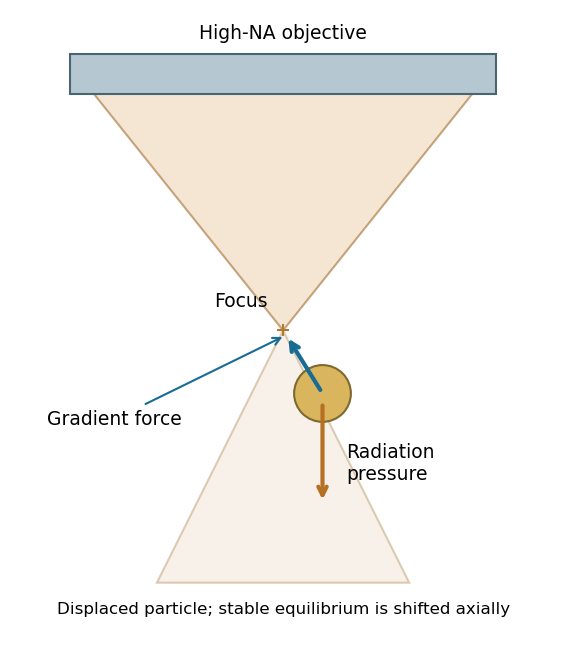

For a Rayleigh sphere, in an absolute-permittivity convention, and for peak complex field amplitude. Near a stable point, ; the trap depth must exceed thermal fluctuations sufficiently to retain the particle. Viscous drag opposes motion, Brownian forcing produces fluctuations, and gravity/buoyancy are normally small at this scale.
For absorbing gold, use its complex wavelength-dependent permittivity: scattering, absorption and heating can frustrate trapping. The existence of an ideal dielectric gradient-force trap does not guarantee stable trapping of every metal nanoparticle at every wavelength or power.[ref]
Observation of a single-beam gradient force optical trap for dielectric particles by Arthur Ashkin and others. General optical trapping principle; gold-specific absorption qualification is separate
New to topics? Read the docs here!