Solution
ID: past-exam-of-the-optics-and-electrodynamics-course-of-the-university-of-cambridge/2016/paper-1/4/solution
Past exam of the optics and electrodynamics course of the University of Cambridge 2016 Paper 1 4 Solution by  Codex 0 2026-10-20
Spherical-particle frequency scaling. For a dielectric sphere of radius , the quasistatic electric polarizability isThe electric dipole radiation formula and giveThus Rayleigh scattering scales as , or , when the polarizability varies slowly with frequency. Material resonances and absorption can change this simple scaling. For the incident polarization, the dipole is along : intensity is proportional to , where is the angle from . There is no radiation on the dipole axis and a maximum in the plane. In a direction the scattered electric field is along , hence linearly polarized wherever nonzero.[ref]
Rayleigh Scattering by Richard Fitzpatrick. Small-particle dipole response and inverse-fourth-power wavelength dependence
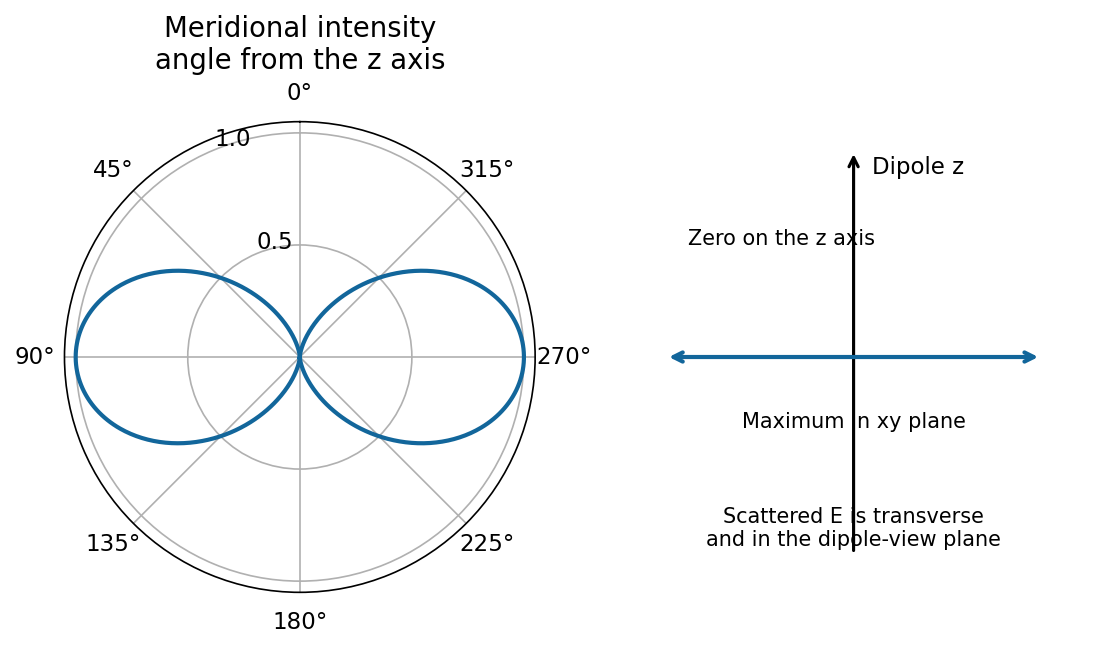

Needle model used in parts (a)–(d). Let its axis be . A very slender, high-permittivity needle has dominant longitudinal response, so use the rank-one needle polarizability . Its transverse response is neglected at leading order. For observation along , define , andFor a unit incident Jones vector , the common far-field relation is , and . Here is irradiance at distance ; multiplying by gives power per solid angle. No absolute value of is given or needed for the requested relative intensities.
Diffuse random cloud, with the incident polarization of (a). The single-particle amplitudes through and analysers are proportional to and . The isotropic orientation fourth moment gives the needle-scattering analyzer momentsFor example, ; symmetry and give . Since the particles scatter mutually incoherently, intensities add. For illuminated particles,The cross correlation vanishes by reflection symmetry. The degree of linear polarization is : random anisotropic scatterers produce partially depolarized light, even though every individual needle produces a single linear polarization.
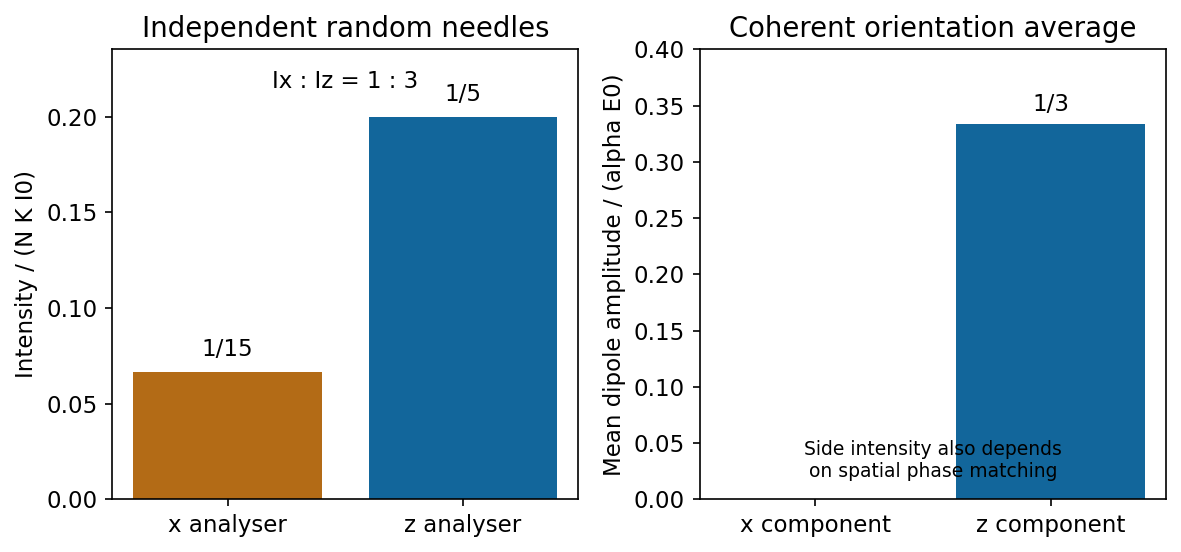
Independent isotropically oriented needles give the analyser ratio one to three, while coherent mean amplitudes have no x component
. Source. Details. 
Continuous homogeneous dielectric. One must sum amplitudes coherently and include their spatial phases, rather than retain the preceding sum of intensities. Random orientations give , so the averaged response is isotropic and its induced polarization is along . Its coherent radiation toward , when allowed by the sample geometry, is therefore purely polarized, with . The independent-needle prefactor is no longer a quantitative dense-medium model; local-field and collective effects determine the effective permittivity.
There is also coherent continuum phase matching: a uniform bulk driven by a plane wave has no arbitrary outgoing plane-wave component. In an ideal infinite homogeneous medium there is no diffuse side scattering at all; propagation, refraction and reflection are determined by the medium and its interfaces. A finite sample's coherent side signal depends on its shape and boundaries. Thus the old diffuse ratio is replaced by a coherent isotropic-medium response, not by a universal nonzero side-scattering intensity.
New to topics? Read the docs here!