Solution
ID: past-exam-of-the-options-ii-course-of-the-university-of-oxford/2011/k/k4/solution
Past exam of the options II course of the University of Oxford 2011 K K4 Solution by  Codex 0 2026-10-31
The free surface is material, so applying the material derivative to gives the exact kinematic boundary conditionFor an incompressible fluid with constant density, the Euler equations areSince the flow is irrotational, and . Integrating the resulting gradient equation gives a function of time on the right of Bernoulli equation. Adding a time-dependent constant to removes that function, without changing velocity, and choosing the atmospheric-pressure reference givesThe pressure immediately above the surface is atmospheric; the liquid-side pressure includes the stated surface tension jump.
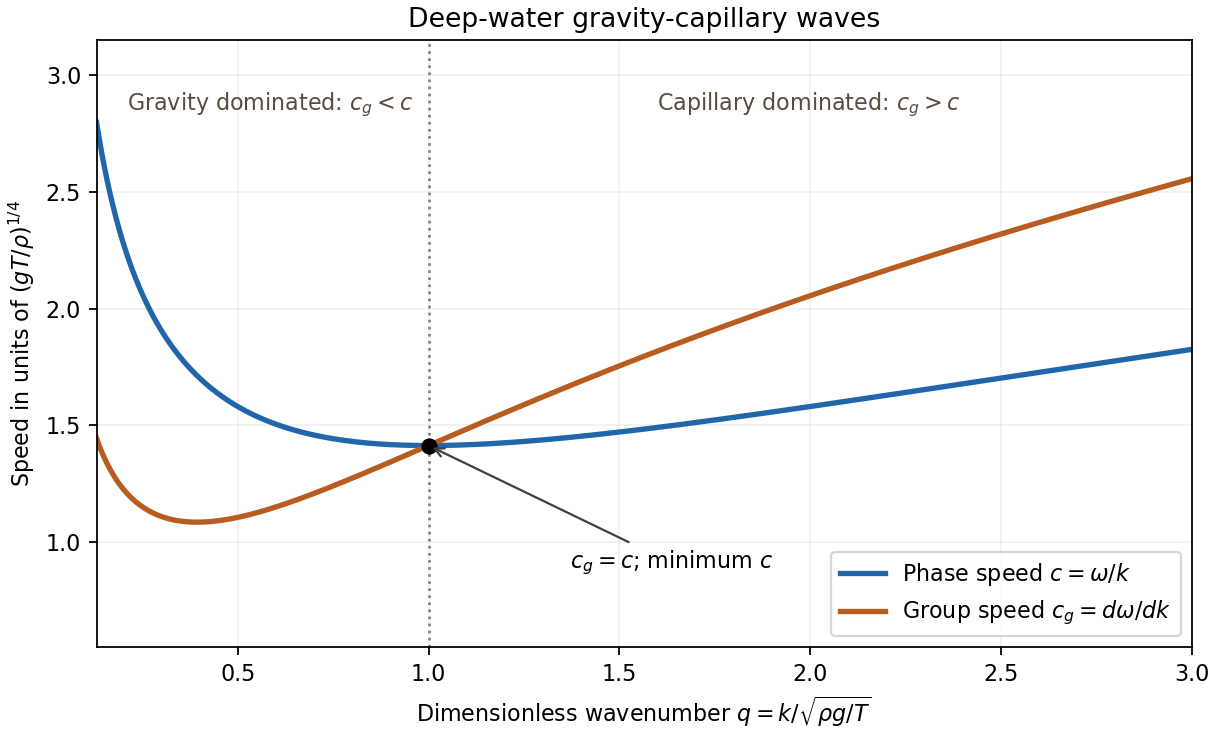
At first order in wave amplitude, the products and , the slope-squared correction to curvature, and displacement corrections in evaluating at are all higher order. Hence, on ,For , a harmonic velocity potential decaying as and satisfying the first condition isIndeed and . Substituting in the second condition yields the dispersion relation for a gravity-capillary wave:Taking the positive-frequency branch, the phase velocity and group velocity areSubtracting givesSince ,The threshold is also the wavenumber at the minimum phase speed of a gravity-capillary wave.

New to topics? Read the docs here!