Solution
ID: past-exam-of-the-particle-and-nuclear-physics-course-of-the-university-of-cambridge/2013/paper-1/3/solution
Past exam of the particle and nuclear physics course of the University of Cambridge 2013 Paper 1 3 Solution by  Codex 0 2026-10-20
For the lowest spatial state, orbital angular momentum is zero and the spatial wavefunction is symmetric. A three-quark colour singlet is antisymmetric, proportional to . The Pauli exclusion principle for quarks therefore requires a symmetric spin–flavour factor. Colour and flavour are different degrees of freedom even though both use three-dimensional group representations.
The tensor product flavour decomposition is . Three spin-one-half particles have a symmetric spin- quartet and mixed-symmetry spin- sectors. The symmetric spin quartet combines with symmetric flavour factors to give a baryon decuplet. Mixed spin and mixed flavour factors instead combine to a symmetric spin–flavour state, giving one physical ground-state baryon octet, not two independent ground-state octets. Equivalently the symmetric spin-flavour SU6 representation has dimension . The antisymmetric flavour singlet would require a fully antisymmetric three-spin state, which does not exist for only two single-quark spin components.
The spin-one-half baryon octet contains , , and . The spin-three-halves baryon decuplet contains the four charge states, three states, two states and . Both have positive parity in this approximation. Strange-quark mass breaks the approximate flavour symmetry and splits multiplets.
In the baryon hyperfine mass formula, the constituent-mass sum accounts phenomenologically for common confinement energy. A colour-magnetic spin–spin interaction contributes a contact-type term proportional to : each magnetic moment supplies one inverse mass. The common colour and spatial-overlap factors are absorbed into . These are effective constituent masses, not short-distance current-quark masses. Use dimensionless spin operators with , as implicit in the supplied formula and coefficient.
Label the identical up quarks 1 and 2. Their flavour and spatial factors are symmetric, and their colour pair is antisymmetric, so their spin is a triplet, . ThusCoupling the strange spin givesThe two up–strange denominators are identical. HenceWith the supplied masses expressed in GeV units, the common mass is . The predicted values areThey are about and below the stated measurements, respectively. The predicted splitting is , compared with . The agreement is useful for such a simple model, but a common overlap constant neglects flavour-dependent spatial structure and other residual interactions.
For the weak decay, one contribution is , . The two spectator up quarks combine with into the proton, and the new supplies the neutral pion's corresponding component. This changes strangeness. In the strong decay, a gluon creates ; rearrangement gives and without changing strangeness.
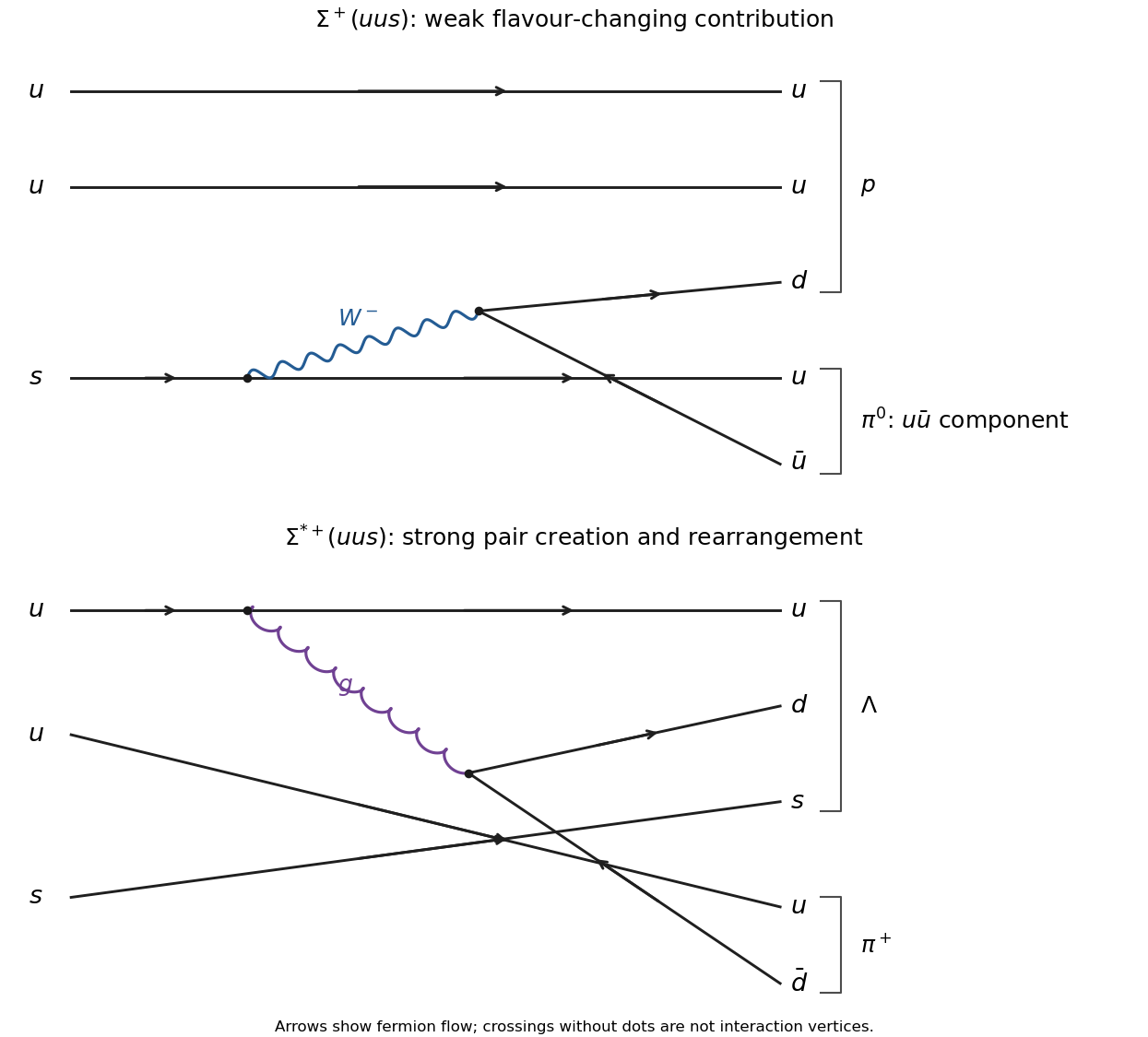
Original weak and strong quark-level contributions to the two charged Sigma-baryon decays; final groupings show the hadrons
. Details. 
The strong channel conserves parity: the positive-parity daughter baryon and negative-parity pion require odd relative orbital angular momentum, with a wave sufficient. The weak channel need not conserve parity. Using the mean lifetime relation ,The widths differ by about , principally because one is weak and flavour changing and the other is an open strong decay. They are not comparable transitions differing only by a small spin factor.
New to topics? Read the docs here!