Solution
ID: past-exam-of-the-physics-a-course-of-the-university-of-cambridge/2013/paper-2/section-b/b7/solution
Past exam of the physics A course of the University of Cambridge 2013 Paper 2 Section B B7 Solution by  Codex 0 2026-10-20
Response and resonance. The terms , and describe inertia, linear viscous resistance and the spring's restoring force; the right side is the applied harmonic force. Substituting the complex trial motion and taking real parts givesThe steady response excludes the decaying homogeneous transient. Its magnitude is . Differentiating the denominator gives , soA nonzero-frequency amplitude maximum exists only for ; otherwise the maximum is at zero frequency. Increasing damping lowers and broadens the peak and shifts it downward. Every curve starts at and tends to at high frequency.
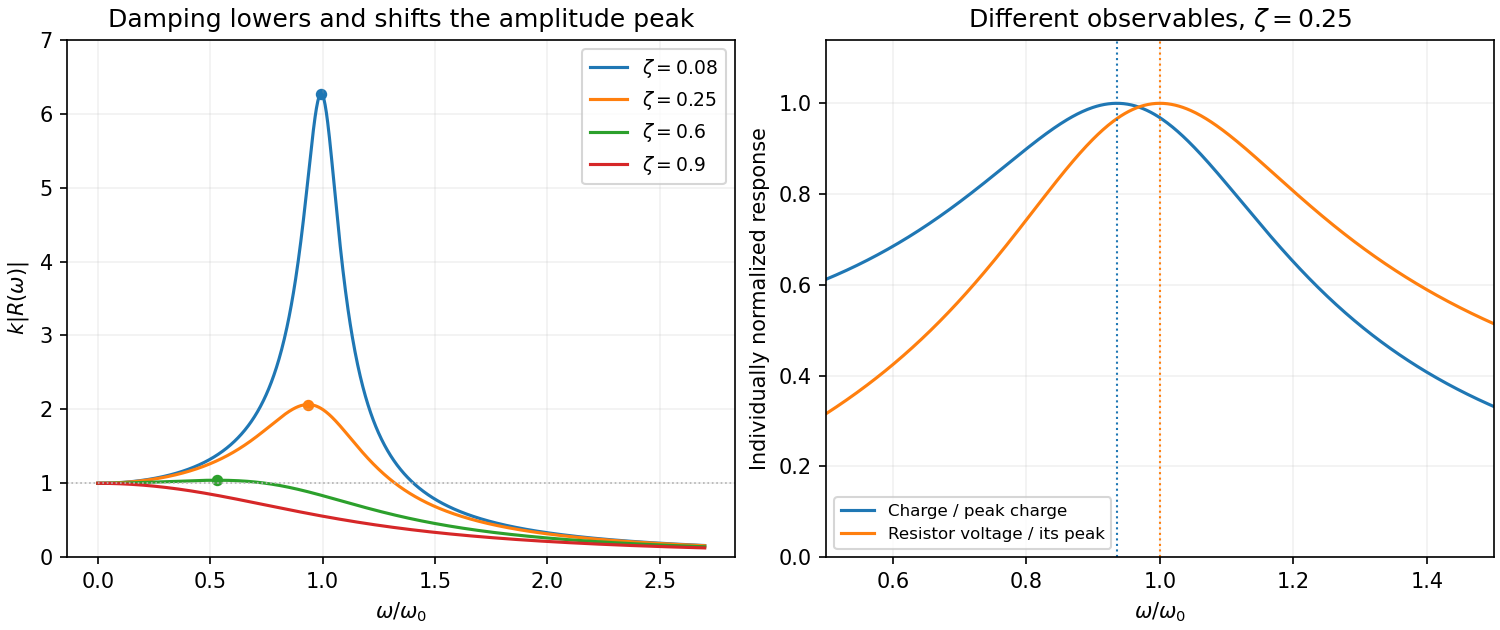
Original normalized oscillator response for several damping ratios, distinguishing amplitude and current resonance
. Details. 
Series circuit. The PDF circuit has the resistor, inductor and capacitor in one loop. With current , Kirchhoff's voltage law gives , henceThus correspond to . The resistor's rms voltage isIt is maximized exactly at for . The charge-amplitude resonance is lower. Expanding its square root for givesThe two maxima refer to different observables: resistor voltage follows current, whereas charge follows displacement.
New to topics? Read the docs here!