Solution
ID: past-exam-of-the-physics-a-course-of-the-university-of-cambridge/2014/paper-1/section-c/c10/solution
Past exam of the physics A course of the University of Cambridge 2014 Paper 1 Section C C10 Solution by  Codex 0 2026-10-20
Each electromagnetic normal mode is a quantum harmonic oscillator with . For its canonical partition function and occupation probabilities areThe geometric distribution is normalized and gives thermal mode energy . The zero-point term is not part of the thermally emitted black-body intensity. The equilibrium photon chemical potential is zero because photon number is not conserved.
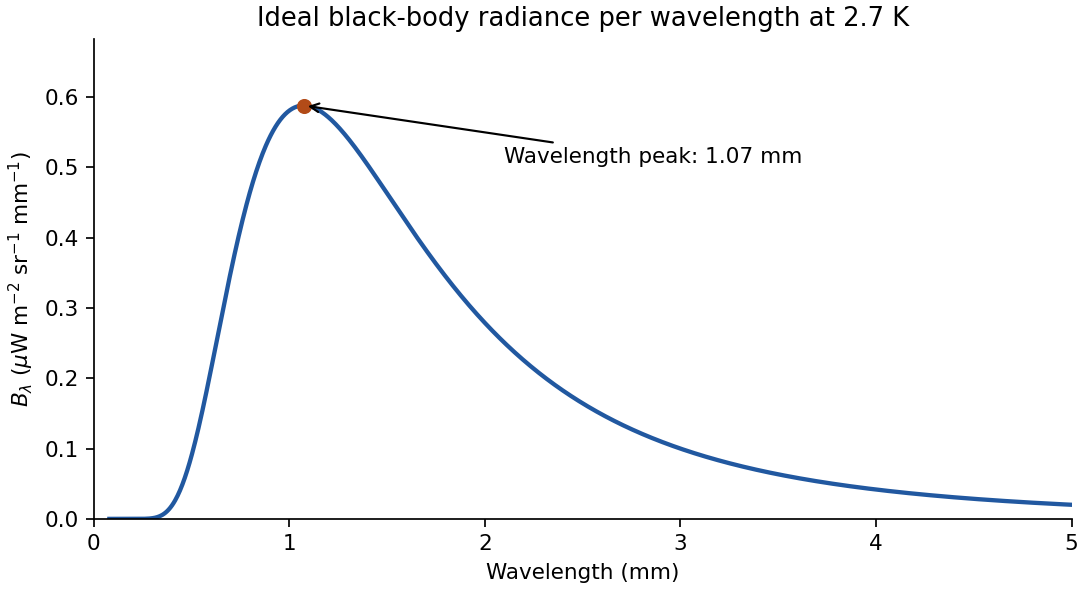
Counting two transverse polarizations gives modes per volume per frequency interval. Thus the spectral energy density is . In an isotropic radiation field, spectral radiance is . Transforming the spectral measure, , givesHere intensity means radiance per wavelength and solid angle; the hemispheric spectral exitance of a black surface is . The extra Jacobian is essential: the wavelength peak is not found by simply converting the frequency peak using .
At short wavelength the exponential suppresses radiation. At long wavelength the Rayleigh-Jeans limit is ; using classical equipartition at every frequency instead would produce the ultraviolet catastrophe. The wavelength maximum solves , with nonzero root , yielding Wien's displacement law. For the specified temperature,Integrating the hemispheric flux gives the Stefan-Boltzmann law, . The plot uses the specified ideal temperature, rather than substituting a later measured value. The physical black-body description of the cosmic microwave background is tested by comparing the sky spectrum with an absolute reference blackbody and separating instrumental and Galactic contributions.[ref]
The Cosmic Microwave Background Spectrum from the Full COBE/FIRAS Data Set by Dale J. Fixsen and others. abstract; FIRAS comparison with a precise blackbody and limits on spectral residuals

New to topics? Read the docs here!