Solution
ID: past-exam-of-the-physics-b-course-of-the-university-of-cambridge/2015/paper-1/section-c/c11/solution
Past exam of the physics B course of the University of Cambridge 2015 Paper 1 Section C C11 Solution by  Codex 0 2026-10-20
In Lagrangian mechanics, choose independent generalized coordinates compatible with the mechanical constraints, write , and apply the Euler-Lagrange equationEquivalently, the physical path makes the action stationary under variations with fixed endpoints. For ideal holonomic constraints, their unknown reaction forces need not appear in the reduced equations. Direct use of Newton's laws of motion instead resolves vector forces and reactions and enforces the constraints separately. Both approaches describe the same mechanics; the scalar Lagrangian is often shorter in curvilinear coordinates. Nonconservative generalized forces must be added separately. Here a drive maintains the prescribed azimuthal angular velocity .
The mass has polar speed and azimuthal speed , so its kinetic energy is . The elastic potential energy is , and the height is , giving gravitational potential energy . Thereforeand the Euler-Lagrange equation givesFor , define and , so . Near zero,When the upright equilibrium is linearly stable and the small oscillations have .
For , the graph of initially rises, whereas . There must therefore be a zero inside the interval. More strongly, for ,is strictly decreasing: decreases and increases because . The ratio goes from to , giving exactly one zero in that interval. At the zero, , so it is a stable equilibrium. The rotating torsion-stabilized inverted pendulum also has a symmetric stable angle if both signs of tilt are permitted.
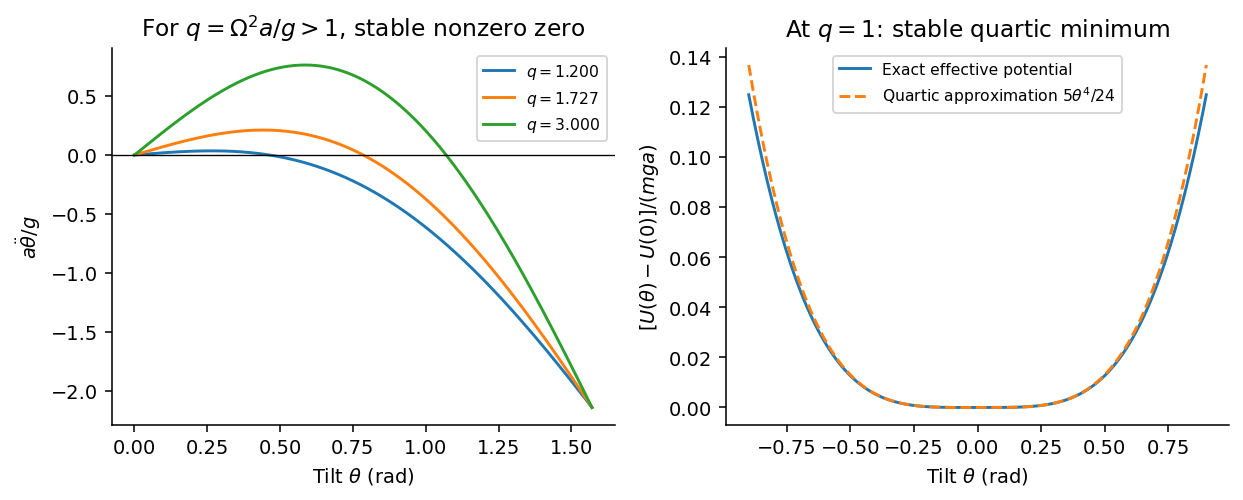

At , setting gives , soFor , the linearized equation is . Since ,At the threshold the linear restoring term vanishes, but the cubic term remains:The upright state remains nonlinearly stable, with no nonzero infinitesimal harmonic frequency. Small finite disturbances produce quartic oscillator motion whose frequency is proportional to its small angular amplitude; its period tends to infinity as that amplitude tends to zero. Zero linear stiffness is not the same as an absent restoring torque.
New to topics? Read the docs here!