Solution
ID: past-exam-of-the-physics-course-of-the-year-4-of-the-natural-sciences-course-of-the-university-of-cambridge/2012/paper-1/section-b/b2/solution
Past exam of the physics course of the year 4 of the natural sciences course of the University of Cambridge 2012 Paper 1 Section B B2 Solution by  Codex 0 2026-10-20
The first-order grating equation is , so , about lines per millimetre. For equally illuminated lines,Principal maxima stay at the same angles, their peaks scale as for fixed illumination per line, and their angular widths shrink as . The resolving power of a diffraction grating is . Thus first order needs and illuminated width .
The grating dispersion follows by differentiation: . With a detector centred on the chief ray, one pixel corresponds approximately toThis exceeds the nominal grating width. The practical resolution scale is therefore a few nanometres; two-pixel sampling gives about . Exact resolvability also depends on slit width and image sampling. Taking the detector coordinate as about the original axis instead changes the single-pixel estimate only to .
Use a lock-in amplifier for phase-sensitive detection: chop or otherwise modulate the source before the entrance slit, retaining a synchronous reference. At each grating setting amplify the photodiode output, multiply it by a reference and low-pass filter. For a signal and reference , the low-pass output is ; quadrature demodulation also recovers . Choose the modulation frequency above slow drift while within the source/detector bandwidth and away from strong electrical interference. Average for many cycles before changing the grating setting.
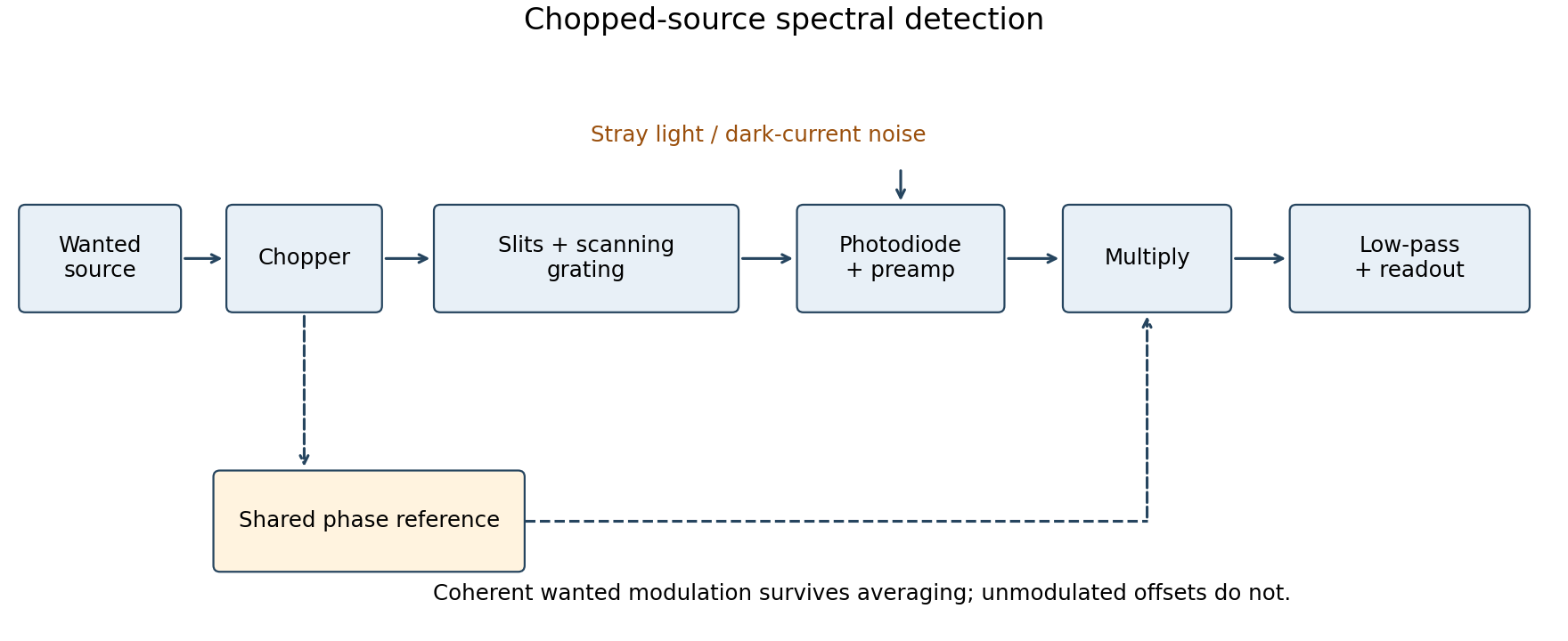
Chopped-source spectral detection
. Original functional diagram separates modulation of the wanted source from unmodulated detector dark current and stray light. A shared reference drives demodulation; low-pass averaging sets the detected bandwidth. Details.
This rejects steady backgrounds and reduces low-frequency noise through narrow-band detection. It does not remove random dark-current/stray-light shot noise within that bandwidth, nor a background modulated coherently with the source. The chopping geometry must therefore distinguish wanted light from stray paths.[ref]
About Lock-In Amplifiers by Stanford Research Systems. physical pp. 1–2: phase-sensitive multiplication, low-pass filtering, bandwidth and quadrature outputs
New to topics? Read the docs here!