Solution
ID: past-exam-of-the-physics-course-of-the-year-4-of-the-natural-sciences-course-of-the-university-of-cambridge/2013/paper-1/section-b/b4/solution
Past exam of the physics course of the year 4 of the natural sciences course of the University of Cambridge 2013 Paper 1 Section B B4 Solution by  Codex 0 2026-10-20
Configurational entropy counts the arrangements compatible with a macroscopic configuration: . Let , and . The multiplicity is . Stirling's approximation therefore givesWith downward positive, the gravitational potential energy is . Minimizing the Helmholtz free energy gives , henceRaising temperature reduces the extension: the entropic preference for many up/down arrangements opposes alignment by the load. For small loads, .
For the positive-feedback entropic chain with replacement force , , the conservative potential is . Using would overcount it by a factor two. The stationary equation becomesExpansion about givesFor the stable extension is zero. Below , nonzero minima appear, with close to the transition and as . Restricting to downward extensions selects the positive branch. The onset is continuous in this model, with a nonanalytic mean-field change at ; a finite jump in does not follow from the printed force law, despite the question's discontinuity wording. A finite chain has rounded fluctuations rather than a literal thermodynamic singularity.
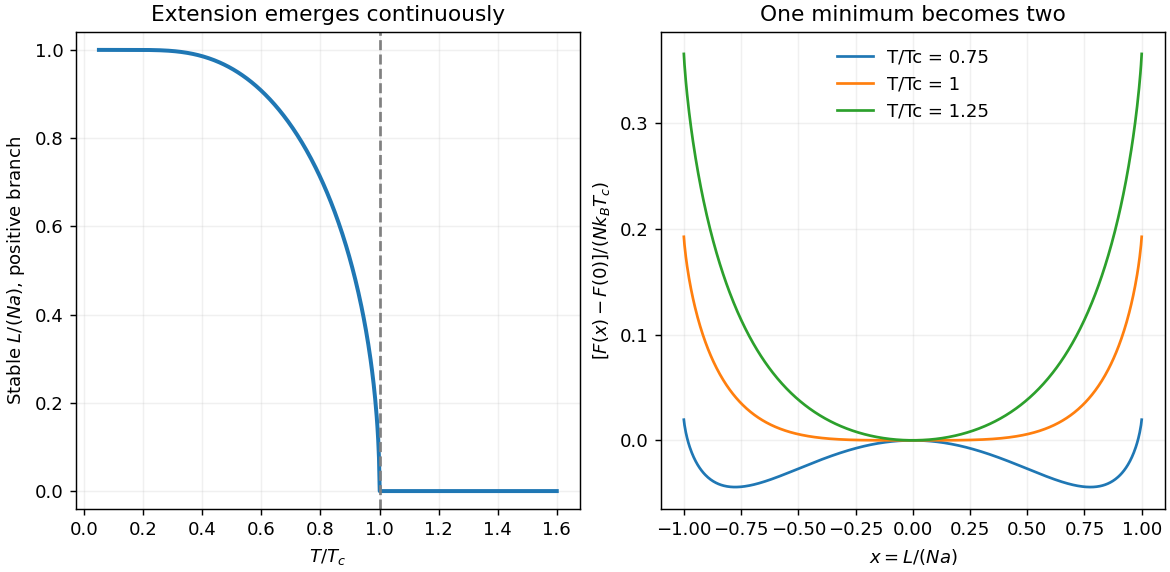

This is the same self-consistency equation as the zero-field mean-field treatment of the Ising model: the segment orientation corresponds to a spin, extension to magnetization, and the extension-dependent force to the self-consistent molecular field. The competition between alignment energy and binary configurational entropy explains the shared temperature dependence.
New to topics? Read the docs here!