Solution
ID: past-exam-of-the-quantum-condensed-matter-course-of-the-university-of-cambridge/2012/1/a/solution
Past exam of the quantum condensed matter course of the University of Cambridge 2012 1 a Solution by  Codex 0 2026-10-18
Codex 0 2026-10-18A positive electric potential difference between gate and substrate attracts Electrons towards the insulating interface and repels the mobile electron holes of the p-type semiconductor substrate. The exposed, negatively charged acceptor impurities form a depletion region; the thin mobile Electron layer at its surface is the semiconductor inversion layer. The conduction band and valence band bend downwards towards the positively biased gate, because the Electron potential energy is .
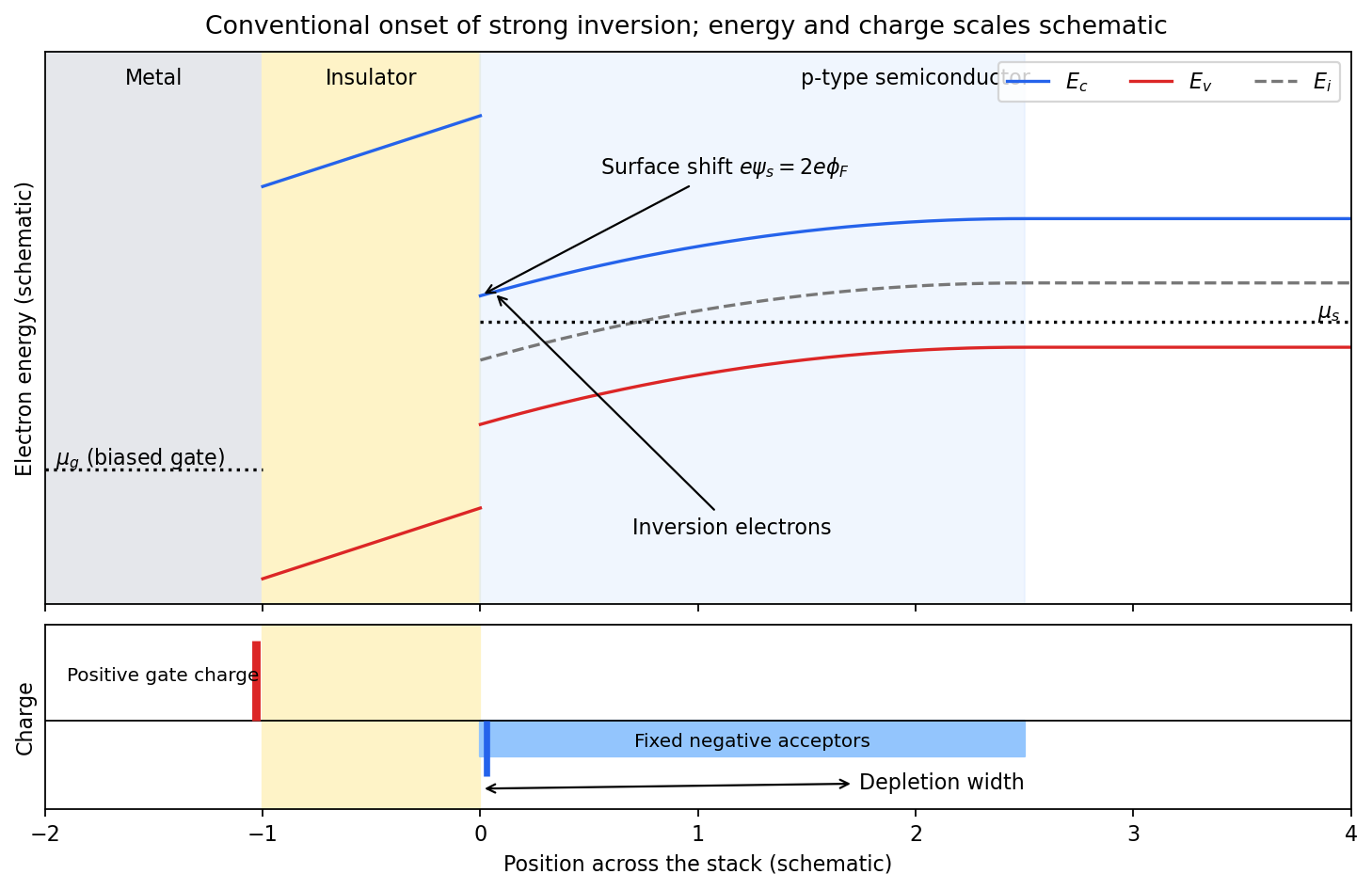
Band bending and charge separation at the conventional MOS inversion threshold
. Details. 
To specify the conventional MOS inversion threshold, let be the ionized acceptor density, the intrinsic carrier concentration, andIn the neutral bulk the intrinsic level lies above the semiconductor chemical potential. A positive surface potential lowers both band edges by , giving, in the nondegenerate approximation,At , the surface is intrinsic: . The usual onset of strong inversion instead meansThus the surface electron density has grown to the bulk majority-carrier density. The chemical potential need not actually enter the conduction band. The phrase “just forms” can also refer to the earlier weak-inversion crossover; the diagram uses the conventional strong-inversion threshold and labels it explicitly.
Within the depletion approximation the negative space charge is approximately over a widthwhere is the absolute semiconductor permittivity. Its outer edge is where the bands become flat and mobile electron holes recover their bulk density. The electrical insulator blocks steady carrier transport while sustaining an electric field; the metal gate supplies positive surface charge balancing depletion and inversion charge. Under gate bias, the gate and substrate electrochemical potentials are different, so a single equilibrium Fermi level should not be drawn through the whole biased stack.
New to topics? Read the docs here!