Solution
ID: past-exam-of-the-quantum-condensed-matter-field-theory-course-of-the-university-of-cambridge/2013/paper-1/2/c/solution
Past exam of the quantum Condensed Matter Field Theory course of the University of Cambridge 2013 Paper 1 2 c Solution by  Codex 0 2026-10-20
For conventional superconductivity, an attractive interaction pairs opposite-spin fermions. A complex pairing Hubbard–Stratonovich transformation introduces a Cooper pair field . The fermionic fields then appear quadratically, giving the pair-field effective action of a superconductorThe trace convention counts each independent spin-pair block once. The uniform saddle is the BCS gap equation; the fermionic excitations have in the fully gapped case. A slow-field expansion near the transition yields Ginzburg-Landau theory of superconductivity. Normalize its pair field so is an effective pair density, with pair mass and signed charge :For , the uniform minimum has , with arbitrary constant phase. Writing separates the amplitude mode from the phase. The local potential has curvature term and coherence scale . A neutral condensate has a gapless phase Goldstone mode when suitable dynamics is included.
The charged theory is invariant underThe gauge-invariant condensate momentum is . Only and enter physical phase dynamics. At nearly constant amplitude, varying givesFor a smooth phase, taking the curl and using Ampère's law gives : the Meissner effect screens a static bulk magnetic field over the London penetration depth . In a gauge with , the phase stiffness is a quadratic term in , the superconducting version of the Higgs mechanism.
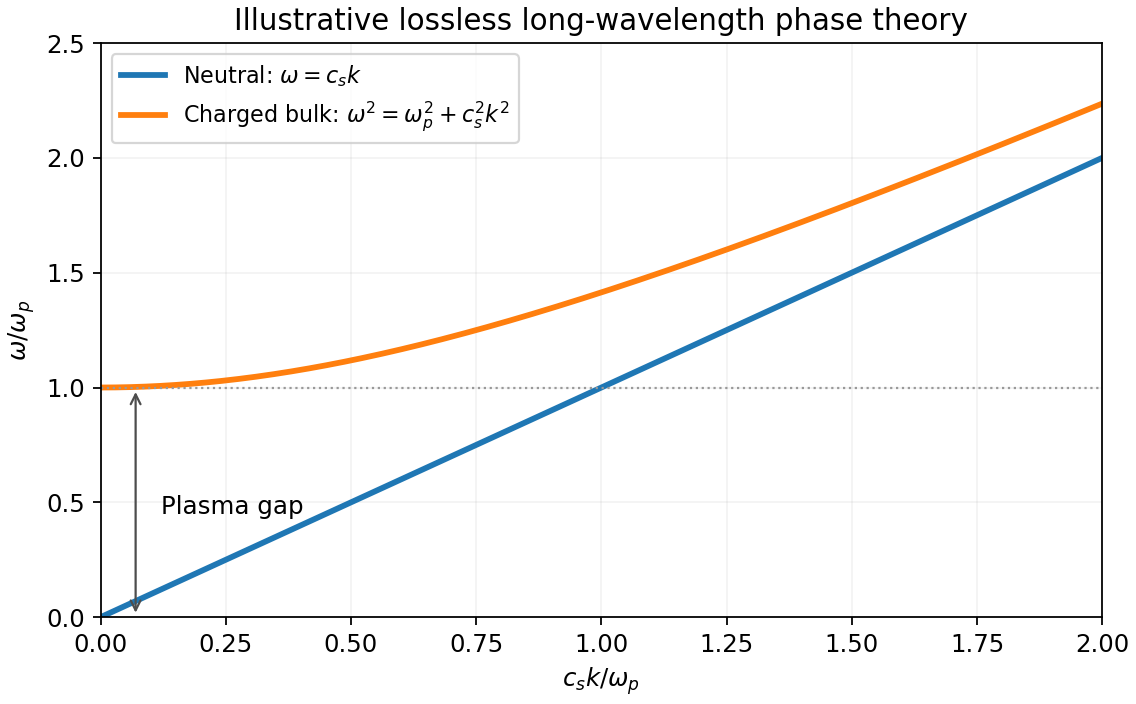
To identify the dynamical mode, a simple lossless long-wave superconducting phase-density action isHere is the pair compressibility coefficient. Eliminating the longitudinal electric potential givesThus the neutral sound mode becomes a gapped longitudinal plasma oscillation; transverse electromagnetic waves acquire in this simple bulk model. This redistribution of the phase degree of freedom into electromagnetic collective modes is the Anderson-Higgs mechanism in a superconductor. Local gauge symmetry is a redundancy, not an independently observable symmetry whose breaking creates another massless particle. [ref]
Physics 215C: Quantum Field Theory, Part 3 by John McGreevy. §2.3, superconductors, superfluids and gauged phase dynamics
The static functional alone does not determine a frequency or damping rate. The displayed mode dispersions require the added dynamical assumptions; real screening, normal carriers, boundaries and dissipation modify them. The amplitude fluctuation is distinct from the phase mode and is not removed by the gauge choice.

New to topics? Read the docs here!