Solution
ID: past-exam-of-the-quantum-condensed-matter-field-theory-course-of-the-university-of-cambridge/2015/paper-1/2/a/solution
Past exam of the quantum Condensed Matter Field Theory course of the University of Cambridge 2015 Paper 1 2 a Solution by  Codex 0 2026-10-20
The Holstein–Primakoff transformation converts a spin algebra into bosonic operators while retaining the finite physical spin Hilbert space. With , writeThe Holstein–Primakoff occupation constraint is . Acting on , the raising matrix element is and the lowering element is . Their squared difference is , reproducing . Operator ordering inside the square roots is essential. For low boson occupation relative to , expand them to obtain and . Keeping quadratic terms gives the linear spin-wave approximation; higher terms describe magnon interactions. Large helps control the expansion, but a low-dimensional infrared divergence can invalidate it even at large finite .
For the ferromagnet choose , , with unit lattice spacing and . Expand around the all-up state. A longitudinal bond contributes , and the transverse exchange contributes . After a Fourier transform,These are ferromagnetic magnons. The polarized vacuum is an exact ground state of the full ferromagnetic Hamiltonian: every bond is in its maximum total-spin sector, minimizing that bond energy. It therefore has no quantum zero-point reduction of its magnetization. The one-magnon dispersion is also exact, although interacting many-magnon states need not be free bosons. Rotating the polarization generates the maximum-total-spin ground-state multiplet. Selecting a definite direction in a thermodynamic symmetry-breaking description breaks to ; the two transverse spin components form a canonical pair, producing a single quadratic type-B Goldstone boson. A small aligning field gaps it by the Zeeman energy.
At nonzero temperature the one-dimensional ferromagnet is different: its thermal magnon number contains , with infrared behaviour . The divergent magnetization reduction signals the absence of finite-temperature long-range order in an infinite short-range isotropic chain, consistent with the Mermin-Wagner theorem. It does not disallow the polarized zero-temperature ground states just constructed.[ref]
For the antiferromagnet use , still , on an even bipartite chain. The classical reference state alternates up and down. Rotate one sublattice through so that both local quantization axes point along their reference spins. In unrotated physical components, to leading order , , and . Choosing Fourier phases using the actual site positions givesThe reduced Brillouin zone has momenta and length . The pair creation and annihilation terms express the fact that an antiparallel reference product state is not an eigenstate. A bosonic Bogoliubov transformation with , , diagonalizes each two-mode block. With the sign convention and , the result isThus the harmonic antiferromagnetic modes have linear, rather than quadratic, long-wave dispersion. In an unfolded Brillouin-zone description the same result is represented by zeros at both zero and the antiferromagnetic wavevector; these are not extra independent degrees of freedom beyond the two-sublattice accounting.
The Bogoliubov vacuum has no or excitations but contains original spin bosons, with . Its staggered magnetization is . This quantum depletion of Néel order diverges logarithmically at small in one dimension. Linear spin-wave theory therefore does not establish a stable ordered antiferromagnetic ground state for this chain. Its nominal gapless dispersion is a result of expanding around an invalid ordered reference, not a general proof of the exact excitation spectrum. For the nearest-neighbour isotropic chain, integer-spin systems have a Haldane gap, whereas half-integer-spin systems are gapless; the spin-one-half chain in particular has fractional spin excitations rather than a simple dilute gas of ordered-state magnons. This distinction requires physics beyond the harmonic expansion, including the topological term in the continuum theory.[ref]
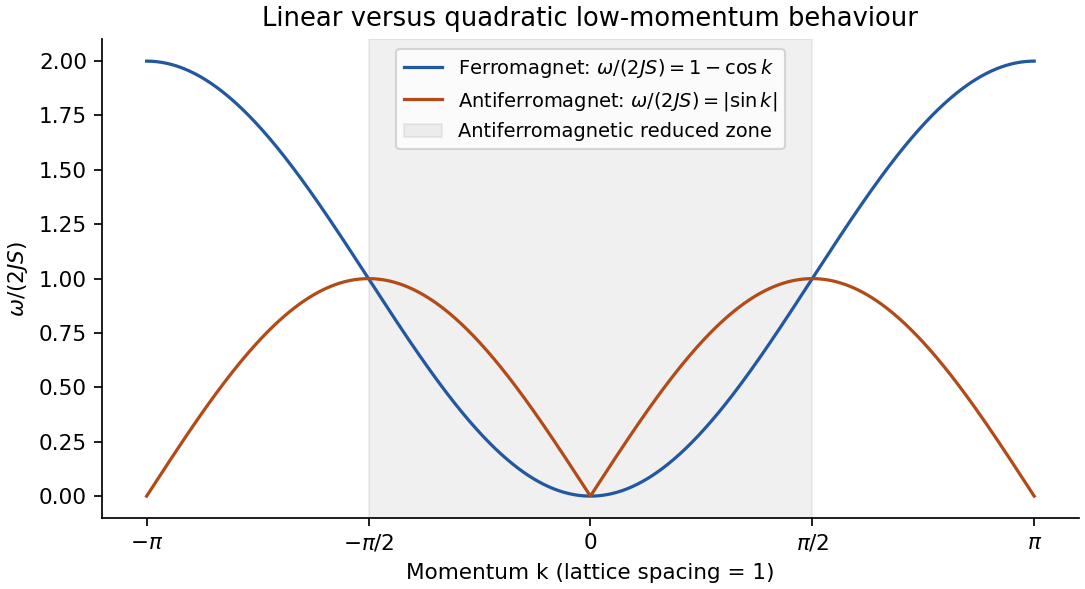
Original harmonic chain dispersions; the antiferromagnetic curve is a spin-wave approximation, not the exact spectrum for every spin
. Details. 
New to topics? Read the docs here!