Solution
ID: past-exam-of-the-quantum-condensed-matter-field-theory-course-of-the-university-of-cambridge/2015/paper-1/3/d/solution
Past exam of the quantum Condensed Matter Field Theory course of the University of Cambridge 2015 Paper 1 3 d Solution by  Codex 0 2026-10-20
At wavelengths with , neglect the density-gradient term in the quadratic density-phase action. Complete the square in its remaining density terms:The convergent Gaussian integral can be performed by a contour shift or by its Fourier-transform identity. Its determinant is independent of at this order. Combining that normalization with the saddle action into a constant givesThe saddle contribution to is ; the additional measure-dependent constant need not be assigned an invented numerical value. The density Gaussian extends the fluctuation integration beyond its exact positivity domain, which is justified only while fluctuations around are small. The smooth zero-winding assumption is also required as discussed above. A constant global phase zero mode gives a finite compact-group volume, handled separately from nonzero phonon modes.
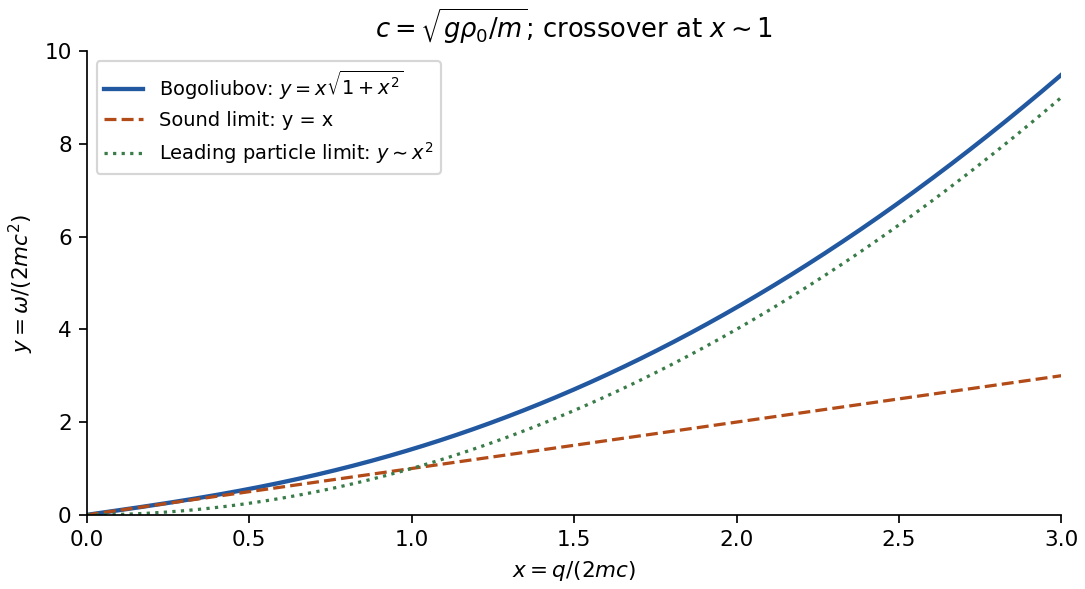
Fourier transforming the Bose-gas phase-only action gives a kernel . Analytically continuing gives its real-frequency poles,In the present units the excitation energy equals . Each real Fourier coordinate is a harmonic oscillator with inertia coefficient and spring coefficient , hence frequency equal to the square root of their ratio. This is the direct relation to a quantum harmonic chain. The mode is a gapless sound phonon; its finite speed reflects both the compressibility and the phase stiffness .
Retaining the density-gradient term provides a useful check. Its integration instead gives a temporal coefficient , soThis is the Bogoliubov spectrum. Its small- limit is the derived sound branch; at large within the contact model it crosses towards particle-like behaviour. The crossover in the squared dispersion is , precisely the scale beyond which the discarded density gradient is not small.
The same action checks the dimensional restriction in the saddle analysis. At nonzero temperature its zero Matsubara mode gives phase fluctuations proportional to ; at zero temperature integrating the frequency gives . Their infrared divergences invalidate uniform true long-range order for at nonzero temperature and for at zero temperature. The long-wave collective description can remain useful for correlations even where a global condensate saddle is not a literal symmetry-broken state. The contact coupling here is an effective low-energy parameter; this calculation does not determine ultraviolet renormalization or trap-specific surface modes.

New to topics? Read the docs here!