Compressibility measures how readily a sample's volume decreases when its pressure increases. For a simple compressible system with fixed particle number and composition, specify the constraint :Here denotes pressure, also written elsewhere. The minus sign makes compressibility positive on a mechanically stable equilibrium branch. Its units are inverse pressure, ; its reciprocal is the constrained bulk modulus, measured in pascal units. Holding temperature fixed gives isothermal compressibility; holding entropy fixed gives isentropic compressibility along an isentropic process. The latter describes a reversible adiabatic compression, since an irreversible adiabatic process can increase entropy. [ref]
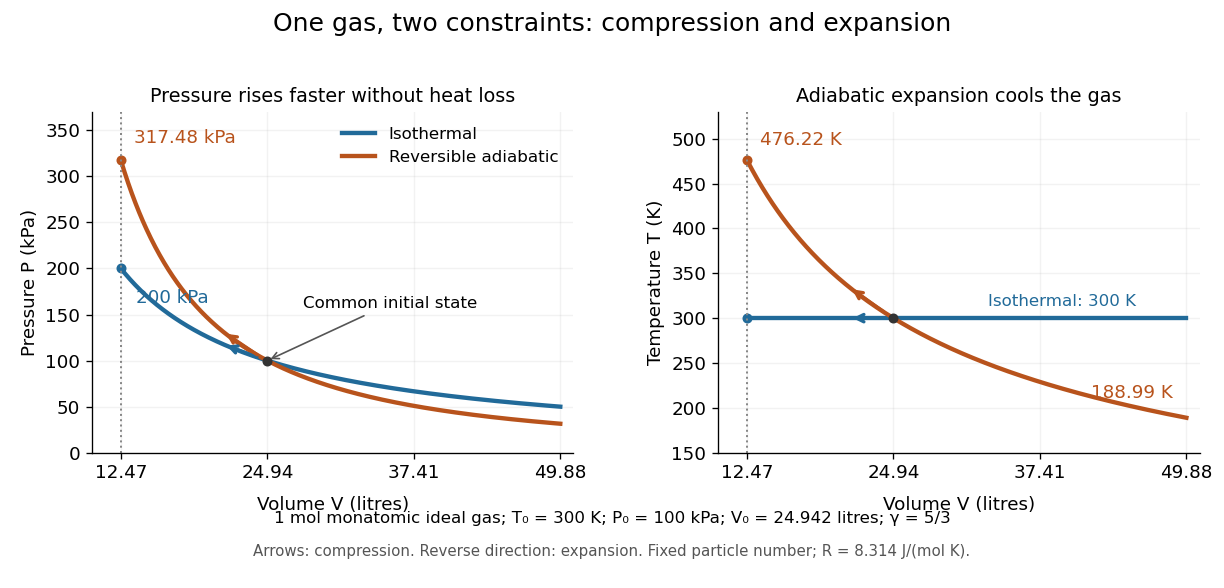
For an ideal gas, the ideal gas law and the reversible ideal-gas adiabat give, at the same equilibrium state,Here and are the whole sample's heat capacity at constant pressure and heat capacity at constant volume, and is the heat capacity ratio. Constant is required for the finite-path formula . Reversible adiabatic compression raises the temperature, making the pressure rise more steeply than in an isothermal compression. Thus keeping entropy fixed makes the gas harder to compress locally. For a classical monatomic gas at , , so and ; the corresponding values of the bulk modulus are and .
For a smooth, stable single thermodynamic phase at positive temperature, Maxwell relations also implywhere is the coefficient of thermal expansion. The ideal gas result is one example of this broader link between mechanical and thermal responses. The equality is possible when and the other responses remain finite. These formulas compare equilibrium partial derivatives, rather than arbitrary fast or dissipative compression histories. [ref]
The static density susceptibility is the linear density response to a chemical-potential perturbation. In the quadratic uniform contact Bose gas, . Its inverse is a density stiffness. At zero wavevector at mean field, while the isothermal compressibility includes the additional factor .
In a smooth fixed-composition thermodynamic region, write , , , and , with . The chain rule gives and . Multiplying these expressions by and , respectively, gives the same Jacobian determinant .
Using heat capacity at constant pressure , heat capacity at constant volume , isothermal compressibility and isentropic compressibility proves the displayed ratio. The derivation does not require division by thermal expansion, so it still applies when that derivative vanishes. For a stable single phase, the Maxwell relation also explains why and .
Isothermal compressibility is the compressibility measured at fixed temperature, particle number and composition. A slowly compressed sealed piston in contact with a thermal reservoir can approach this constraint. For an ideal gas, differentiating at fixed temperature gives , hence . A small pressure increase therefore gives . For a finite change, use the whole isothermal process curve instead.
Take one mole of classical monatomic gas, with stipulated molar gas constant , initially at and . The initial volume is . Compressing to givesThe isothermal compression releases heat to the thermal reservoir; the reversible adiabatic compression retains the input work as internal energy. Reversing either curve gives the corresponding expansion, with adiabatic expansion cooling the gas.
The equilibrium curvature of Gibbs free energy provides another measurement of isothermal compressibility:This follows from , with denoting Gibbs free energy. Within a stable single thermodynamic phase, increasing pressure reduces volume and makes this curvature negative. At phase coexistence, changing the phase fraction can change the volume at constant temperature and pressure; the usual finite single-phase isothermal compressibility then need not exist. Near a critical point, it can diverge. [ref]
https://www.feynmanlectures.caltech.edu/I_45.html#Ch45-S3. Feynman, Leighton and Sands, section 45-3: compression and phase coexistence
For the cubic-density model, gives . Divergence from above is a mean-field critical prediction. The negative value below signals an unstable homogeneous branch rather than an equilibrium negative compressibility.
For a homogeneous extensive single-component thermodynamic phase, the Gibbs-Duhem equation at fixed temperature gives . With number density , fixed gives . The chain rule therefore givesThe derivatives are evaluated within the same smooth equation of state; an interface contribution or phase coexistence can invalidate this simple homogeneous derivation.
Isentropic compressibility is the compressibility at fixed entropy, particle number and composition. The conventional name adiabatic compressibility refers to a reversible adiabatic process; an irreversible adiabatic compression need not keep entropy fixed. For an ideal gas, it is , where is the heat capacity ratio. It describes a steeper local pressure response than isothermal compressibility when .
Articles by others on the same topic


Compressibility is a property of materials that describes their ability to change volume under pressure. Specifically, it refers to the measure of how much a given volume of a substance decreases when subjected to an increase in pressure. This property is particularly significant in the study of gases, but it can also apply to liquids and solids to varying extents.